



Custom Traffic Signs: Design, Compliance & Best Practices
Custom traffic signs serve a critical function in managing traffic flow, enhancing road safety, and communicating important information to drivers and pedestrians. Unlike standard regulatory signs, custom traffic signs address specific site conditions, unique hazards, or special traffic management requirements that cannot be adequately communicated through conventional signage. Whether for private estates, industrial complexes, construction zones, or municipal roadways, understanding the design principles, regulatory frameworks, and manufacturing considerations is essential for creating effective, compliant signage solutions.
Understanding Regulatory Standards for Custom Traffic Signs
Traffic sign design is governed by strict standards to ensure consistency, legibility, and immediate recognition across diverse driving conditions. The Manual on Uniform Traffic Control Devices (MUTCD) establishes comprehensive guidelines for traffic control devices, including detailed specifications for custom sign design. These standards address fundamental elements such as shapes, sizes, colours, retroreflectivity requirements, and permissible deviations from standard designs.
When developing custom traffic signs, manufacturers must balance creativity with compliance. The design of signs requires careful consideration of colours, shapes, and legibility to ensure standardisation whilst accommodating unique messaging requirements. This balance becomes particularly important when organisations need to communicate site-specific information that extends beyond standard regulatory messages.
International and Regional Compliance Considerations
Compliance requirements vary significantly across jurisdictions. Whilst the MUTCD provides federal standards in the United States, individual states often implement modified versions that reflect regional priorities and conditions. South African road signage standards similarly incorporate international best practices whilst addressing local requirements and driving conditions.
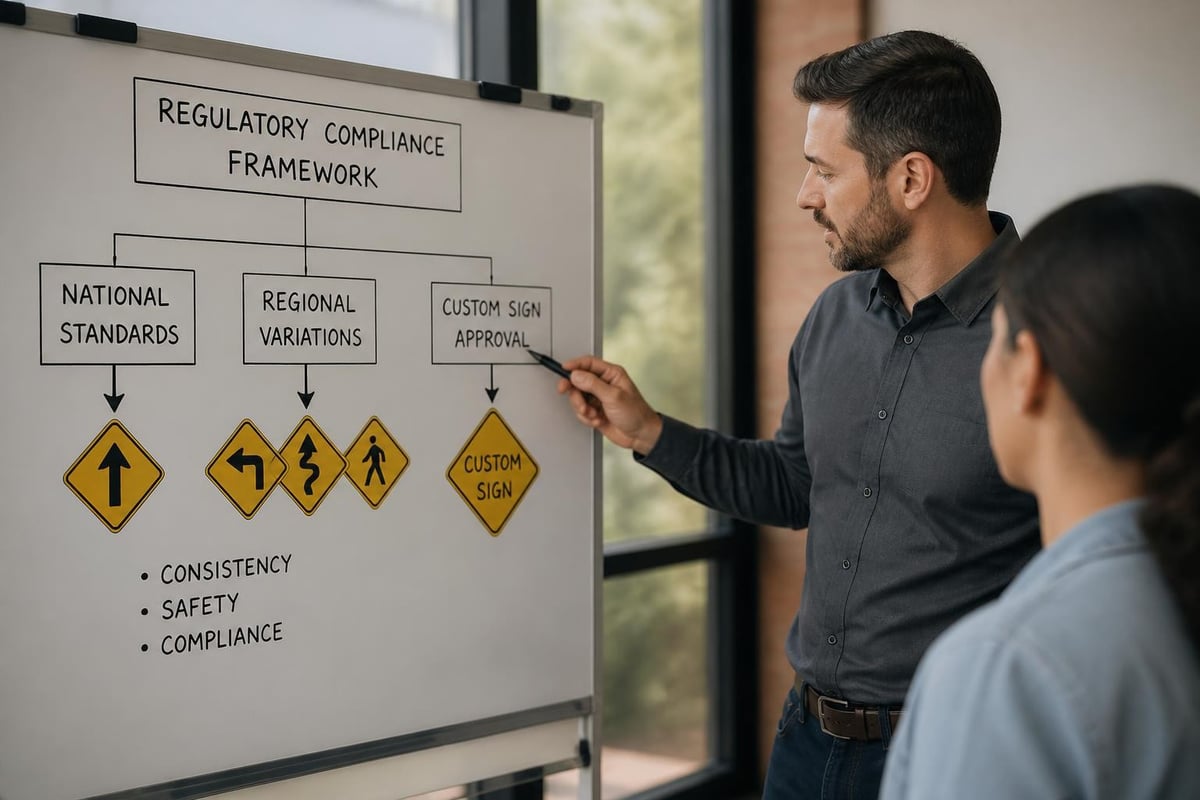
Professional signage manufacturers must navigate these complex regulatory landscapes to ensure custom traffic signs meet all applicable standards. This expertise proves invaluable for organisations requiring custom signage solutions that comply with local authority requirements whilst effectively communicating unique messages.
Design Principles for Effective Custom Traffic Signs
Effective custom traffic signs must achieve instant recognition and comprehension, often under challenging visibility conditions. The human factors guidelines for road systems provide detailed specifications regarding letter size, contrast ratios, and geometric properties that ensure legibility across diverse driver populations and viewing distances.
Typography and Legibility Requirements
Font selection significantly impacts sign effectiveness. Traffic signs typically employ specialised typefaces designed for maximum readability at speed and distance. Letter height, stroke width, and spacing must be calculated based on anticipated viewing distances and speeds.
| Design Element | Standard Requirement | Custom Considerations |
|---|---|---|
| Letter Height | Varies by speed/distance | Minimum 100mm for 50km/h zones |
| Stroke-to-Height Ratio | 1:5 to 1:8 | Bolder for high-speed roads |
| Character Spacing | 20-30% of letter height | Adjust for message length |
| Word Spacing | 75-100% of letter height | Maintain readability |
The relationship between viewing distance and letter height follows established formulae. For every 15 metres of required reading distance, letters must be approximately 25mm tall. This calculation ensures drivers have adequate time to read, comprehend, and respond to sign messages whilst maintaining safe speeds.
Colour and Contrast Standards
Colour selection in custom traffic signs follows standardised conventions that drivers instinctively understand. Red indicates prohibition or danger, yellow signals caution, blue provides information, and green offers directional guidance. Deviating from these conventions, even for custom applications, risks confusion and compromised safety.
Contrast ratios between text and background must meet minimum thresholds to ensure visibility across varying light conditions. Recent research on automated traffic sign assessment demonstrates the importance of evaluating sign visibility during both daytime and nighttime conditions, particularly for custom installations that may face unique environmental challenges.
Material Selection and Manufacturing Considerations
The durability and performance of custom traffic signs depend heavily on material selection and manufacturing quality. Modern traffic signs utilise advanced materials engineered to withstand harsh environmental conditions whilst maintaining optical properties over extended service lives.
Substrate Materials and Properties
Aluminium sheet remains the predominant substrate for permanent traffic signs due to its excellent strength-to-weight ratio, corrosion resistance, and dimensional stability. Thickness varies based on sign size and mounting configuration, typically ranging from 1.6mm for smaller signs to 3.0mm for large installations subject to wind loading.
- Aluminium alloy sheet: Industry standard for permanent installations, offering 10-15 year service life
- Composite materials: Lightweight alternatives for temporary or portable applications
- Steel backing: Used for high-security or vandalism-prone locations
- Flexible substrates: Roll-up signs for temporary traffic management
The choice between these materials involves balancing performance requirements, budget constraints, and expected service life. Professional guidance from experienced signage work specialists ensures optimal material selection for specific applications.
Retroreflective Sheeting Technologies
Retroreflectivity enables traffic signs to remain visible during nighttime conditions by returning light to its source. Modern retroreflective sheetings are classified by performance grades, each suited to different applications and service environments.
Engineering grade sheeting provides basic retroreflectivity suitable for low-speed environments and supplemental signage. High-intensity and diamond-grade sheetings offer superior performance for high-speed roadways and critical safety applications. When specifying custom traffic signs, retroreflectivity requirements must align with road classification, speed limits, and ambient lighting conditions.

Applications and Use Cases for Custom Traffic Signs
Custom traffic signs address diverse requirements across multiple sectors. Understanding common applications helps organisations identify opportunities for improved traffic management and safety communication.
Private Development and Estate Signage
Residential estates, business parks, and industrial complexes frequently require custom traffic signs to address site-specific traffic patterns and safety concerns. These applications may include speed limits specific to private roads, directional signage for delivery vehicles, or warning signs for unique hazards such as electric gates or pedestrian crossings in unexpected locations.
For larger developments requiring prominent wayfinding solutions, Pylon Signage designed and manufactured to specification can complement ground-level traffic control devices whilst reinforcing brand identity and providing essential directional information.
Construction and Temporary Traffic Management
Construction zones present constantly evolving traffic patterns that standard signage cannot adequately address. Custom traffic signs enable precise communication of changing conditions, detour routes, and specific hazards related to active work zones. These applications often require portable mounting systems and durable construction to withstand frequent relocation.
Understanding road construction signs requirements ensures temporary traffic management solutions meet safety standards whilst effectively communicating complex routing information to unfamiliar drivers navigating altered road networks.
Industrial and Warehouse Facilities
Internal traffic management within industrial facilities requires custom signage addressing forklift operations, loading dock protocols, and pedestrian safety zones. These signs must communicate clearly to diverse audiences, including employees, contractors, and visitors who may not share common languages.
Effective warehouse safety signs integrate traffic control messaging with broader safety communication strategies, creating comprehensive visual management systems that reduce accidents and improve operational efficiency.
Design and Approval Processes
Developing compliant custom traffic signs requires systematic design processes and appropriate regulatory approvals. Understanding these workflows prevents costly redesigns and installation delays.
Initial Concept Development
The design process begins with thorough site assessment and stakeholder consultation. Traffic engineers, safety managers, and signage specialists collaborate to identify specific communication requirements, viewing distances, environmental conditions, and mounting constraints.
- Conduct site survey to document existing conditions and traffic patterns
- Define message requirements based on specific hazards or information needs
- Determine viewing distances and calculate appropriate letter sizing
- Select appropriate colours and symbols following regulatory guidelines
- Develop preliminary design concepts incorporating all technical requirements
- Review designs with relevant stakeholders and regulatory authorities
This structured approach ensures custom traffic signs address genuine needs whilst maintaining compliance with applicable standards.
Regulatory Approval and Certification
Many jurisdictions require formal approval before installing custom traffic signs on public roadways. This process typically involves submitting detailed design documentation demonstrating compliance with relevant standards and justifying the need for non-standard messaging.
Approval timelines vary significantly based on local authority resources and the complexity of proposed signage. Early engagement with regulatory bodies and comprehensive documentation expedites review processes and reduces the likelihood of required modifications.
Installation and Maintenance Best Practices
Proper installation and ongoing maintenance ensure custom traffic signs deliver intended safety benefits throughout their service lives. Professional signage installation proves critical for achieving design performance and regulatory compliance.
Mounting Methods and Structural Considerations
Sign mounting must account for wind loading, vandalism potential, and maintenance access requirements. Common mounting methods include:
| Mounting Type | Applications | Advantages | Considerations |
|---|---|---|---|
| Post-mounted | Standard roadside installations | Cost-effective, easily relocated | Requires breakaway posts for safety |
| Overhead gantry | High-speed motorways, complex junctions | Maximum visibility, multiple lanes | Higher installation costs |
| Wall-mounted | Urban environments, building facades | Space-efficient | Limited to appropriate structures |
| Portable base | Temporary traffic management | Maximum flexibility | Lower wind resistance |
Foundation design must provide adequate stability whilst incorporating breakaway features where appropriate to minimise injury risk during vehicle impacts. Professional installation ensures proper post embedment depths, concrete curing, and hardware torque specifications.
Ongoing Maintenance and Performance Monitoring
Traffic signs require regular inspection and maintenance to sustain visibility and structural integrity. Establishing systematic maintenance schedules prevents degradation that compromises safety performance. Key signage maintenance activities include:
- Cleaning sign faces to remove dirt, pollution deposits, and organic growth
- Inspecting retroreflective sheeting for delamination, fading, or damage
- Checking mounting hardware for corrosion, loosening, or structural deterioration
- Verifying sign orientation and ensuring proper viewing angles
- Documenting condition and scheduling replacement before failure
Advanced monitoring approaches now incorporate automated assessment technologies that evaluate sign visibility under various lighting conditions, enabling data-driven maintenance scheduling and resource allocation.

Cost Considerations and Return on Investment
Understanding the economics of custom traffic signs helps organisations make informed procurement decisions and justify investments in superior materials and manufacturing quality.
Factors Influencing Project Costs
Custom traffic sign costs vary significantly based on size, materials, quantities, complexity, and installation requirements. Basic custom signs may cost only marginally more than standard equivalents, whilst complex installations incorporating specialised materials or unique mounting systems can represent substantial investments.
Design complexity affects manufacturing costs. Simple text modifications to standard templates incur minimal additional expense, whereas completely custom graphics requiring specialised tooling increase production costs. Quantity significantly influences unit pricing, with larger orders benefiting from economies of scale in material procurement and manufacturing setup.
Lifecycle Cost Analysis
Evaluating custom traffic signs requires considering total lifecycle costs rather than initial purchase prices alone. Higher-quality materials and manufacturing standards deliver extended service lives and reduced maintenance requirements that offset premium acquisition costs.
A comprehensive cost analysis includes initial procurement, installation labour and equipment, ongoing maintenance, eventual replacement, and disposal costs. Professional-grade signs manufactured from premium materials and advanced retroreflective sheetings typically deliver superior long-term value despite higher upfront investment.
Emerging Technologies and Future Trends
Traffic sign technology continues evolving, incorporating digital capabilities, smart infrastructure integration, and advanced materials that enhance functionality and performance.
Dynamic and Intelligent Signage
Electronic message signs enable real-time message updates responding to changing traffic conditions, weather events, or temporary hazards. These systems prove particularly valuable for managing variable speed limits, lane controls, and incident warnings on high-traffic routes.
Emerging international standards address dynamic sign visibility and placement, establishing guidelines for safety and accessibility in illuminated and variable-message applications. These standards recognise the growing importance of dynamic traffic management in modern road networks.
Integration with Connected Vehicle Systems
Future traffic management systems will increasingly communicate directly with vehicles through connected infrastructure. This evolution does not eliminate the need for physical signage but rather complements traditional signs with digital messaging that provides redundant communication channels and enhanced detail.
Custom traffic signs in this emerging environment must be designed considering both traditional visual communication and machine-readable elements that enable automated vehicle systems to recognise and respond to traffic control devices.
Quality Assurance and Testing Protocols
Ensuring custom traffic signs meet performance specifications requires rigorous quality control throughout manufacturing and installation processes. Professional manufacturers implement comprehensive testing protocols validating materials, optical properties, and structural performance.
Testing programmes typically address retroreflectivity measurements, colour accuracy verification, adhesion testing for sheeting materials, and structural load testing for mounting assemblies. These quality assurance measures ensure finished signs meet specified performance standards and applicable regulatory requirements.
Third-party certification programmes provide independent verification of sign quality and compliance. Specifying certified materials and manufacturing processes delivers confidence that custom traffic signs will perform as intended throughout their service lives.
Selecting the Right Manufacturing Partner
The success of custom traffic sign projects depends significantly on manufacturer capabilities, experience, and quality standards. Organisations should evaluate potential partners based on several critical factors.
Technical expertise proves essential for navigating regulatory requirements and optimising designs for specific applications. Manufacturers with deep understanding of traffic engineering principles, materials science, and relevant standards deliver superior solutions that balance compliance, performance, and cost-effectiveness.
Manufacturing capabilities influence project feasibility and quality outcomes. Modern facilities equipped with precision cutting systems, automated vinyl application equipment, and quality control instrumentation produce consistently superior results compared to basic fabrication shops.
Custom traffic signs represent critical safety infrastructure requiring careful attention to design standards, material selection, and manufacturing quality. When organisations need professional signage solutions backed by technical expertise and national manufacturing capabilities, Signs4SA delivers comprehensive custom traffic sign solutions tailored to specific requirements across corporate, retail, construction, and industrial applications throughout South Africa.