




No Overtaking Road Sign: Meaning, Rules & Compliance
Road safety depends on clear, universally understood traffic control devices that guide driver behaviour and prevent dangerous manoeuvres. The no overtaking road sign stands as one of the most critical regulatory signs on our highways, specifically designed to prohibit passing in areas where such actions would create unacceptable risk. Understanding this sign's purpose, legal implications, and proper deployment ensures safer roads for all users whilst reducing collision rates in high-risk zones.
Understanding the No Overtaking Road Sign
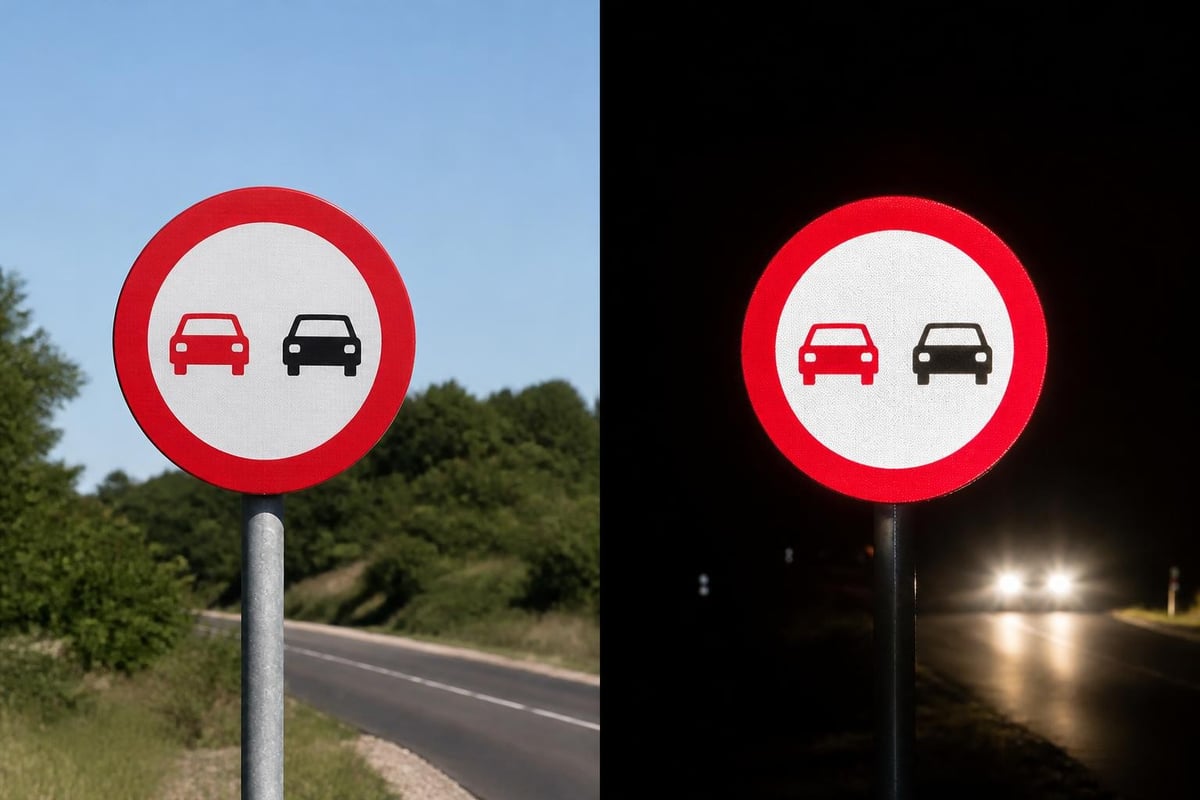
The no overtaking road sign communicates a simple yet vital instruction: drivers must not attempt to pass the vehicle ahead of them within the designated zone. This regulatory sign typically features two vehicles side by side within a red circle, crossed by a diagonal red line, though variations exist across different jurisdictions and traffic control standards.
Primary Functions and Purpose
Traffic authorities deploy this signage to address specific road conditions that make overtaking particularly hazardous. These conditions include:
- Limited sight distances caused by horizontal or vertical curves
- Narrow carriageway widths insufficient for safe passing clearance
- Approaching intersections, railway crossings, or pedestrian zones
- Bridge approaches where lane width restricts manoeuvring space
- Areas with frequent turning traffic or driveway access points
The sign creates legally enforceable zones where overtaking becomes a traffic offence, typically accompanied by significant penalties. Unlike advisory signs that merely suggest caution, this regulatory device carries the force of law, making compliance mandatory rather than optional.
According to the UK Highway Code, drivers who violate no overtaking restrictions face penalty points, fines, and potential driving bans depending on the severity and circumstances of the offence. The regulatory framework supporting these signs treats violations seriously because the prohibited zones exist specifically where passing attempts frequently result in head-on collisions.
Design Standards and Specifications
Professional signage manufacturers must adhere to strict specifications when producing no overtaking road signs to ensure consistency, visibility, and legal compliance. These standards govern every aspect from dimensions to reflectivity ratings.
Material and Construction Requirements
| Component | Specification | Purpose |
|---|---|---|
| Face Material | Class 1 or Class 2 Retroreflective Sheeting | Night-time visibility and durability |
| Substrate | Aluminium alloy (minimum 2mm thickness) | Weather resistance and longevity |
| Mounting | Hot-dip galvanised steel posts | Structural integrity and corrosion protection |
| Colours | BS381C Signal Red and White | Immediate recognition and regulatory authority |
The retroreflective properties prove particularly crucial for the no overtaking road sign. These signs must remain clearly visible during night-time conditions, adverse weather, and reduced visibility scenarios when drivers most need guidance. High-intensity prismatic sheeting provides superior performance compared to standard grades, especially on high-speed roads where decision time is limited.
Size and Placement Criteria
Sign dimensions vary based on road classification and prevailing speed limits. Typically, diameters range from 600mm for urban roads to 900mm for rural highways. Mounting height standards require the bottom edge positioned between 1.5 and 2.5 metres above the carriageway to prevent obstruction whilst maintaining driver line of sight.
Placement location demands careful engineering analysis. The MUTCD guidance emphasises that regulatory signs must be installed at the point where the restriction begins, often supplemented by advance warning signs that alert drivers to upcoming no passing zones. This layered approach provides adequate reaction time whilst reinforcing the regulatory message.
Legal Framework and Enforcement
The no overtaking road sign operates within a comprehensive legal framework that defines driver obligations, establishes penalties for violations, and outlines the authority of traffic management agencies to designate restricted zones.
Regulatory Authority and Installation Criteria
Traffic authorities follow systematic procedures when determining no overtaking zone placement. Engineering studies assess numerous factors:
- Sight distance measurements along the roadway alignment
- Traffic volume data and vehicle mix characteristics
- Historical crash data identifying collision patterns
- Roadway geometry including gradient, curvature, and width
- Adjacent land use affecting access points and turning movements
The Connecticut DOT guidelines exemplify the rigorous engineering approach applied to no passing zone designation, incorporating field surveys, geometric calculations, and safety analysis to ensure restrictions align with actual hazard conditions rather than arbitrary placement.
Professional organisations like Signs4SA work closely with transportation authorities to manufacture compliant signage that meets these exacting standards, ensuring durability and visibility throughout the sign's service life.
Penalties and Consequences
Violating no overtaking restrictions carries substantial consequences across jurisdictions. Typical penalties include:
- Fixed penalty notices with fines ranging from £100 to £1,000
- Penalty points added to driving licences (usually 3-6 points)
- Mandatory court appearances for particularly dangerous violations
- Temporary or permanent driving bans in severe cases
- Insurance premium increases following conviction
Beyond legal penalties, violations create significant collision risk. Head-on crashes in no passing zones frequently result in fatalities or serious injuries due to the combined impact speeds and reduced escape options available to drivers.
Engineering Applications and Zone Design
Effective no overtaking zone design requires sophisticated engineering analysis that balances safety objectives against traffic flow efficiency. Overly restrictive zones frustrate drivers and encourage risky behaviour, whilst inadequate restrictions leave hazardous gaps in protection.
Sight Distance Calculations
The fundamental criterion for no overtaking zones centres on available sight distance. Engineers calculate the minimum distance required for a driver to:
- Perceive a potential conflict
- Decide to abort the overtaking manoeuvre
- Safely return to the original lane
- Complete the action before reaching an oncoming vehicle
These calculations incorporate multiple variables including road design speed, acceleration characteristics of typical vehicles, and perception-reaction times. The resulting minimum safe passing sight distance typically ranges from 300 metres for 60 km/h roads to over 800 metres for 120 km/h highways.
| Design Speed (km/h) | Minimum Passing Sight Distance (m) | Typical No Overtaking Zone Length (m) |
|---|---|---|
| 60 | 300-350 | 150-200 |
| 80 | 450-500 | 250-300 |
| 100 | 600-650 | 350-400 |
| 120 | 800-850 | 500-550 |
Pavement Markings and Supplementary Devices
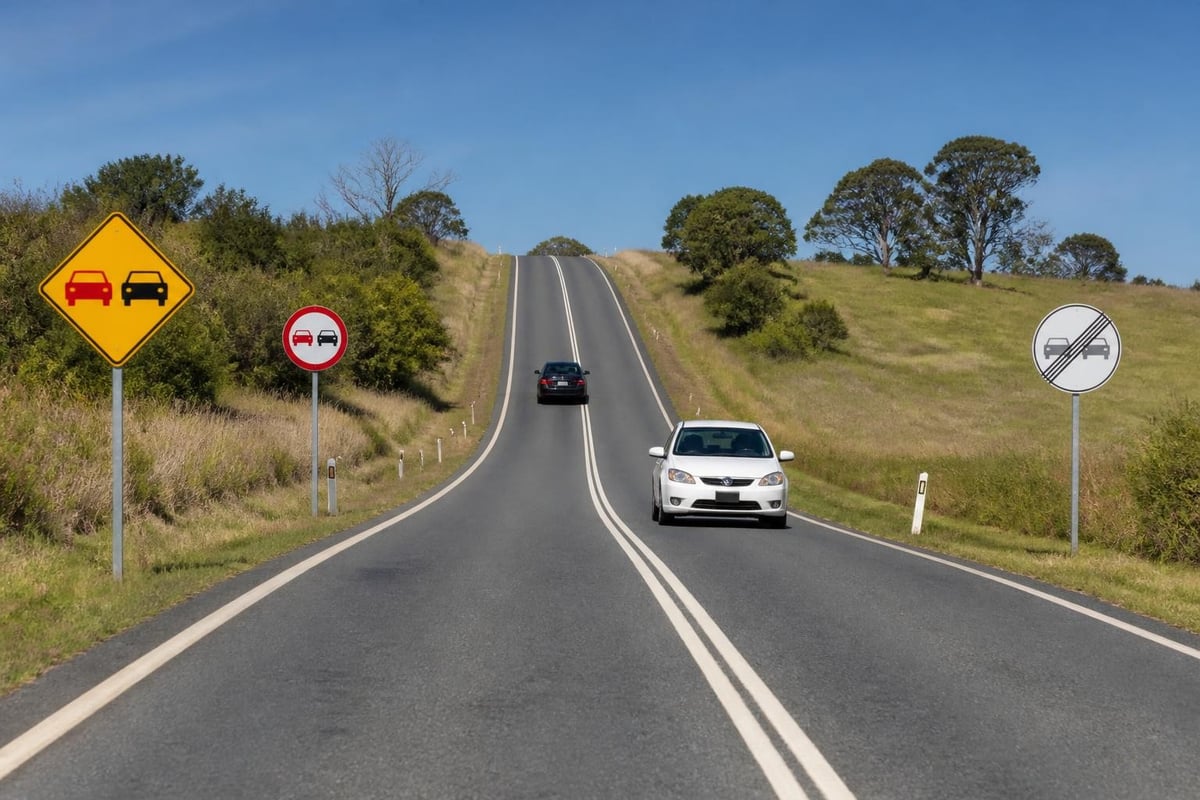
The no overtaking road sign works in conjunction with road surface markings to create a comprehensive regulatory system. Continuous solid yellow or white lines painted along the carriageway centre reinforce the overtaking prohibition, providing constant visual reference whilst driving through restricted zones.
Advanced warning signs positioned 100-200 metres before the restriction begins give drivers adequate notice to complete any overtaking manoeuvres already in progress. End-of-restriction signs indicate where passing becomes permissible again, preventing driver confusion and promoting compliance.
Manufacturing and Quality Assurance
Professional production of regulatory traffic signs demands precision manufacturing processes, rigorous quality control, and adherence to national and international standards. The integrity of the no overtaking road sign directly impacts road safety outcomes.
Production Processes
Modern sign manufacturing employs computer-controlled cutting systems, precision screen printing, and advanced adhesive technologies to ensure dimensional accuracy and colour consistency. Digital printing technologies now enable even greater precision for complex graphics whilst maintaining the durability required for outdoor exposure.
Quality assurance protocols verify multiple critical parameters:
- Retroreflectivity testing using calibrated photometric equipment
- Colour accuracy verification against standard reference samples
- Adhesion testing to ensure graphics withstand environmental stress
- Dimensional inspection confirming compliance with specification tolerances
- Durability assessment through accelerated weathering tests
Manufacturers specialising in safety signage understand that regulatory traffic signs require the same attention to detail and quality standards as industrial safety devices, where lives depend on clear, reliable communication.
Installation and Maintenance Considerations
Proper installation proves equally critical to manufacturing quality. Posts must be embedded to specified depths with adequate concrete foundations to resist wind loading and potential vehicle impacts. Mounting hardware requires regular inspection and tightening to prevent sign rotation or displacement.
Maintenance schedules should include:
- Quarterly visual inspections for damage, vandalism, or vegetation obstruction
- Annual retroreflectivity measurements to verify performance standards
- Immediate replacement of damaged or deficient signs
- Routine cleaning to remove dirt, grime, and atmospheric deposits
Signs exhibiting reduced retroreflectivity, faded colours, physical damage, or poor visibility require prompt replacement to maintain the regulatory system's effectiveness.
International Variations and Standards
Whilst the fundamental purpose remains consistent globally, the no overtaking road sign exhibits variations in design, symbolism, and regulatory approach across different countries and regions. Understanding these differences proves essential for international traffic management and sign manufacturing operations.
Regional Design Differences
European standards typically employ the dual-vehicle symbol within a red circular border, creating immediate visual recognition. United Kingdom implementations follow this convention as specified in the Traffic Signs Regulations and General Directions, with specific provisions for sign size, placement, and supplementary plates.
North American practice differs significantly. The MUTCD standards specify rectangular "DO NOT PASS" or "NO PASSING ZONE" text signs in black on white, often accompanied by pennant-shaped advance warning signs. This text-based approach contrasts with the symbolic European methodology, reflecting different philosophical approaches to traffic control communication.
African nations generally adopt variations based on colonial heritage and regional harmonisation efforts. South African traffic control devices broadly follow international conventions whilst incorporating specific national requirements detailed in the Road Traffic Signs Manual.
Harmonisation Efforts
International bodies work toward greater consistency in traffic control devices to facilitate cross-border travel and improve road safety for international drivers. The Vienna Convention on Road Signs and Signals provides a framework for standardisation, though implementation remains incomplete across signatory nations.
Key harmonisation principles include:
- Consistent use of colour coding (red for prohibitions)
- Circular shape for regulatory/mandatory signs
- Standardised symbolic representations over text when possible
- Common sizing methodologies based on road classification
- Unified retroreflectivity standards for night visibility
Special Applications and Complex Scenarios
Certain road environments require modified approaches to no overtaking signage beyond standard two-lane highway applications. These special cases demand careful engineering analysis and sometimes customised signage solutions.
Multi-Lane Highways
Motorways and dual carriageways with multiple lanes in each direction require different overtaking controls. Lane-specific restrictions may prohibit heavy goods vehicles from using outside lanes whilst permitting lighter vehicles to overtake freely. Variable message signs and digital signage technologies enable dynamic lane management that adjusts to traffic conditions, incidents, or maintenance activities.
These sophisticated systems combine traditional regulatory signs with electronic displays, creating flexible traffic management capabilities that respond to real-time conditions whilst maintaining clear driver guidance.
Temporary Traffic Management
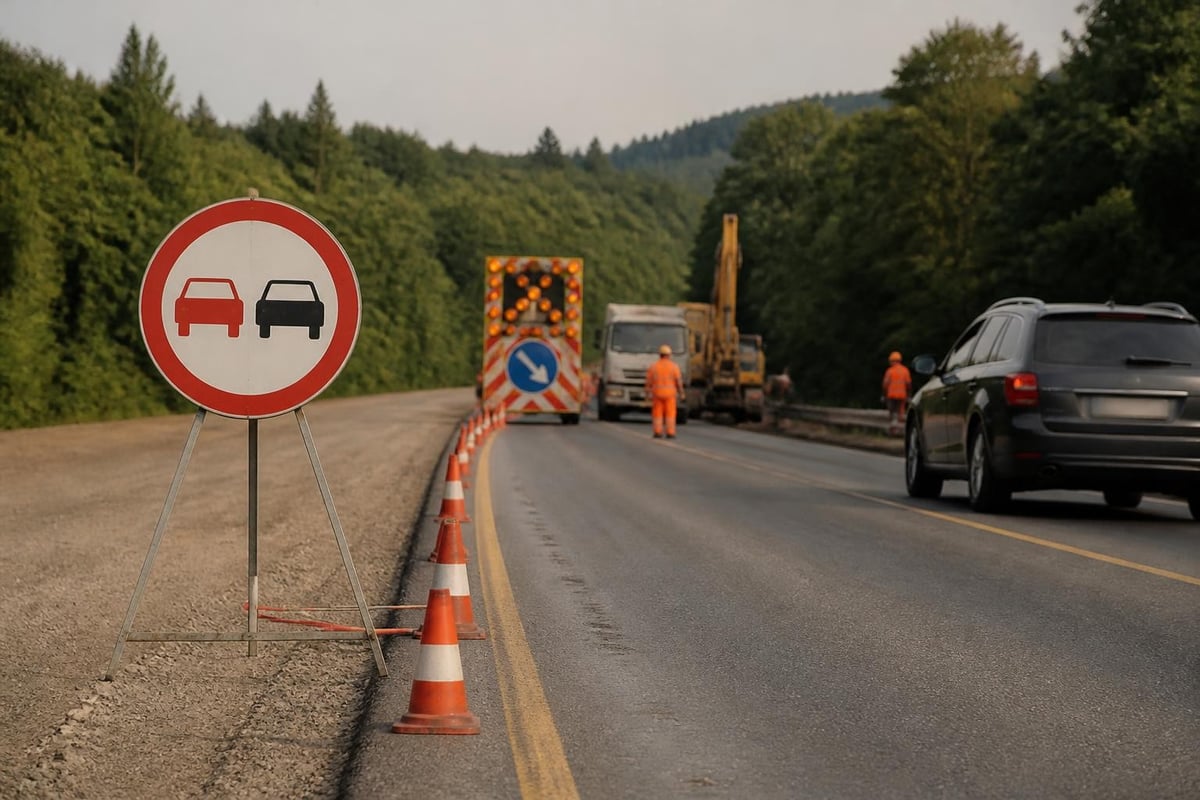
Construction zones, incident scenes, and temporary road works frequently require short-term no overtaking restrictions. Portable signs mounted on temporary supports provide the necessary regulatory control whilst remaining easily repositionable as work zones progress.
Temporary applications demand:
- High-visibility support systems (often fluorescent orange or yellow)
- Stable bases resistant to wind and vehicle wake turbulence
- Clear advance warning of changed traffic patterns
- Consistent placement and removal procedures
- Regular inspection throughout the deployment period
Driver Education and Compliance
Even perfectly designed and manufactured signs achieve limited effectiveness without driver understanding and compliance. Comprehensive driver education programmes and effective enforcement strategies complement physical infrastructure to create safer road environments.
Public Awareness Campaigns
Transportation authorities invest significantly in public education initiatives that reinforce regulatory sign meanings and emphasise compliance importance. These campaigns utilise multiple channels:
- Driving test curricula incorporating detailed sign recognition requirements
- Public service announcements through broadcast and digital media
- Community outreach programmes targeting high-risk demographics
- School-based education building early awareness and respect for traffic controls
- Refresher training for professional drivers and fleet operators
Research demonstrates that driver familiarity with the no overtaking road sign correlates strongly with compliance rates and reduced collision frequency in restricted zones.
Enforcement Technologies
Modern enforcement combines traditional police patrols with technological solutions. Fixed and mobile camera systems detect vehicles crossing solid centre lines within no overtaking zones, generating photographic evidence for penalty notice issuance.
Emerging technologies including GPS-based tracking and telematics systems enable fleet managers to monitor driver behaviour, identifying and addressing pattern violations before they result in crashes. These tools prove particularly valuable for commercial vehicle operations where professional driver standards carry added importance.
Future Developments and Innovations
Traffic control technology continues evolving, bringing new capabilities to regulatory signage whilst maintaining the fundamental communication principles that ensure road safety. The no overtaking road sign concept adapts to incorporate these advances.
Intelligent Transportation Systems Integration
Connected vehicle technologies enable direct communication between roadside infrastructure and vehicle navigation systems. Digital transmission of no overtaking restrictions directly to vehicle displays supplements traditional physical signs, providing redundant communication channels that improve compliance rates.
Advanced systems capabilities include:
- Real-time restriction updates based on weather conditions
- Vehicle-specific limitations (weight, length, or type-based restrictions)
- Dynamic zone adjustments responding to traffic flow patterns
- Integration with autonomous vehicle navigation systems
- Enhanced enforcement through automated violation detection
These technologies complement rather than replace physical signs. Visual roadside devices remain essential for older vehicles, visitors unfamiliar with local systems, and backup communication when electronic systems fail.
Sustainable Materials and Production
Environmental considerations drive innovation in sign manufacturing. Recycled aluminium substrates, water-based inks, and solar-powered illumination reduce environmental impacts whilst maintaining performance standards. Extended service life through improved materials and coatings decreases replacement frequency and lifecycle costs.
Manufacturers exploring these innovations balance sustainability objectives against the uncompromising safety requirements that govern regulatory traffic signs. The no overtaking road sign must perform reliably for years in harsh outdoor environments, making material selection and production quality paramount considerations.
Procurement and Project Specifications
Organisations requiring no overtaking road signs for infrastructure projects must develop comprehensive specifications ensuring compliant, high-quality products. Effective procurement processes balance cost considerations against performance requirements and long-term value.
Specification Development
Technical specifications should address multiple dimensions:
| Specification Category | Key Requirements |
|---|---|
| Materials | Substrate type, thickness, corrosion resistance, sheeting grade |
| Dimensions | Sign face size, mounting height, post specifications |
| Performance | Retroreflectivity class, colour accuracy, durability rating |
| Standards Compliance | Applicable national/international standards, testing certifications |
| Installation | Mounting hardware, foundation requirements, positioning tolerances |
| Warranty | Coverage period, performance guarantees, replacement terms |
Detailed specifications prevent ambiguity and ensure bidders understand exact requirements, enabling accurate cost estimation and reducing project risks associated with non-compliant deliverables.
Supplier Selection Criteria
Choosing qualified signage suppliers requires assessment beyond initial pricing. Evaluation factors include:
- Manufacturing capabilities and quality control systems
- Track record delivering similar projects successfully
- Compliance certifications and testing laboratory access
- Technical support and design assistance availability
- Installation services and ongoing maintenance capabilities
- Financial stability and warranty backing credibility
Organisations benefit from establishing relationships with experienced manufacturers like those specialising in signage solutions who understand regulatory requirements and maintain comprehensive quality assurance programmes throughout production and installation processes.
Economic Impact and Safety Returns
Investment in proper no overtaking signage generates measurable economic returns through collision reduction, injury prevention, and traffic flow improvement. Understanding these benefits supports infrastructure funding decisions and project prioritisation.
Cost-Benefit Analysis
Transportation agencies conduct economic analyses comparing signage installation costs against anticipated safety benefits. Typical considerations include:
- Initial procurement and installation expenses
- Ongoing maintenance and replacement costs
- Expected collision reduction rates in designated zones
- Economic value of prevented fatalities and injuries
- Property damage avoidance and insurance savings
- Reduced emergency response and medical treatment costs
Studies consistently demonstrate positive benefit-cost ratios for properly engineered no overtaking zones, often exceeding 5:1 or 10:1 when accounting for comprehensive societal costs of traffic collisions. These compelling economics justify continued investment in regulatory signage infrastructure.
Broader Safety System Context
The no overtaking road sign functions as one component within comprehensive road safety systems. Its effectiveness multiplies when combined with complementary measures including appropriate road design, effective enforcement, driver education, and vehicle safety technologies.
Integrated safety approaches recognise that isolated interventions achieve limited results. Synergistic combinations of engineering, enforcement, and education create safer outcomes than any single measure could accomplish independently. Quality signage provides the foundation for these integrated strategies.
Understanding the no overtaking road sign's purpose, proper application, and manufacturing requirements enables safer road infrastructure that protects all users whilst maintaining efficient traffic flow. Whether you're a transportation authority planning new restrictions, a contractor requiring compliant signage for infrastructure projects, or an organisation managing private road networks, partnering with experienced manufacturers ensures your regulatory signs meet exacting standards. Signs4SA combines comprehensive manufacturing capabilities with deep understanding of traffic control requirements, delivering signage solutions that enhance safety across South Africa's diverse road network.