





Display Stands: Complete Guide for Business Success
Display stands represent one of the most versatile and cost-effective marketing tools available to businesses across retail, corporate, and promotional environments. Whether you're showcasing products at a trade exhibition, guiding customers through a retail space, or reinforcing brand identity in a corporate lobby, the right display solution can transform how audiences engage with your message. Understanding the full spectrum of display stand options, their strategic applications, and design best practices enables organisations to maximise visibility, improve customer experience, and ultimately drive measurable business results.
Understanding Display Stand Categories and Applications
Modern display stands serve numerous functions across different commercial contexts, and selecting the appropriate type requires understanding both your immediate needs and longer-term marketing strategy.
Permanent versus Temporary Solutions
The fundamental distinction between permanent and temporary display stands shapes every subsequent design decision. Permanent installations typically feature robust construction from materials like steel, aluminium, or high-grade acrylic, designed to withstand years of constant use in fixed locations. These solutions suit retail environments, corporate reception areas, and public spaces where consistency and durability matter most.
Temporary or portable display stands prioritise different attributes:
- Lightweight construction for easy transportation
- Tool-free assembly enabling quick setup
- Compact storage when not in use
- Modular components allowing configuration changes
- Lower initial investment for occasional use
Trade show exhibitors and businesses running seasonal promotions frequently choose portable options, whilst permanent fixtures better serve organisations requiring year-round presence. The Point of Purchase Advertising International research demonstrates that well-designed permanent displays can increase sales by up to 20% in retail environments, highlighting the value of strategic installation planning.
Retail Display Stand Configurations
Within retail contexts, display stands fulfil multiple roles simultaneously, from product presentation to wayfinding and promotional messaging. Floor-standing units create focal points at strategic locations throughout the store, whilst countertop displays capture attention at the point of purchase. Wall-mounted systems maximise vertical space without impeding traffic flow.

The pharmaceutical and construction industries demand specialised display solutions that accommodate technical specifications, regulatory information, and safety documentation. These sectors benefit from display stands incorporating literature holders, product samples, and digital integration points that transform passive viewing into active engagement.
Materials and Construction Considerations
Material selection fundamentally impacts both the aesthetic appeal and functional longevity of display stands, with each option offering distinct advantages depending on application requirements.
Comparative Material Properties
| Material | Durability | Weight | Cost | Best Applications |
|---|---|---|---|---|
| Aluminium | Excellent | Light | Medium-High | Trade shows, portable displays |
| Steel | Outstanding | Heavy | Medium | Permanent retail fixtures |
| Acrylic | Good | Light | Low-Medium | Countertop displays, product showcases |
| Corrugated Board | Fair | Very Light | Low | Short-term promotions, temporary displays |
| Wood | Very Good | Medium-Heavy | Medium-High | Premium retail environments |
| Fabric (tension) | Good | Very Light | Medium | Exhibition graphics, backdrop displays |
Aluminium frames dominate the portable display market due to exceptional strength-to-weight ratios and resistance to corrosion. These characteristics prove particularly valuable in South Africa's diverse climate zones, where outdoor display stands may encounter both coastal humidity and inland temperature extremes.
Acrylic displays offer transparency that allows products to remain the focal point whilst providing protection and structure. The material's versatility enables complex shapes and integrated lighting solutions impossible with traditional materials. However, acrylic requires careful handling during transport and regular cleaning to maintain optical clarity.
Structural Engineering for Display Stands
Beyond material choice, structural design determines stability, load capacity, and overall safety. Display stands supporting heavy products, digital screens, or large format graphics require engineering calculations accounting for:
- Centre of gravity and weight distribution
- Base width relative to height (aspect ratio)
- Wind loading for outdoor applications
- Floor surface characteristics
- Seismic considerations in applicable regions
The VESA mounting standards provide crucial guidance when display stands incorporate digital screens, ensuring mechanical compatibility and safety compliance. These internationally recognised specifications cover mounting hole patterns, weight ratings, and installation procedures that protect both equipment and users.
Design Principles for Maximum Impact
Effective display stand design balances aesthetic appeal with functional performance, creating visual hierarchies that guide viewer attention whilst communicating brand values through every design element.
Visual Hierarchy and Information Flow
Strategic design directs the viewer's eye through information in a deliberate sequence, typically following the "Z-pattern" or "F-pattern" that mirrors natural reading behaviours. Primary messaging occupies the top portion of display stands at eye level (approximately 1.5 to 1.7 metres for standing viewers), whilst supporting details and calls-to-action occupy lower zones.
Colour psychology plays a significant role in attracting attention and conveying brand personality. High-contrast colour combinations increase readability from distance, whilst brand-consistent colour palettes reinforce recognition and recall. The retail sector particularly benefits from colour-coded display stands that help customers navigate product categories and pricing tiers instinctively.
Typography selection affects both legibility and brand perception. Sans-serif typefaces generally provide superior readability on display stands, especially when viewed from various angles and distances. Font sizes should scale appropriately, with headline text visible from at least 3 metres and body copy readable from 1 metre under typical lighting conditions.
Accessibility and Inclusive Design
Modern display stand design must accommodate diverse audiences, including individuals with visual, mobility, or cognitive differences. The U.S. Access Board guidance on accessible facilities provides valuable principles applicable to commercial display design, including:
- Placement height allowing wheelchair users to view and interact
- Tactile elements for visually impaired visitors
- Clear pathways maintaining minimum clearance widths
- Audio supplements for text-heavy information
- High contrast ratios between text and backgrounds
Implementing these considerations expands your audience reach whilst demonstrating corporate social responsibility. Many organisations discover that accessibility improvements benefit all users, not merely those with specific requirements.
Strategic Placement and Environmental Integration
The most brilliantly designed display stands fail when positioned incorrectly within their environment. Strategic placement considers traffic patterns, sight lines, lighting conditions, and adjacency to complementary marketing elements.
Traffic Flow Analysis
Retail environments demonstrate predictable movement patterns that savvy marketers exploit through deliberate display stand positioning. Most shoppers instinctively turn right upon entering a store, making this prime territory for promotional displays. Decompression zones near entrances require minimal signage, as customers orient themselves before engaging with messaging.
High-traffic areas such as main aisles and queue lines provide excellent visibility but demand compact footprints that don't impede movement. Conversely, destination zones at the rear of stores can accommodate larger, more detailed display stands, as customers reaching these areas demonstrate higher engagement intent.
The pharmaceutical industry exemplifies specialised placement requirements, where promotional display signage must balance visibility with regulatory compliance, often requiring distinct separation between prescription and over-the-counter product displays.
Lighting Integration Strategies
Proper illumination transforms display stands from passive fixtures into compelling focal points. Accent lighting directed at key products or messages creates visual hierarchy, whilst backlit displays ensure visibility in challenging ambient conditions. LED technology now dominates display lighting due to energy efficiency, long lifespan, and precise colour rendering.

Consider natural lighting variations throughout the day when specifying display stand materials and finishes. Glossy surfaces may create problematic reflections during peak sunlight hours, whilst matte finishes maintain consistent readability. South African businesses must account for intense UV exposure that can fade graphics and degrade certain materials over time.
Digital Display Stand Integration
The convergence of physical display stands with digital technology creates dynamic, updatable platforms that deliver personalised content whilst collecting valuable audience data.
Interactive Display Technologies
Modern display stands increasingly incorporate touchscreens, motion sensors, and mobile integration that transform passive viewing into active engagement. Interactive displays allow customers to explore product catalogues, configure options, compare specifications, and even complete purchases without staff intervention.
Digital Signage solutions range from simple screen-and-stand combinations to sophisticated networked systems delivering targeted content based on time, location, and audience demographics. Content management systems enable centralised control across multiple locations, ensuring brand consistency whilst allowing localised customisation.
Integration with mobile devices through QR codes, NFC tags, or Bluetooth beacons extends the display stand experience beyond the physical installation. Customers can capture product information, access exclusive offers, or continue their journey through linked digital channels, creating seamless omnichannel experiences.
Display Stand Specifications for Digital Screens
When incorporating screens into display stands, several technical specifications require attention beyond basic mounting compatibility. The VESA standards and specifications cover performance criteria including DisplayHDR ratings, colour accuracy, and viewing angles that determine screen suitability for various applications.
| Screen Feature | Retail Application | Corporate Application | Trade Show Application |
|---|---|---|---|
| Brightness (nits) | 400-700 | 250-400 | 500-1000 |
| Viewing Angle | 178° horizontal | 160° horizontal | 178° both axes |
| Resolution | 1080p minimum | 1080p minimum | 4K preferred |
| Touch Response | Optional | Recommended | Highly recommended |
| Operating Hours | 16/7 rated | 12/5 rated | 8 hours/day peak performance |
Power management and cable routing require careful planning during display stand design. Concealed cable channels maintain professional aesthetics whilst ensuring safety compliance. Battery-powered screens suit temporary installations but demand recharging protocols for multi-day events.
Industry-Specific Display Stand Requirements
Different sectors impose unique requirements on display stand design, materials, and messaging that reflect regulatory environments, customer expectations, and competitive dynamics.
Corporate and Professional Services
Corporate environments favour understated elegance over promotional exuberance, with display stands reinforcing brand professionalism through premium materials, refined typography, and sophisticated colour palettes. Building signage elements often coordinate with display stands to create cohesive environmental graphics throughout facilities.
Professional services firms use display stands to communicate expertise through case studies, awards, certifications, and thought leadership content. Literature holders provide take-away materials supporting the sales process, whilst digital displays can showcase client testimonials and project portfolios.
Retail and Consumer-Facing Applications
Retail display stands operate in highly competitive visual environments where differentiation determines success. Seasonal rotation strategies keep displays fresh and relevant, with modular systems allowing cost-effective updates. Custom retail signs often complement standalone display stands as part of comprehensive merchandising programmes.
Point-of-purchase displays influence buying decisions at critical moments, with research indicating that up to 70% of purchase choices occur in-store. Effective retail display stands therefore emphasise emotional triggers, limited-time offers, and clear product benefits rather than exhaustive specifications.
Construction and Industrial Sectors
Construction companies utilise display stands at project sites, industry conferences, and client presentations to showcase capabilities, safety records, and completed projects. Durable outdoor-rated materials withstand site conditions, whilst weatherproof document holders protect technical drawings and specifications.
Safety messaging requirements often necessitate dedicated display stands for regulatory compliance documentation, emergency procedures, and equipment operation instructions. These installations must meet visibility and placement standards ensuring all site personnel can access critical information.
Maintenance and Lifecycle Management
Proper maintenance extends display stand lifespan whilst ensuring consistent brand presentation throughout the asset's service life.
Cleaning and Preservation Protocols
Different materials demand specific cleaning approaches to prevent damage and maintain appearance:
- Acrylic surfaces: Microfibre cloths with dedicated acrylic cleaner (avoid ammonia-based products)
- Powder-coated metals: Mild detergent solution and soft cloths
- Printed graphics: Dry dusting or slightly damp cloth (excessive moisture risks delamination)
- Fabric graphics: Vacuum with brush attachment or professional cleaning for stubborn stains
- Digital screens: Screen-specific cleaning solutions and lint-free cloths
Establishing regular maintenance schedules prevents minor issues escalating into costly replacements. Weekly cleaning suits high-traffic retail environments, whilst monthly maintenance suffices for corporate installations with controlled access.
Refresh and Update Strategies
Even well-maintained display stands require periodic updates to remain relevant and effective. Modular systems with interchangeable graphic panels offer the most cost-effective refresh pathway, allowing new messaging without replacing entire structures.
Planned obsolescence considerations should inform initial display stand selection. Anticipate business evolution, product lifecycle changes, and branding updates when specifying solutions. Display stands with standard mounting systems and common component sizes facilitate future modifications without custom fabrication costs.
Storage protocols matter for seasonal and event-based display stands. Climate-controlled storage prevents material degradation, whilst proper packaging protects graphics and structural elements during transport. Documentation including assembly instructions, spare parts inventories, and maintenance logs ensures institutional knowledge survives staff changes.
Measuring Display Stand Effectiveness
Justifying display stand investments requires demonstrating measurable returns through appropriate metrics and analytical frameworks.
Performance Metrics and Analytics
Traditional retail metrics include sales lift percentages, comparing performance during display presence against baseline periods. Product movement velocity, average transaction values, and customer dwell time near displays all provide insights into effectiveness.
Digital display stands enable sophisticated tracking impossible with static installations:
- Engagement duration: How long viewers interact with content
- Touch interactions: Which elements attract most engagement
- Conversion rates: Percentage progressing from viewing to action
- Time-of-day patterns: Peak engagement periods informing staffing and content scheduling
- A/B testing results: Comparing different content approaches
The WaterSense programme case studies demonstrate how government agencies measure public education display effectiveness through pre- and post-exposure surveys, methodology applicable to commercial contexts.
Return on Investment Calculations
Comprehensive ROI analysis accounts for both direct and indirect benefits. Direct returns include incremental sales attributable to display presence, calculated through controlled testing or historical comparison. Indirect benefits encompass brand awareness improvements, customer education reducing support costs, and competitive differentiation value.
| Cost Factor | Calculation Method | Typical Range (ZAR) |
|---|---|---|
| Initial Production | Material + fabrication + graphics | 5,000 - 150,000+ |
| Installation | Labour + equipment hire + site preparation | 2,000 - 25,000 |
| Annual Maintenance | Cleaning + repairs + graphic updates | 500 - 5,000 |
| Replacement Graphics | Design + printing + installation (periodic) | 1,500 - 15,000 |
| Total 5-Year Cost | Initial + (annual costs × 5) + periodic updates | 15,000 - 250,000+ |
Amortising costs across expected lifespan provides accurate per-year investment figures for comparison against annual revenue impact. Premium display stands with 10+ year lifespans justify higher initial costs when maintained properly.
Environmental Sustainability Considerations
Growing environmental consciousness amongst consumers and regulators makes sustainable display stand practices both ethically sound and commercially advantageous.
Eco-Friendly Material Choices
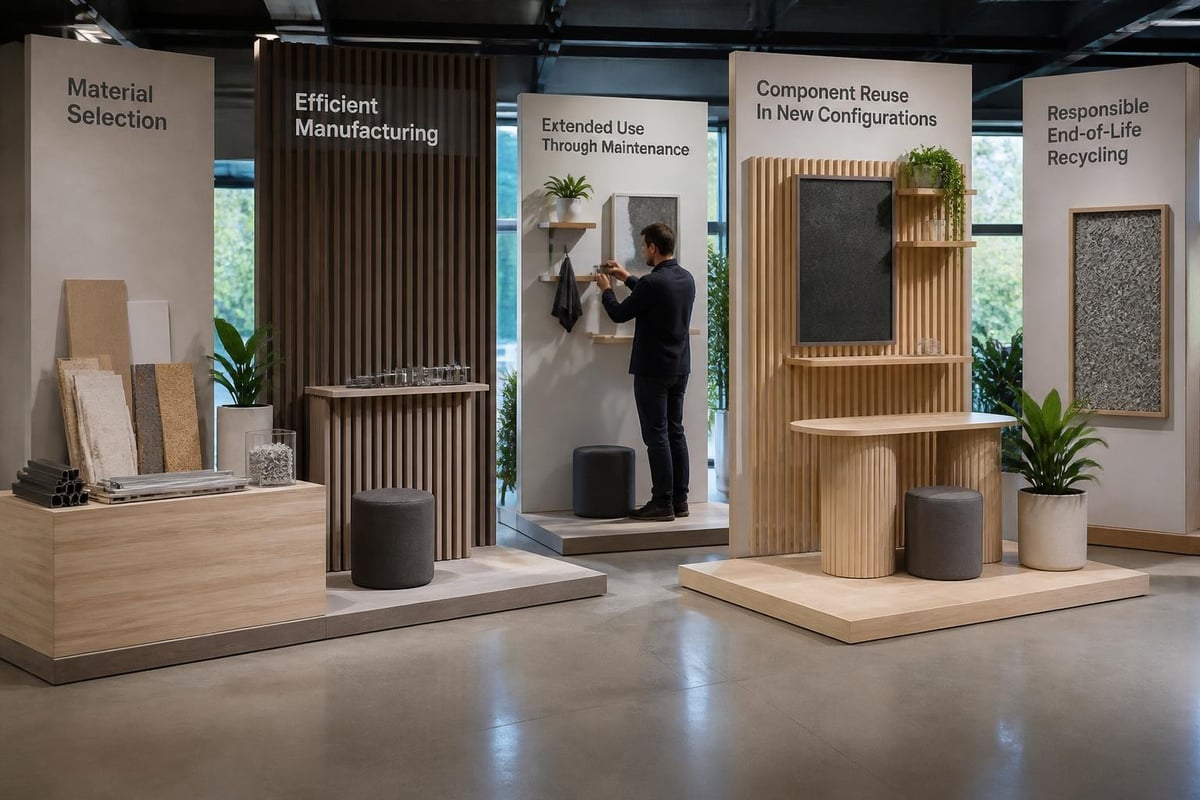
Sustainable material selection begins with understanding environmental impact across the full lifecycle. Recycled aluminium requires 95% less energy than primary production, making it an environmentally preferable choice for frame construction. FSC-certified timber ensures responsible forestry practices, whilst bio-based plastics derived from renewable resources reduce petroleum dependence.
Recyclability at end-of-life represents a crucial sustainability factor. Display stands designed for disassembly enable component separation and material-specific recycling, preventing valuable resources entering waste streams. Modular construction extends effective lifespan through repair and reconfiguration rather than total replacement.
Water-based inks and solvent-free adhesives reduce volatile organic compound emissions during production, improving workplace safety whilst minimising environmental impact. These technologies now achieve quality and durability matching traditional alternatives, eliminating performance trade-offs.
Longevity and Reusability Strategies
The most sustainable display stand is one that remains in productive use for extended periods. Design for durability prioritises robust construction, timeless aesthetics, and adaptable configurations that accommodate changing requirements without obsolescence.
Rental and leasing programmes offer sustainability advantages by maximising asset utilisation across multiple users and applications. Specialised event display companies maintain large inventories serving temporary needs more efficiently than individual ownership for occasional use.
Donation or resale of retired display stands extends their useful life whilst supporting community organisations with limited marketing budgets. This approach builds goodwill whilst ensuring responsible asset disposal aligned with corporate sustainability commitments.
Strategic deployment of display stands creates powerful customer touchpoints that inform, persuade, and guide audiences through carefully crafted experiences. By selecting appropriate types, materials, and technologies whilst considering placement, design, and sustainability factors, organisations maximise both immediate impact and long-term value. Whether you need permanent retail fixtures, portable exhibition displays, or integrated digital solutions, Signs4SA combines manufacturing expertise with strategic insight to deliver display stands that elevate your brand presence across corporate, retail, construction, and pharmaceutical environments throughout South Africa and beyond.