



One Stop Signs: Complete Guide to Traffic Control
Traffic control depends fundamentally on clear, consistent signage that drivers can interpret instantly. Among the most critical regulatory signs in road safety infrastructure, one stop signs establish right-of-way rules at intersections where multiple traffic streams converge. Understanding the specifications, applications, and implementation requirements for these essential traffic control devices ensures safer roads and more efficient traffic movement. Whether you're a municipal planner, property developer, or facilities manager, knowing how one stop signs function within broader traffic management strategies enables better decision-making for your projects.
Regulatory Framework for One Stop Signs
The design and deployment of one stop signs follows strict standards established by national and international traffic authorities. In the United States, the Manual on Uniform Traffic Control Devices (MUTCD) provides comprehensive specifications that many countries adapt for their own contexts.
Standard Design Requirements
One stop signs must meet specific dimensional and visual criteria to ensure consistent recognition:
- Shape: Octagonal (eight-sided) configuration
- Colour: Red background with white legend
- Lettering: White reflective "STOP" text
- Size: Minimum 750mm dimension for urban roads, 900mm for higher-speed routes
- Reflectivity: High-intensity or diamond-grade sheeting for night-time visibility
The octagonal shape itself represents a unique element in traffic control signage. No other regulatory sign uses this configuration, enabling drivers to identify one stop signs even from the rear or when visibility is partially obscured. This distinctive geometry has remained unchanged since standardisation efforts in the early 20th century.
Material specifications vary based on installation environment. Aluminium substrates dominate permanent installations due to durability and corrosion resistance, whilst steel backing provides additional strength in high-wind zones. The reflective sheeting must maintain specified minimum reflectivity levels throughout its service life, typically seven to ten years depending on grade and environmental exposure.

Implementation Scenarios and Warrants
One stop signs cannot be arbitrarily installed at every intersection. Traffic engineers must evaluate specific conditions, called warrants, before authorising placement. Wisconsin DOT traffic operations guidance exemplifies how state agencies interpret federal standards for local application.
Warrant Criteria Assessment
| Warrant Type | Primary Consideration | Threshold Criteria |
|---|---|---|
| Volume | Traffic demand | Minor street volume exceeds 300 veh/day |
| Crash History | Safety record | Three correctable collisions in 12 months |
| Sight Distance | Geometric limitations | Available sight distance below minimum |
| Speed | Approach velocity | Speed differential exceeds 15 km/h |
Traffic volume represents the most quantifiable warrant. Engineers conduct turning movement counts at proposed locations, analysing both major and minor street volumes. When minor street traffic exceeds specified thresholds whilst lacking safe gaps for entry, one stop signs become justified.
Sight distance limitations frequently warrant stop control at locations where horizontal curves, vertical grades, or roadside obstacles prevent drivers from seeing conflicting traffic. Rather than expecting drivers to judge gap availability under compromised visibility, one stop signs transfer right-of-way responsibility to the stopped approach.
Crash history analysis examines collision patterns over typically twelve-month periods. Three or more crashes attributable to inadequate gap judgement or right-of-way violations often indicate need for enhanced control. However, engineers must verify that one stop signs will address the specific crash type rather than simply shifting collision locations or patterns.
All-Way Stop Applications
All-way stop control (AWSC) installations, where one stop signs control all approaches simultaneously, require even more rigorous evaluation. Research published in Transportation Research Record demonstrates that AWSC performs best at specific intersection types rather than as a universal solution.
AWSC warrants typically include:
- Balanced traffic volumes on all approaches
- Crash patterns indicating confusion over right-of-way
- Minimum combined volume thresholds (typically 500 veh/h)
- Geometric conditions limiting sight distance on multiple approaches
- Interim measure pending signal installation
Property developers and business parks often request all-way stop installations believing they enhance safety universally. However, inappropriate AWSC implementation can actually increase rear-end collisions whilst creating unnecessary delay. Professional signage work requires understanding these nuanced applications.
Manufacturing and Material Considerations
Producing compliant one stop signs demands precision manufacturing capabilities and quality materials. The reflective sheeting applied to sign faces undergoes rigorous testing to ensure performance across temperature extremes, UV exposure, and mechanical stress.
Reflective Sheeting Technologies
Modern one stop signs utilise three primary sheeting types:
Engineer Grade (Type I): Enclosed lens design offering seven-year minimum performance. Suitable for low-speed, low-volume locations where replacement cycles accommodate shorter service life. Most economical option for temporary or private road applications.
High-Intensity (Type III): Encapsulated lens technology providing ten-year performance. Enhanced reflectivity at wider angles makes this grade appropriate for most urban and suburban installations. Balances cost and performance effectively.
Diamond Grade (Type XI): Microprismatic construction delivering exceptional brightness and colour saturation. Twelve-year minimum performance with superior reflectivity at sharp entrance angles. Specified for high-speed approaches and locations requiring maximum conspicuity.
| Sheeting Type | Service Life | Reflectivity | Cost Factor | Best Application |
|---|---|---|---|---|
| Engineer Grade | 7 years | Standard | 1.0x | Private roads, temporary |
| High-Intensity | 10 years | Enhanced | 1.5x | Urban/suburban streets |
| Diamond Grade | 12+ years | Maximum | 2.5x | High-speed, critical locations |
The substrate material selection impacts durability equally. Aluminium sheets ranging from 1.6mm to 3.0mm thickness provide the standard backing for permanent one stop signs. Thicker gauges resist deformation from impacts and wind loading, particularly important for larger signs or exposed locations.

Placement and Mounting Specifications
Proper positioning of one stop signs critically affects their effectiveness. Placement errors can render even perfectly manufactured signs ineffective or create liability concerns for property owners and municipalities. Understanding warehouse safety signs principles helps translate regulatory sign concepts to private property applications.
Lateral and Vertical Positioning
One stop signs must be positioned to enter drivers' cone of vision without requiring head movement or scanning. Lateral offset from the edge of pavement typically ranges from 1.8m to 3.6m, balancing visibility against roadside safety considerations. Greater offsets apply where right-of-way width permits and where breakaway supports can be utilised.
Vertical mounting height measured from the bottom of the sign to the road surface follows these standards:
- Urban areas: 2.1m to 2.4m
- Rural areas: 1.5m to 2.1m
- Bicycle paths: 1.2m to 1.5m
Higher mounting in urban contexts accounts for sight line obstructions from parked vehicles, street furniture, and pedestrians. Rural installations use lower heights where sight lines remain clear and where maintenance vehicles may require easier access.
Advance Placement Considerations
Determining the precise location relative to the stop line involves calculating stopping sight distance based on approach speeds. The one stop signs must be visible from a distance allowing drivers travelling at the 85th percentile speed to perceive, react, and stop comfortably.
For a 60 km/h approach, minimum stopping sight distance typically requires 85 metres of unobstructed view. The sign must be positioned sufficiently in advance that drivers can recognise it, assess whether other traffic has stopped, and prepare for their own stop without emergency braking.
Mounting hardware selection affects long-term maintenance costs. Breakaway posts in high-speed zones reduce collision severity when errant vehicles strike supports. U-channel posts accommodate quick sign replacement without removing the entire assembly. Foundation depth must extend below frost lines to prevent heaving in cold climates.
Complementary Traffic Control Elements
One stop signs rarely function in isolation. Effective intersection control integrates multiple elements working cohesively. Understanding this systems approach helps facilities managers and developers implement comprehensive traffic management rather than isolated signage.
Stop Line Markings
Pavement markings work synergistically with one stop signs to define stopping points. The stop bar, typically 300mm to 600mm wide, extends across all approach lanes 1.2m to 15m before the crosswalk or intersection. This visual reference helps drivers judge the appropriate stopping position, particularly important for compliance when the actual intersection lies beyond immediate sight distance.
Thermoplastic markings offer superior durability compared to paint, maintaining visibility for three to five years under moderate traffic. Retroreflective additives enhance night-time conspicuity, complementing the reflective properties of the one stop signs themselves. For commercial properties and business parks, coordinating sign and marking maintenance ensures consistent messaging.
Supplementary Plaque Applications
Additional information sometimes supplements basic one stop signs through plaque installations:
- All-way plaques: Confirm that cross traffic also faces stop control
- Distance plaques: Indicate upcoming stop ("STOP AHEAD 150m")
- Condition plaques: Specify time-of-day or conditional application
- Multi-way plaques: Clarify complex intersection configurations
These supplementary elements must meet the same reflectivity and material standards as primary signs. Over-signing, however, can dilute message effectiveness. Traffic engineers carefully evaluate whether additional information genuinely aids decision-making or simply creates visual clutter.
Pylon Signage installations near intersections controlled by one stop signs require careful coordination to avoid creating visual confusion or obscuring regulatory signage. Height, setback, and illumination must be evaluated to ensure commercial signage enhances rather than compromises traffic safety.
Compliance and Enforcement Considerations
The effectiveness of one stop signs depends ultimately on driver compliance. Research examining stop-sign compliance reveals significant variation in driver behaviour based on intersection characteristics, enforcement presence, and perceived crash risk.
Factors Influencing Compliance
Complete stops (vehicle velocity reaching zero) occur at higher rates when:
- Cross traffic remains visible during approach
- All-way control eliminates competitive gap acceptance
- Enforcement occurs regularly and visibly
- Geometric design prevents "rolling" through turns
- Pedestrian activity creates social enforcement
Conversely, compliance deteriorates at isolated locations with excellent sight distance, minimal cross traffic, and absent enforcement. This creates a dilemma for traffic engineers: installing one stop signs where they appear unnecessary breeds disrespect for traffic control devices generally.
Legal and Liability Aspects
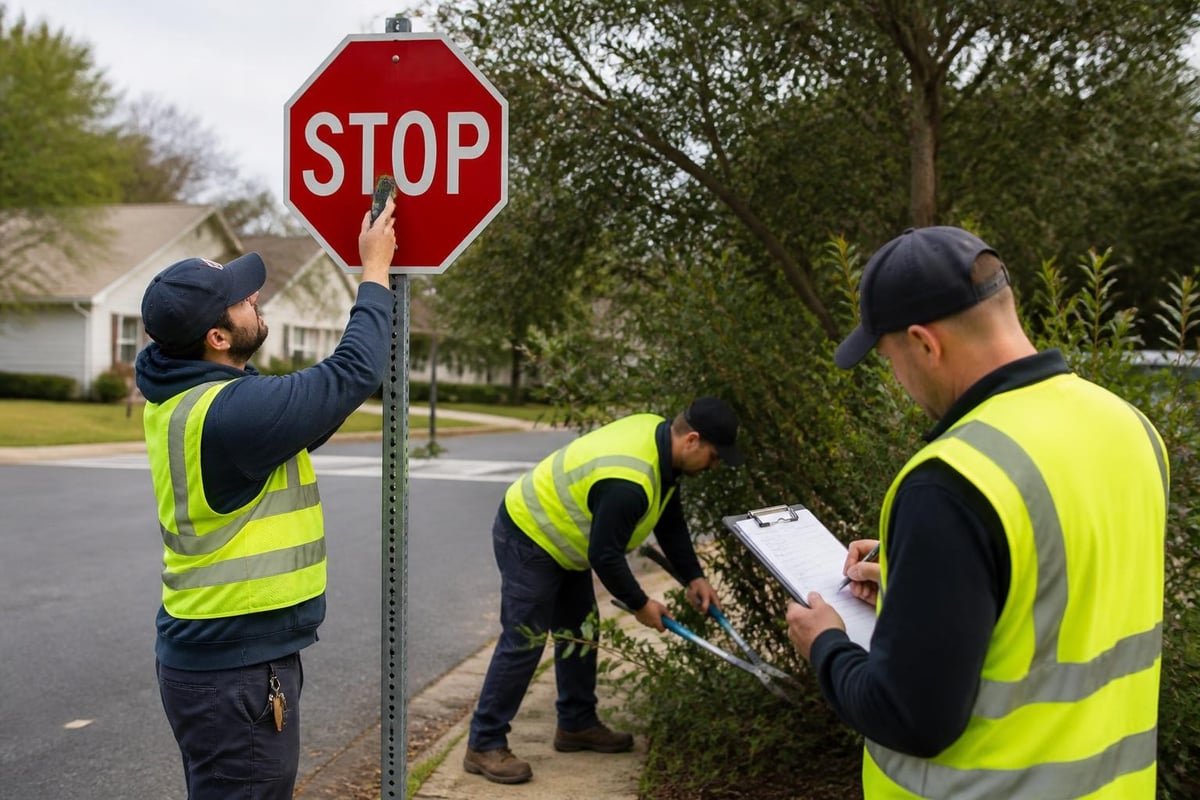
Property owners bear responsibility for maintaining one stop signs on private roads and car parks to specified standards. Faded reflectivity, damaged faces, or incorrect placement can establish negligence in collision litigation. Regular inspection programmes documenting sign condition provide important liability protection.
Maintenance cycles should address:
- Reflectivity testing annually using retroreflectometers
- Face cleaning to remove dirt, insect debris, and oxidation
- Structural integrity checks for post corrosion or loosening
- Vegetation management maintaining clear sight lines
- Documentation through photographic records and inspection logs
For organisations managing multiple facilities across regions, understanding safety signage best practices enables systematic compliance programmes rather than reactive maintenance.
Integration with Modern Traffic Management
Contemporary traffic control increasingly integrates one stop signs within intelligent transportation systems (ITS) and data-driven management approaches. Whilst the signs themselves remain passive devices, their operation connects to broader smart infrastructure initiatives.
Performance Monitoring Technologies
Video analytics and sensor networks now monitor compliance rates, queue lengths, and delay at stop-controlled intersections. This data informs decisions about:
- Timing interventions: Identifying peak periods where control type should change
- Warrant reassessment: Quantifying whether original justification remains valid
- Enforcement deployment: Directing resources to locations with systematic violations
- Alternative treatments: Evaluating roundabouts, signals, or other control types
Some jurisdictions trial dynamic stop control where one stop signs illuminate only during specific conditions. School zones might activate stop requirements during arrival and dismissal periods whilst reverting to yield control at other times. Though non-standard, these applications represent evolving approaches to adaptive traffic management.
Sustainability and Lifecycle Management
Environmental considerations increasingly influence one stop signs specifications and management. Solar-powered LED-enhanced signs reduce energy consumption whilst improving conspicuity. Recycling programmes for aluminium substrates and sheeting materials minimise waste.
Lifecycle cost analysis compares initial investment against maintenance expenses and replacement frequency:
- Premium materials increase upfront costs by 40-60%
- Extended service life reduces replacement frequency by 30-50%
- Enhanced reflectivity may reduce collision rates and associated costs
- Simplified maintenance procedures lower labour requirements
For organisations committed to industry insights and sustainable operations, these total cost considerations outweigh simple purchase price comparisons.
Multi-Industry Applications Beyond Public Roads
Whilst one stop signs primarily serve public roadway networks, their application extends to various private and industrial settings where similar traffic control needs arise. Understanding these broader applications helps facilities managers implement appropriate solutions.
Industrial and Commercial Campuses
Large manufacturing facilities, distribution centres, and corporate campuses face internal traffic management challenges paralleling public roadway conditions. Trucks, forklifts, private vehicles, and pedestrians interact at intersections between buildings, loading docks, and parking areas.
One stop signs in these environments must:
- Meet visibility standards despite competing industrial signage
- Withstand exposure to specialised environmental conditions (chemicals, extreme temperatures)
- Integrate with site-specific traffic management policies
- Address mixed vehicle types with varying sight heights and stopping capabilities
Material specifications for industrial applications sometimes exceed public roadway requirements. Chemical plants may specify stainless steel substrates and specialised coatings. Cold storage facilities require materials maintaining flexibility at sub-zero temperatures.
Construction Site Traffic Control
Temporary one stop signs control traffic at construction sites where haul routes intersect public roads or where internal circulation requires management. These applications demand portable mounting systems allowing repositioning as work zones evolve.
Portable sign stands typically feature:
- Weighted bases providing stability without ground penetration
- Spring-loaded mechanisms allowing signs to deflect from impacts
- Fluorescent backgrounds enhancing conspicuity in work zones
- Quick-release mounting for rapid deployment and removal
Sign stands designed for construction applications must balance portability against wind resistance, particularly important for one stop signs whose effectiveness depends on remaining upright and visible.
Parking Facility Management
Multi-level car parks and surface parking lots use one stop signs controlling exit points, blind corners, and pedestrian crossing areas. These applications face unique challenges:
- Limited sight distances from structural elements
- Mixed traffic including reversing vehicles
- Pedestrian interactions at high frequencies
- Indoor environments affecting reflectivity requirements
Internally illuminated or LED-enhanced one stop signs overcome low ambient lighting in enclosed parking structures. Some facilities supplement traditional signs with flashing LED borders activating when motion sensors detect approaching vehicles, creating dynamic warning systems.
Training and Public Education Initiatives
The effectiveness of one stop signs depends not solely on proper engineering and manufacturing but on driver understanding and compliance. Public education programmes reinforce proper behaviour and explain the rationale behind stop control placement.
Professional Driver Training
Commercial driver licensing programmes emphasise complete stop requirements and proper scanning techniques at stop-controlled intersections. Key training elements include:
- Three-second rule: Maintaining complete stop for minimum duration
- Systematic scanning: Left-right-left traffic checks before proceeding
- Pedestrian priority: Yielding to crosswalk users before and after stopping
- Line of sight: Creeping forward only when initial stop point lacks visibility
Fleet safety programmes for organisations operating commercial vehicles reinforce these protocols through regular refresher training and telematics monitoring of stop compliance.
Public Awareness Campaigns
Municipal and regional safety campaigns educate the general public about one stop signs and related controls. Effective initiatives:
- Explain warrant criteria helping drivers understand placement logic
- Demonstrate proper stopping technique through video and simulation
- Publicise enforcement programmes deterring violations
- Share collision statistics illustrating stop control effectiveness
- Engage community groups in identifying problematic intersections
These educational efforts complement engineering solutions, recognising that traffic safety requires both proper infrastructure and appropriate driver behaviour. Understanding signage plays an important role in our society helps communicate the broader value of traffic control to sceptical stakeholders.
Future Developments in Stop Control Technology
Emerging technologies promise to enhance one stop signs effectiveness whilst maintaining their fundamental regulatory function. Connected and autonomous vehicle systems will interact with traditional traffic control in evolving ways.
Vehicle-to-Infrastructure Communication
Next-generation one stop signs may incorporate digital communication capabilities broadcasting their presence to equipped vehicles. V2I (vehicle-to-infrastructure) protocols enable:
- Advanced warning: Vehicles receive stop indication before visual acquisition
- Compliance monitoring: Infrastructure tracks which vehicles complete proper stops
- Dynamic messaging: Signs communicate current control status for adaptive systems
- Navigation integration: Stop locations populate mapping databases automatically
These capabilities augment rather than replace visual signs, ensuring compatibility with mixed traffic including conventional vehicles, cyclists, and pedestrians.
Autonomous Vehicle Interaction
Self-driving vehicles rely on multiple sensing modalities to detect and respond to one stop signs:
- Vision systems: Cameras recognising shape, colour, and legend
- LIDAR mapping: Three-dimensional stop line and sign position detection
- HD mapping: Pre-loaded intersection geometry and control data
- V2I communication: Direct sign-to-vehicle data transmission
Redundancy across these systems ensures reliable stop detection even when individual sensors face degraded conditions. However, maintaining traditional visual standards remains essential during the extended transition period whilst human-driven vehicles predominate.
Predictive Maintenance Applications
Internet of Things (IoT) sensors embedded in one stop signs can monitor their own condition and performance:
- Photocells tracking reflectivity degradation
- Accelerometers detecting impacts or structural damage
- Tilt sensors identifying post movement or foundation issues
- Communication modules reporting status to central management systems
These capabilities enable predictive maintenance programmes replacing signs before compliance failures occur rather than responding to deteriorated conditions after they create safety concerns.
One stop signs remain fundamental to safe, efficient traffic management across diverse applications from public highways to private industrial facilities. Proper specification, installation, and maintenance of these critical control devices requires understanding regulatory requirements, material science, and human factors engineering. Whether you're managing a corporate campus, developing a retail centre, or overseeing municipal infrastructure, Signs4SA delivers comprehensive signage solutions meeting exacting standards. Our expertise in regulatory signage, combined with our national footprint and skilled manufacturing capabilities, ensures your traffic control installations achieve both compliance and effectiveness. Contact Signs4SA today to discuss your traffic management signage requirements.