

Laser Cut Signage: Precision Fabrication for Modern Brands
Modern brand communication demands signage solutions that balance precision engineering with creative flexibility. Laser cut signage has emerged as the manufacturing method of choice for businesses seeking intricate designs, consistent quality and production efficiency across multiple materials. From architectural wayfinding systems to dimensional letterforms, this technology enables fabricators to translate digital designs into physical brand touchpoints with micrometre-level accuracy. For corporate environments, retail spaces and pharmaceutical facilities, the combination of speed, repeatability and material versatility makes laser cutting an indispensable tool in contemporary signage production.
Understanding Laser Cutting Technology for Signage Applications
The fundamental principle behind laser cutting involves focusing a high-powered beam through optical lenses to melt, burn or vaporise material along a programmed path. Two primary laser types dominate the signage industry: CO2 lasers excel at cutting non-metallic materials like acrylic, wood and foam, whilst fibre lasers specialise in metals including stainless steel, aluminium and brass.
Material Capabilities and Selection
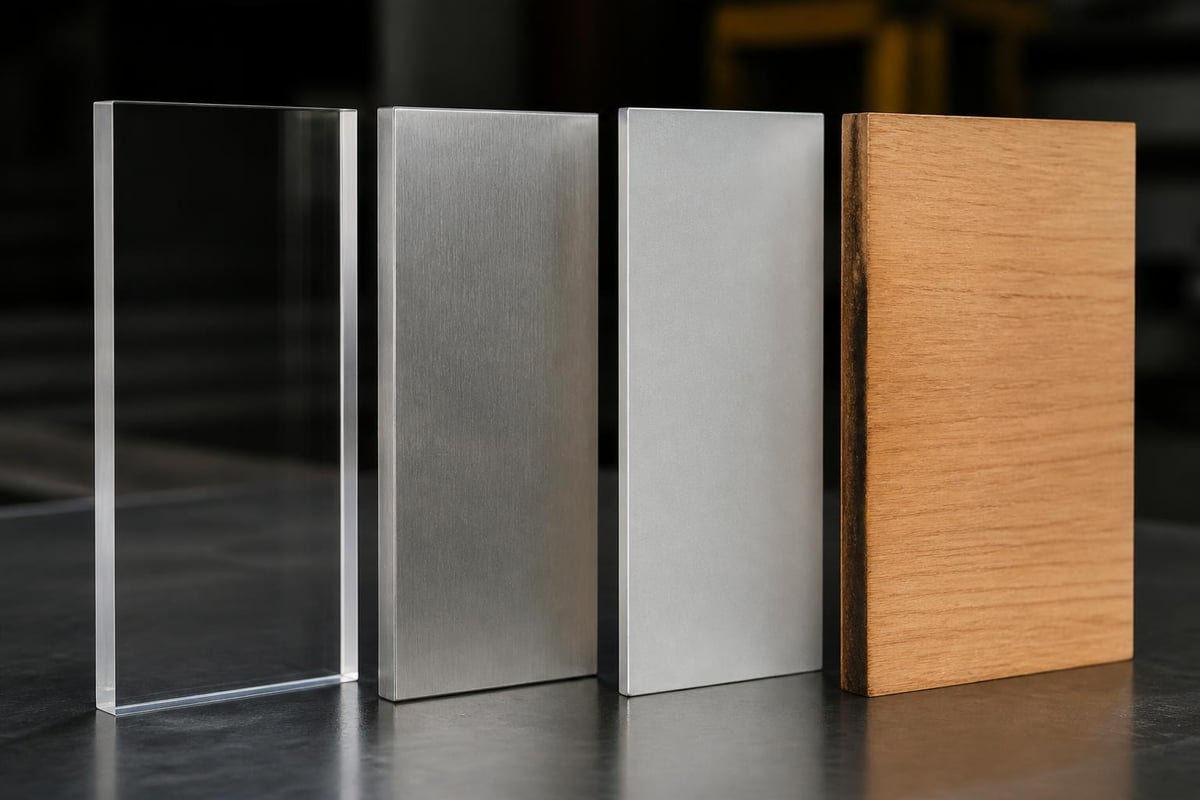
Different substrate materials respond distinctively to laser processing, influencing both aesthetic outcomes and structural performance.
Commonly processed materials for signage:
- Acrylic (cast and extruded): flame-polished edges, minimal post-processing
- Stainless steel: clean cuts up to 6mm, ideal for architectural applications
- Aluminium: lightweight with excellent corrosion resistance for outdoor installations
- Mild steel: cost-effective for painted or powder-coated finished products
- Wood and MDF: natural aesthetic for interior wayfinding and branded environments
- Dibond and composite panels: sandwich construction for large-format applications
The manufacturing processes reference provides comprehensive technical details on how CO2 and fibre laser systems interact with different substrate materials. Each material category requires specific parameter adjustments-power density, cutting speed, assist gas composition-to achieve optimal edge quality and dimensional accuracy.
Edge Quality and Finishing Considerations
Edge finish directly impacts both the visual refinement and functional performance of laser cut signage. Acrylic typically produces a flame-polished edge that appears transparent and glass-like, eliminating the need for secondary polishing operations. Metal cutting, conversely, may produce minor oxidation or dross attachment that requires deburring or finishing.
The laser-cut quality guide offers detailed troubleshooting protocols for common edge defects including taper, dross formation and heat-affected zones. Production facilities implement quality control checkpoints to ensure consistency across batch runs, particularly for projects requiring multiple identical components.
| Material Type | Typical Edge Finish | Post-Processing Required | Outdoor Durability |
|---|---|---|---|
| Cast Acrylic | Flame-polished, transparent | None to minimal | Excellent (UV-stable grades) |
| Stainless Steel | Clean cut, minor oxidation | Light deburring | Superior corrosion resistance |
| Aluminium | Bright cut surface | Deburring, anodising optional | Excellent with treatment |
| Mild Steel | Grey oxide layer | Deburring, painting essential | Requires protective coating |
| Dibond | Sealed composite edge | Edge sealing for outdoor use | Good with proper sealing |
Design Advantages for Corporate and Architectural Signage
Laser cut signage delivers distinctive design capabilities that elevate brand expression beyond the limitations of traditional fabrication methods. The technology enables designers to execute intricate patterns, dimensional letterforms and perforated panels that integrate seamlessly with contemporary architectural vocabularies.
Complex geometries that would prove prohibitively expensive through conventional routing or die-cutting become economically viable. Internal radii can be held to fractions of a millimetre, enabling crisp rendering of serif typefaces, fine logos and decorative patterns. This precision proves particularly valuable for 3D lettering applications where dimensional accuracy affects visual alignment and mounting integrity.
Architectural Scale Applications
Recent projects demonstrate the expanding role of laser technology in architectural wayfinding and facade systems. The Melbourne Indigenous Transition School showcases large-scale perforated metal panels that function simultaneously as branding elements, privacy screens and architectural features. These installations illustrate how laser cutting transcends traditional signage categories to become integrated building systems.
Architectural applications gaining prominence:
- Perforated metal screens with custom brand patterns
- Dimensional letterforms for lobby installations
- Wayfinding pictograms meeting accessibility standards
- Privacy panels with graduated perforation densities
- Facade-integrated identity systems
For pharmaceutical and healthcare environments, laser cut signage offers the added benefit of non-porous, cleanable surfaces. Stainless steel components can be electro-polished to medical-grade finishes, whilst acrylic elements maintain their integrity through repeated disinfection protocols.
Production Workflow and Technical Specifications
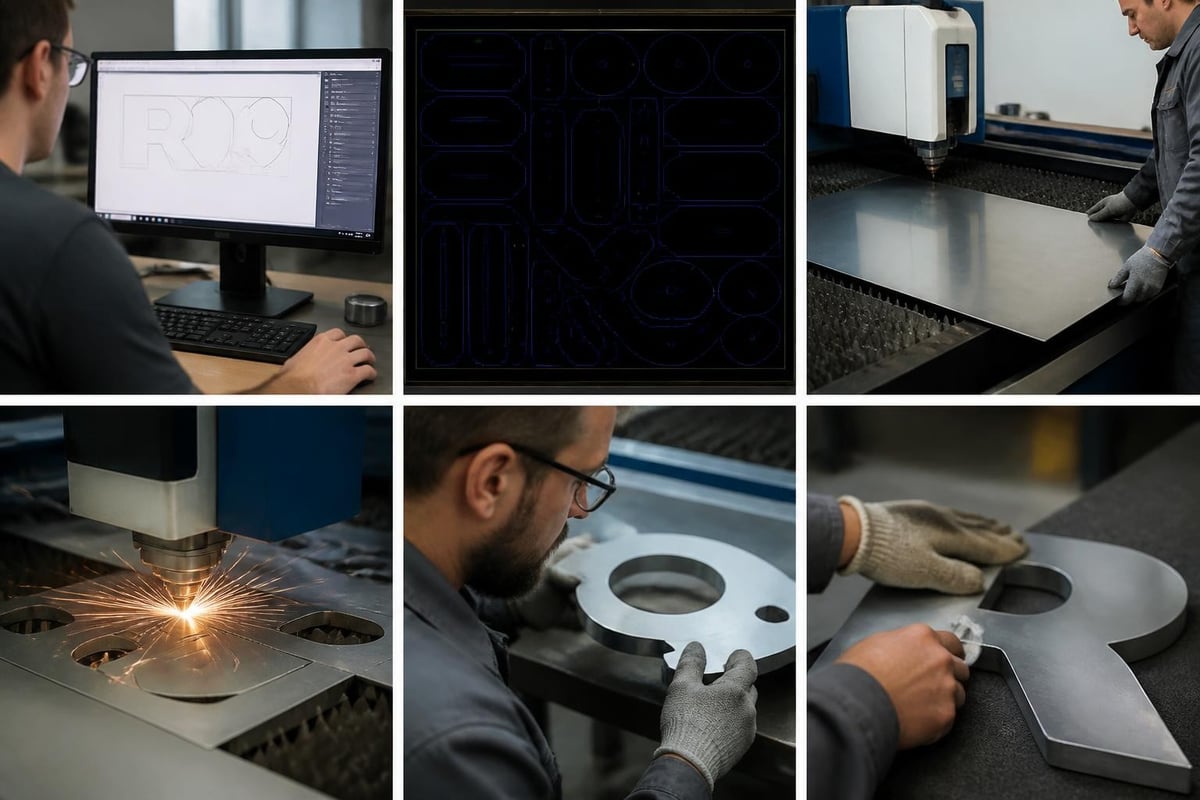
Professional laser cutting facilities operate sophisticated workflows that transform digital artwork into fabricated components. Understanding this production chain enables designers and project managers to optimise files for manufacturing efficiency whilst maintaining design intent.
File Preparation and Kerf Compensation
Vector artwork must be prepared with precise attention to line weights, nested layouts and cutting sequences. The laser beam itself possesses physical width-known as kerf-typically ranging from 0.1mm to 0.5mm depending on material and laser type. This material removal must be compensated during file preparation to maintain specified dimensions.
Research from the Hasso Plattner Institute documents automated kerf calibration systems that measure and compensate for variability across different machines and material batches. Production facilities serving the signage industry increasingly adopt these precision controls to ensure dimensional consistency across large production runs.
The Acryclear fabrication guide provides manufacturer-specific recommendations for acrylic cutting parameters, edge finishing techniques and recommended practices that ensure optimal material performance in finished signage installations.
Nesting Efficiency and Material Utilisation
Professional production facilities maximise material yield through sophisticated nesting software that arranges components to minimise waste. For high-volume projects, a 5-10% improvement in material utilisation translates directly to cost savings and environmental benefits.
| Sheet Size (mm) | Typical Yield | Waste Percentage | Best For |
|---|---|---|---|
| 1220 × 2440 (4×8) | 85-92% | 8-15% | Large panels, minimal components |
| 1220 × 1220 (4×4) | 88-94% | 6-12% | Mixed component sizes |
| Custom blanks | 92-97% | 3-8% | High-volume identical parts |
Production scheduling often batches projects by material type and thickness to reduce setup time and maintain consistent cutting parameters throughout production runs. This operational efficiency directly impacts both project timelines and final costs.
Integration with Illumination and Mounting Systems
Laser cut signage frequently serves as one component within larger signage assemblies that incorporate illumination, mounting structures and protective finishes. The precision of laser fabrication enables tight tolerances essential for alignment between multiple layers or with LED modules.
Backlit and Edge-Lit Configurations
Acrylic components benefit particularly from laser cutting precision when designed for illumination. Edge-lit configurations rely on polished acrylic edges to receive LED input, distributing light across engraved or surface-printed graphics. The flame-polished edge produced by laser cutting provides optimal light transmission without additional polishing operations.
For retail and hospitality environments, custom signage solutions increasingly combine laser-cut dimensional letters with integrated LED illumination. The letters provide physical depth and shadow play during daylight hours, whilst internal or halo illumination creates dramatic evening presence.
Common illumination integration methods:
- Halo illumination: laser-cut letters mounted on spacers with rear LEDs
- Face illumination: translucent acrylic faces with internal LED arrays
- Edge-lit panels: polished acrylic edges receiving LED input
- Silhouette effects: backlit perforated metal creating pattern projection
Digital signage represents another evolution in illuminated communications. Whilst laser-cut components don't directly compete with digital signage displays, they often frame or complement digital installations, providing permanent branded elements that contextualise dynamic content.
Mounting Hardware and Installation Considerations
The precision of laser cutting extends to mounting hole placement, enabling accurate alignment with architectural substrates. Through-holes for standoffs, keyholes for concealed hanging systems and registration features can be integrated during the cutting operation rather than added through secondary drilling.
The U.S. Access Board technical guide establishes mounting height and tactile requirements for accessible signage-considerations that influence both design development and installation methodology. Laser-cut components can incorporate tactile elements or be combined with separately fabricated Braille plates to achieve compliance whilst maintaining design cohesion.
Material-Specific Considerations and Performance
Each substrate material presents distinct advantages and limitations that influence both aesthetic outcomes and long-term performance in specific environmental conditions.
Acrylic: Versatility and Optical Properties
Cast acrylic remains the predominant choice for internally illuminated and high-visibility signage applications. The material accepts laser cutting exceptionally well, producing transparent flame-polished edges that enhance both appearance and light transmission properties.
Colour availability spans the complete spectrum, with custom colour matching available for brand-specific requirements. UV-stable formulations resist yellowing and degradation in outdoor environments, whilst impact-modified grades provide enhanced durability for high-traffic locations.
Acrylic performance characteristics:
- Excellent optical clarity (92% light transmission)
- UV stability in quality formulations
- Flame-polished edges require no finishing
- Thermoformable for dimensional applications
- Wide colour range including fluorescents and metallics
Metals: Durability and Premium Aesthetics
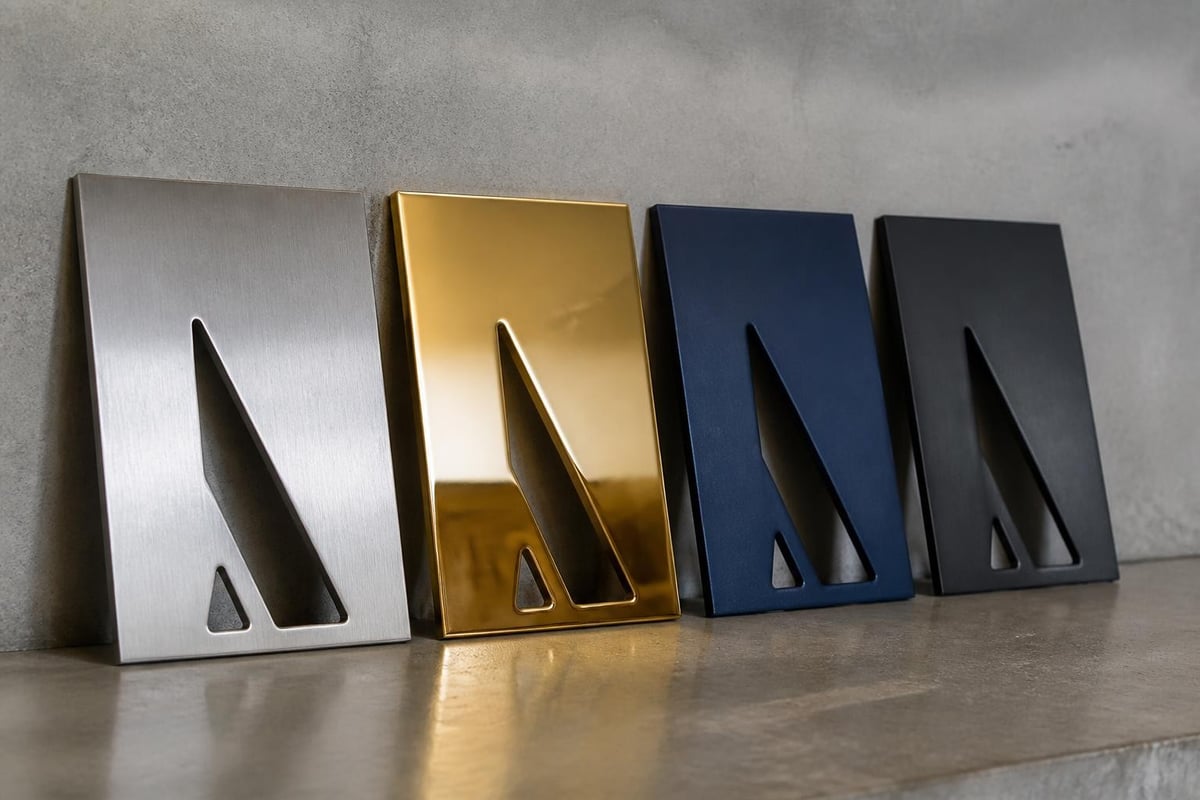
Stainless steel has become synonymous with premium corporate environments, offering unmatched durability and a sophisticated material presence. Grade 316 provides superior corrosion resistance for coastal or high-humidity environments, whilst brushed or mirror finishes enable diverse aesthetic expressions.
Aluminium presents an attractive alternative where weight reduction proves important. The material machines cleanly, accepts anodising or powder coating, and offers excellent outdoor durability when properly finished. For budget-conscious projects, mild steel provides structural integrity at lower material cost, though protective finishing becomes essential for longevity.
Quality Control and Production Standards
Professional signage fabrication facilities implement rigorous quality protocols to ensure dimensional accuracy, edge quality and surface finish meet specification requirements. These controls become particularly critical for projects requiring multiple identical components or precise alignment between layered elements.
Inspection and Verification Processes
Post-cutting inspection typically includes dimensional verification against CAD specifications, edge quality assessment and surface condition review. Automated optical measurement systems can verify critical dimensions across production batches, flagging variations that exceed tolerance thresholds.
For architectural projects, material certification documentation traces substrate provenance and confirms specified grades have been utilised. This documentation proves essential for projects subject to building code compliance or sustainability certification requirements.
Quality checkpoints in production:
- Material verification: grade, thickness, finish specification
- Pre-cut inspection: surface defects, dimensional accuracy of blanks
- Cutting parameter validation: test cuts confirming optimal settings
- Post-cut dimensional verification: critical features measured against specification
- Edge quality assessment: dross, taper, heat-affected zone evaluation
- Surface finish review: scratches, contamination, protective film integrity
- Assembly test-fit: multi-component projects verified before finishing
Cost Factors and Project Economics
Laser cutting costs derive from multiple variables including material selection, cutting time, nesting efficiency and finishing requirements. Understanding these cost drivers enables informed decision-making during design development and material specification.
Material Costs and Thickness Implications
Raw material represents the largest single cost component in most laser-cut signage projects. Acrylic pricing varies significantly between cast and extruded grades, with cast commanding premium pricing for superior optical properties and edge finish. Metal costs fluctuate with commodity markets, though stainless steel consistently prices above aluminium and mild steel.
Material thickness directly influences both material cost and cutting time. Doubling thickness typically increases cutting time by 3-4× whilst only doubling material cost, shifting the cost balance toward cutting operations for thicker substrates.
| Material/Thickness | Relative Material Cost | Cutting Speed | Total Cost Index |
|---|---|---|---|
| 3mm Cast Acrylic | 1.0× | Fast | 1.0× (baseline) |
| 6mm Cast Acrylic | 2.0× | Medium | 2.5× |
| 2mm Stainless Steel | 1.8× | Fast | 1.9× |
| 3mm Stainless Steel | 2.7× | Slow | 3.8× |
| 3mm Aluminium | 1.2× | Fast | 1.3× |
Cutting Time and Production Efficiency
Machine time charges reflect equipment investment, maintenance and operational costs. Complex geometries with extensive internal cutouts require more cutting time than simple external profiles. Sharp internal corners necessitate additional piercing operations that extend cycle time compared to radiused corners.
Production facilities offering industry-specific signage solutions optimise workflows to batch similar materials and thicknesses, reducing setup time between projects. This operational efficiency benefits clients through reduced lead times and competitive pricing.
Environmental Considerations and Sustainability
Laser cutting presents both environmental advantages and considerations that influence sustainable signage production practices. The precision of the technology minimises material waste, whilst energy consumption and fume extraction require careful management.
Material Waste Reduction
The ability to nest components efficiently reduces offcut waste compared to less precise cutting methods. Skeleton material from laser cutting can often be recycled-particularly metals and certain plastics-though contamination from protective films or adhesive residues may limit recyclability.
Some fabricators implement closed-loop material management, collecting offcuts by material type for return to recycling streams. For acrylic, offcuts can be reground and reprocessed into extruded sheet, though not back to cast-grade material.
Sustainability practices in laser cutting operations:
- Optimised nesting to maximise material yield
- Material-specific recycling of offcuts and skeleton
- Energy-efficient laser sources (fibre lasers vs older CO2 technology)
- Fume extraction and filtration to manage process emissions
- Selection of recyclable or bio-based materials where appropriate
For corporate clients pursuing sustainability certifications, material selection and fabrication methodology documentation supports LEED, BREEAM or similar green building requirements. Specifying recycled-content metals or bio-based acrylics contributes to material credits whilst maintaining functional performance.
Applications Across Industry Sectors
Different industry sectors leverage laser cut signage capabilities to address specific functional requirements and aesthetic preferences. Understanding these sector-specific applications guides both design development and material specification.
Corporate and Professional Environments
Reception areas, boardrooms and corporate campuses increasingly feature dimensional laser-cut letterforms that project brand authority and attention to detail. Brushed stainless steel remains the material of choice for financial institutions and professional services firms, whilst technology companies often specify powder-coated aluminium in brand-specific colours.
Wayfinding systems benefit from the consistency laser cutting delivers across multiple identical components. Directional signage, room identification and department markers can be produced in quantity whilst maintaining precise dimensional tolerances and uniform edge quality.
Retail and Hospitality Applications
Fashion retailers and hospitality venues embrace laser cutting for its ability to execute intricate brand patterns and decorative elements. Perforated metal panels create privacy screens that incorporate brand motifs, whilst dimensional acrylic letterforms provide cost-effective alternatives to individually fabricated channel letters.
Seasonal campaign graphics can be produced efficiently, enabling retailers to refresh visual merchandising elements in response to promotional calendars. The combination of speed and precision makes laser cutting ideal for fast-turnaround retail graphics that maintain premium aesthetic standards.
Healthcare and Pharmaceutical Facilities
Pharmaceutical manufacturing and healthcare environments demand cleanable, non-porous signage materials that withstand rigorous infection control protocols. Laser-cut stainless steel components can be electro-polished to medical-grade surface finishes, eliminating surface irregularities that harbour contaminants.
Wayfinding clarity proves essential in healthcare settings, where stress and unfamiliarity impair navigation. High-contrast colour combinations, tactile elements and consistent visual language-all achievable through laser-cut component systems-support patient orientation and reduce cognitive load during facility navigation.
Laser cut signage represents a convergence of precision manufacturing technology and creative design expression that serves the evolving needs of modern brands across sectors. From architectural installations to detailed letterforms, the capabilities of contemporary laser systems enable fabricators to deliver consistent quality, intricate geometries and material versatility that traditional methods cannot match. Whether your project requires brushed stainless steel dimensional letters for a corporate reception, perforated metal wayfinding panels for a pharmaceutical facility, or illuminated acrylic components for retail environments, Signs4SA combines advanced fabrication capabilities with comprehensive industry expertise to transform your brand vision into precision-engineered signage solutions that perform beautifully for years to come.