


Safety Signage: The Complete Guide for South African Workplaces
Safety signage forms the backbone of effective hazard communication across every workplace environment. Understanding all safety signs and their applications is crucial for maintaining compliance, protecting employees, and creating a culture of safety awareness. Whether you're managing a construction site, pharmaceutical facility, retail space, or corporate office, implementing the correct safety signage system can prevent accidents, save lives, and demonstrate your commitment to regulatory standards. This comprehensive guide explores the complete spectrum of safety signs, their meanings, applications, and the standards that govern their use in South African workplaces and beyond.
Understanding the Core Categories of Safety Signs
All safety signs are systematically organised into five primary categories, each serving a distinct purpose in workplace communication. These classifications ensure that anyone, regardless of language or literacy level, can quickly interpret critical safety information through universally recognised symbols and colours.
Prohibition Signs
Prohibition signs communicate actions that must not be taken. These distinctive red circular signs with diagonal lines instantly convey forbidden activities. Common examples include no smoking, no entry, and no unauthorised access signs.
The colour coding and shapes of prohibition signs follow strict international conventions. Red borders with black symbols on white backgrounds create immediate visual recognition, ensuring compliance even in high-pressure situations.
Key prohibition sign applications include:
- Restricted access areas in manufacturing facilities
- Chemical storage zones requiring authorisation
- Areas where mobile phones pose explosion risks
- Zones where eating or drinking contaminate products
Warning Signs
Warning signs alert personnel to potential hazards that require caution and awareness. These triangular signs feature yellow backgrounds with black borders and symbols, making them instantly recognisable even from considerable distances.
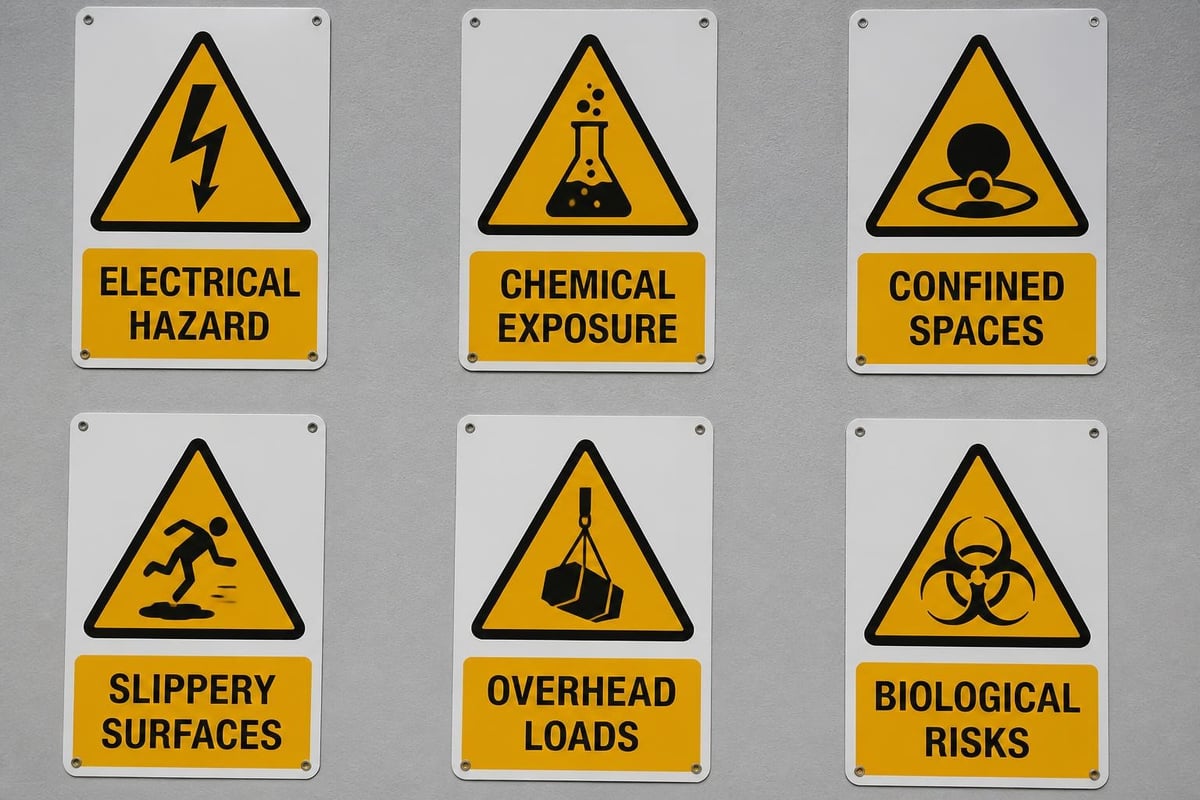
Manufacturing facilities, construction sites, and pharmaceutical environments rely heavily on warning signage to maintain operational safety. The yellow triangle has become synonymous with hazard awareness across industries worldwide.
| Warning Type | Common Applications | Critical Locations |
|---|---|---|
| Electrical hazard | Substations, control panels | Power distribution areas |
| Chemical exposure | Storage rooms, mixing areas | Production facilities |
| Slippery surfaces | Wet processing zones | Food preparation areas |
| Overhead loads | Warehouses, loading bays | Logistics operations |
Mandatory Signs
Mandatory signs indicate actions that must be taken to ensure safety. These circular blue signs with white symbols communicate required behaviour rather than prohibited actions.
Personal protective equipment requirements constitute the majority of mandatory signage applications. Hard hats, safety glasses, hearing protection, and high-visibility clothing all feature prominently in industrial settings.
The blue colour coding differentiates mandatory instructions from prohibitions and warnings, creating a clear visual hierarchy. Workers quickly learn to associate blue signs with compliance requirements rather than hazard warnings.
Essential mandatory sign categories:
- Head protection in construction zones
- Eye protection near grinding operations
- Foot protection in warehousing areas
- Hand protection when handling chemicals
- Respiratory protection in contaminated atmospheres
Safe Condition and Emergency Information Signs
Safe condition signs provide crucial information about emergency routes, first aid facilities, and assembly points. These rectangular or square green signs with white symbols guide people to safety during emergencies.
Emergency exit routes must remain clearly marked and unobstructed at all times. Health and safety sign requirements emphasise the importance of maintained visibility and strategic placement throughout facilities.
First aid stations, emergency eyewash facilities, and safety showers all require appropriate safe condition signage. The green colour coding psychologically associates these signs with safety and reassurance rather than danger.
Fire Equipment Signs
Fire equipment signs identify the location of firefighting equipment and alarm activation points. These red rectangular signs with white symbols ensure rapid access to critical firefighting resources during emergencies.
Fire extinguishers, hose reels, alarm call points, and fire blankets must all be clearly marked. The distinctive red background ensures these signs remain visible even in smoke-filled environments where visibility becomes compromised.
Regulatory Standards Governing All Safety Signs
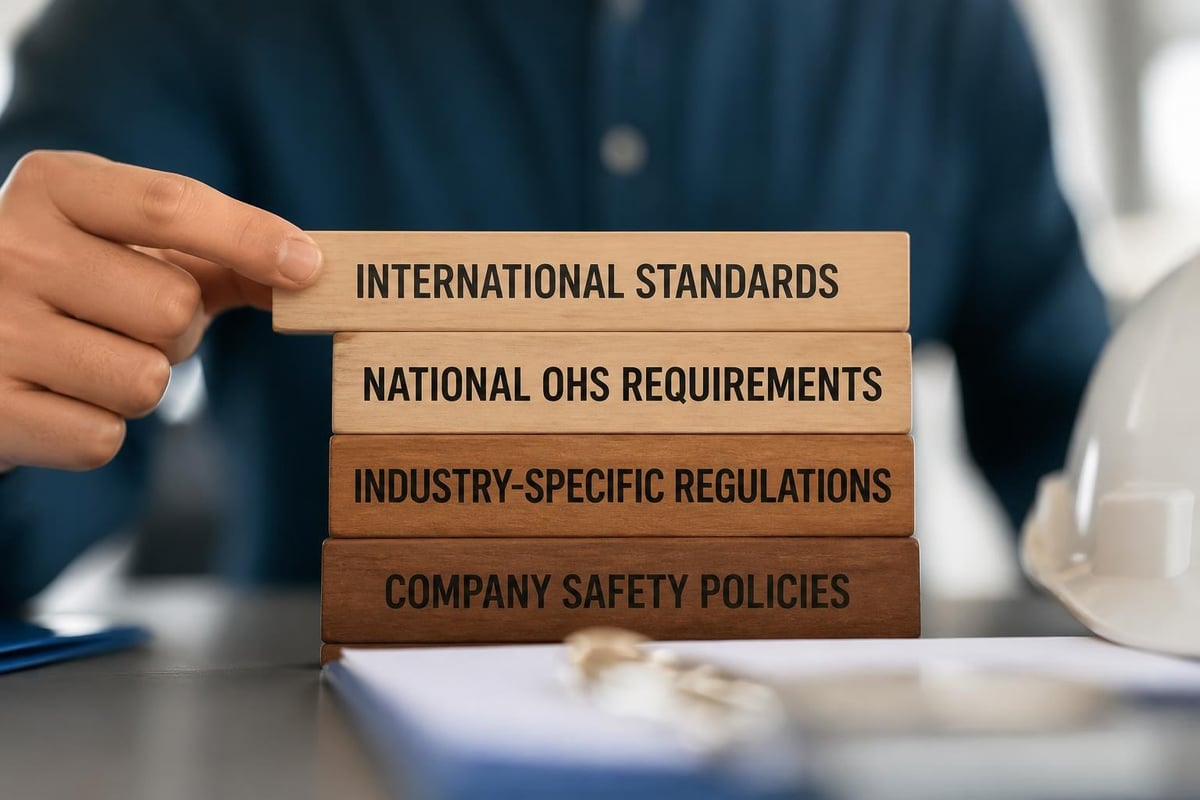
South African safety signage must comply with multiple regulatory frameworks, including Occupational Health and Safety Act requirements and international standards. Understanding these regulations ensures legal compliance whilst maintaining effective safety communication.
The construction safety signs and symbols used across building sites demonstrate how sector-specific requirements build upon core safety signage principles. Construction environments present unique hazards requiring specialised warning and mandatory signage.
International Standards and Harmonisation
ISO 7010 provides internationally recognised safety symbols that transcend language barriers. This standardisation ensures consistent safety communication across multinational operations and diverse workforce demographics.
Benefits of standardised safety signage include:
- Reduced confusion in multilingual workplaces
- Improved compliance with international clients
- Enhanced safety for visiting contractors
- Simplified training procedures
- Better legal defensibility
OSHA and ANSI standards for safety signs establish detailed requirements for design, placement, and maintenance. These comprehensive guidelines cover everything from minimum viewing distances to illumination requirements for emergency signage.
South African Regulatory Context
South African businesses must navigate both local and international standards when implementing safety signage systems. The Occupational Health and Safety Act establishes fundamental requirements, whilst industry-specific regulations add additional layers of compliance.
Pharmaceutical facilities face particularly stringent requirements due to contamination risks and quality assurance demands. Safety signage compliance in South Africa requires understanding both general workplace requirements and sector-specific regulations.
| Industry | Primary Regulations | Unique Signage Needs |
|---|---|---|
| Construction | OHS Act, Building Regulations | Overhead hazard warnings |
| Pharmaceutical | GMP, Quality Standards | Contamination control zones |
| Retail | Fire Safety, Public Access | Customer-facing emergency routes |
| Manufacturing | Machine Safety, Chemical Handling | Multiple hazard warnings |
Strategic Placement and Visibility Considerations
Effective safety signage extends beyond selecting the correct sign types. Strategic placement ensures maximum visibility when and where people need critical safety information most.
Height and Viewing Distance Requirements
All safety signs must be positioned at appropriate heights for their intended audience. Overhead hazard warnings require placement at eye level or higher, whilst floor-level hazards need ground-mounted signage.
Viewing distance calculations determine minimum sign sizes. Larger facilities with longer sightlines require proportionally larger signs to ensure legibility. The regulations and standards for workplace transport settings provide specific guidance for vehicle operation areas.
Critical placement factors include:
- Ambient lighting conditions throughout the day
- Potential obstructions from equipment or inventory
- Traffic flow patterns and pedestrian routes
- Emergency evacuation pathway visibility
- Multilingual workforce comprehension needs
Illumination and Environmental Factors
Indoor environments often require illuminated or photoluminescent safety signs to maintain visibility during power failures. Emergency exit routes particularly benefit from self-illuminating signage that activates automatically when main lighting fails.
Outdoor safety signage faces additional challenges from weather exposure, direct sunlight, and environmental degradation. UV-resistant materials and regular maintenance schedules preserve sign effectiveness over extended periods.
Construction sites present unique environmental challenges requiring robust, weather-resistant safety signage. Digital signage offers modern alternatives for temporary sites where traditional fixed signs prove impractical or inefficient.
Industry-Specific Applications and Requirements
Different industries face unique hazard profiles requiring tailored safety signage approaches. Understanding sector-specific needs ensures comprehensive coverage of all potential risks.
Construction and Building Sites
Construction environments contain constantly evolving hazard profiles as projects progress through different phases. All safety signs in construction must adapt to changing site conditions whilst maintaining consistent safety communication.
OSHA regulations for construction signs establish specific requirements for accident prevention tags and temporary signage systems. These regulations ensure contractors maintain safety standards across dynamic work environments.
Overhead hazards, excavation zones, confined spaces, and heavy equipment operation areas all require dedicated warning signage. Temporary barriers often incorporate integrated safety signs alerting workers and visitors to immediate dangers.
Pharmaceutical Manufacturing Facilities
Pharmaceutical environments demand extremely stringent safety and contamination control measures. All safety signs in these facilities must address both traditional workplace hazards and product quality risks.
Cleanroom classifications, gowning requirements, airlocks, and material flow restrictions all require clear mandatory signage. Cross-contamination prevention relies heavily on effective signage directing personnel through proper procedures.
Pharmaceutical-specific safety signs include:
- Cleanroom classification and gowning requirements
- Airlockentry procedures and timing requirements
- Material and personnel flow direction
- Contamination control zones and restrictions
- Product-specific hazard warnings
Retail and Public Spaces
Retail environments must balance employee safety with customer experience considerations. All safety signs in public spaces require clear communication without creating alarm or detracting from brand aesthetics.
Emergency exits, fire equipment, and assembly points must remain clearly marked whilst integrating with overall design schemes. Many retailers invest in custom-designed safety signage that maintains regulatory compliance whilst supporting brand identity.
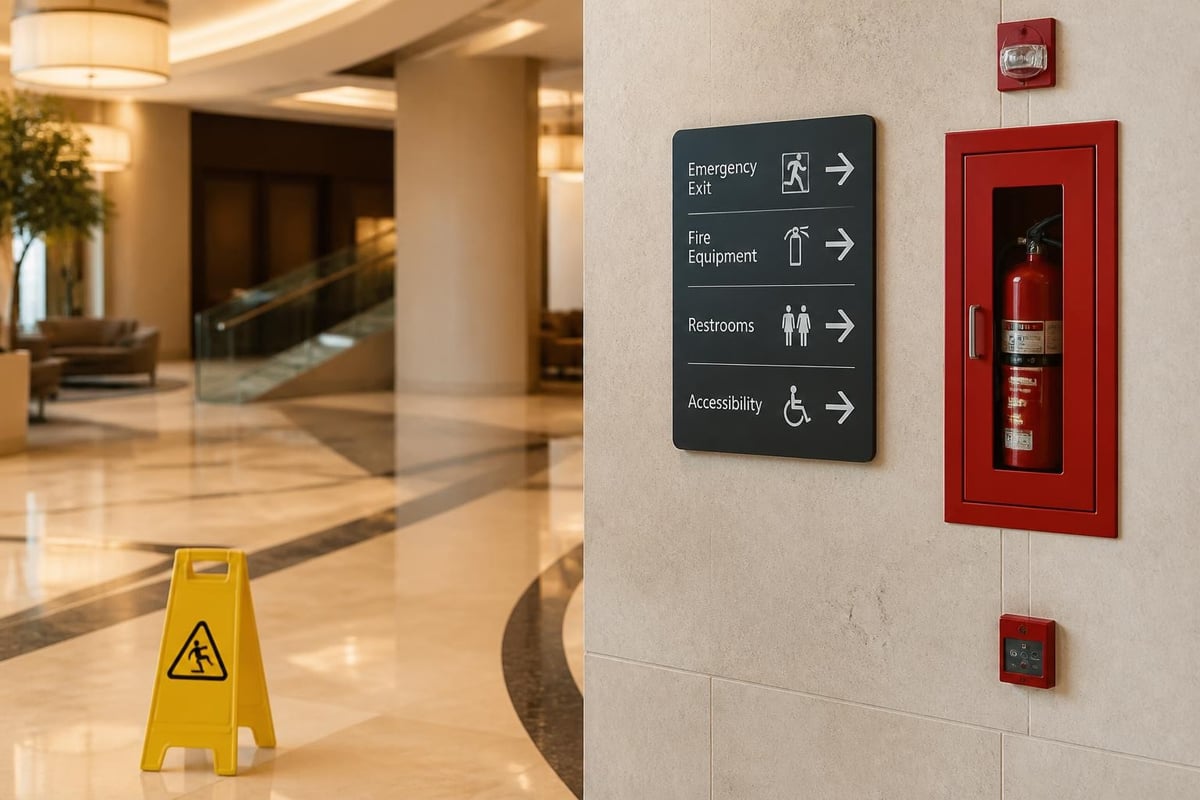
Customer-facing wet floor warnings, automatic door alerts, and accessibility information all contribute to public safety. The industry solutions approach recognises these diverse needs across different sectors.
Material Selection and Durability Factors
The physical construction of all safety signs significantly impacts their long-term effectiveness and compliance. Material selection must balance visibility, durability, environmental resistance, and cost considerations.
Common Safety Sign Materials
Aluminium composite panels offer excellent durability for outdoor applications whilst remaining lightweight for easy installation. These materials resist corrosion, maintain colour integrity, and withstand extreme temperature variations common in South African climates.
Self-adhesive vinyl signs provide cost-effective solutions for temporary applications or indoor environments with controlled conditions. However, outdoor exposure rapidly degrades adhesive vinyl, requiring more frequent replacement cycles.
| Material Type | Typical Lifespan | Best Applications | Limitations |
|---|---|---|---|
| Aluminium composite | 10-15 years | Outdoor permanent signs | Higher initial cost |
| Rigid PVC | 5-8 years | Indoor and protected outdoor | UV degradation |
| Self-adhesive vinyl | 1-3 years | Temporary applications | Weather sensitivity |
| Photoluminescent | 10+ years | Emergency exit routes | Requires light charging |
Reflective and High-Visibility Options
Traffic management and vehicle operation areas benefit from reflective safety signs that maintain visibility during low-light conditions. Retroreflective materials bounce light back toward its source, ensuring drivers and equipment operators clearly see warnings.
High-visibility colour combinations extend recognition distances significantly. Fluorescent backgrounds combined with contrasting symbols create attention-grabbing signs that communicate urgency effectively.
The regulations category explores how material specifications interact with compliance requirements across different jurisdictions and industry sectors.
Maintenance and Lifecycle Management
Installing all safety signs represents only the beginning of an effective safety communication programme. Regular maintenance, inspection, and replacement ensure signage remains effective throughout its service life.
Inspection Schedules and Protocols
Monthly visual inspections identify obvious damage, fading, or obstruction issues requiring immediate attention. Quarterly detailed inspections assess mounting integrity, reflectivity levels, and photoluminescent charge capacity.
Comprehensive inspection checklists should include:
- Physical damage from impacts or vandalism
- Colour fading from UV exposure
- Mounting bracket security and stability
- Obstruction from equipment, inventory, or vegetation
- Reflectivity degradation on traffic signs
- Photoluminescent charging and glow performance
Documentation of inspection findings creates auditable compliance trails demonstrating due diligence. Many organisations integrate safety sign inspections into broader facility maintenance management systems.
Replacement Criteria and Upgrade Schedules
Faded signs that no longer meet minimum colour saturation standards require immediate replacement regardless of physical condition. Safety communication effectiveness depends entirely on instant recognition and comprehension.
Technology advances periodically offer opportunities to upgrade safety signage systems. The transition from traditional pictograms to ISO 7010 standardised symbols represents one such upgrade cycle many organisations have navigated recently.
Budget planning should incorporate predictable replacement cycles based on material specifications and environmental exposure. Proactive replacement prevents compliance gaps and maintains consistent safety communication.
Training and Cultural Integration
Even the most comprehensive collection of all safety signs proves ineffective without proper workforce training and cultural integration. Signs supplement rather than replace safety education and awareness programmes.
Induction and Ongoing Education
New employee inductions must include thorough orientation to facility-specific safety signage systems. Walking through actual locations whilst explaining sign meanings creates stronger retention than classroom presentations alone.
Multilingual workforces benefit from training materials presenting safety signs alongside explanations in multiple languages. Whilst standardised symbols transcend language barriers, reinforcing meanings through native language instruction enhances comprehension and compliance.
Effective training programmes incorporate:
- Site-specific hazard walk-throughs
- Symbol recognition exercises and testing
- Emergency response procedure integration
- Cultural sensitivity considerations
- Regular refresher sessions
Creating Safety-Conscious Work Environments
All safety signs work most effectively within cultures that genuinely value safety over production pressure. Leadership commitment to safety principles encourages workforce engagement with signage systems.
Near-miss reporting systems often identify inadequate or missing safety signage before serious incidents occur. Encouraging workers to report signage issues creates continuous improvement feedback loops.
Recognition programmes celebrating safety awareness reinforce the importance of observing and complying with all safety signs. Positive reinforcement proves more effective than purely punitive approaches to compliance.
Technology Integration and Digital Alternatives
Modern technology offers innovative alternatives to traditional static safety signage in certain applications. Digital displays provide dynamic content capabilities whilst maintaining core safety communication functions.
Smart Safety Signage Systems
Internet-connected digital signs can display contextual warnings based on real-time conditions. Chemical storage areas might display different warnings depending on currently stored substances, whilst manufacturing zones adapt signage to active production runs.
Integration with building management systems enables automatic emergency response signage updates. Fire alarm activation can trigger dynamic exit route signage directing people away from affected areas toward safe evacuation paths.
Environmental sensors monitoring air quality, temperature, or gas concentrations can trigger automated warning sign activation. This real-time responsiveness exceeds static signage capabilities significantly.
Hybrid Approaches and Backup Systems
Critical safety communications require redundancy ensuring sign visibility regardless of power availability or system failures. Digital signs in emergency exit routes should incorporate photoluminescent backup elements maintaining basic guidance during power outages.
The LED signage category explores how modern illuminated signage technologies enhance safety communication whilst offering energy efficiency and extended operational lifespans.
Understanding and implementing all safety signs correctly creates safer workplaces whilst demonstrating regulatory compliance and organisational commitment to employee wellbeing. The comprehensive signage systems discussed throughout this guide form essential components of effective safety management across every industry sector. Whether you require traditional static signs, modern digital alternatives, or integrated hybrid systems, partnering with experienced signage professionals ensures your safety communication meets both current standards and future operational needs. Signs4SA delivers comprehensive safety signage solutions backed by manufacturing expertise and deep understanding of regulatory requirements across corporate, retail, construction, and pharmaceutical sectors throughout South Africa.