


Retail Store Digital Signage: Complete 2026 Guide
The retail landscape has undergone a dramatic transformation over the past decade, with customer expectations rising alongside technological capabilities. Retail store digital signage has emerged as a critical component in creating engaging shopping experiences that bridge the gap between physical and digital commerce. From dynamic promotional displays to interactive wayfinding solutions, these systems have become essential tools for retailers seeking to capture attention, communicate effectively, and ultimately drive sales in an increasingly competitive marketplace.
The Evolution of In-Store Communication
Traditional static signage has served retailers well for generations, but the limitations become apparent in today's fast-paced retail environment. Printed posters cannot respond to real-time inventory changes, weather conditions, or customer demographics. This inflexibility results in missed opportunities and inefficient marketing spend.
Digital displays have revolutionised how retailers communicate with shoppers by enabling instant content updates across single locations or entire chains. A promotion that performed poorly in morning hours can be replaced by mid-afternoon, whilst seasonal messaging can adapt to sudden weather changes. This agility represents a fundamental shift in retail marketing strategy.
Real-Time Responsiveness
The ability to update messaging instantaneously creates unprecedented opportunities for retailers. When inventory levels drop below threshold points, digital signage can automatically shift focus to alternative products. During unexpected weather events, relevant merchandise can be promoted immediately rather than waiting days for printed materials.
Modern retail store digital signage systems integrate with inventory management platforms, point-of-sale systems, and customer relationship databases. These connections enable sophisticated targeting strategies that would be impossible with traditional signage approaches.

Strategic Placement for Maximum Impact
The effectiveness of retail store digital signage depends heavily on strategic positioning within the store environment. Digital signage placement strategies significantly influence customer engagement and conversion rates.
High-Impact Locations:
- Entrance areas where first impressions form
- Queue lines where dwell time is guaranteed
- End caps and feature displays
- Fitting room areas during wait times
- Checkout zones for last-minute promotions
- Window displays attracting foot traffic
Research indicates that displays positioned at eye level receive 40% more attention than those mounted too high or too low. The optimal viewing distance varies with screen size, but most retail installations benefit from positioning screens 1.5 to 2 metres from the floor.
Traffic Flow Considerations
Understanding customer movement patterns within retail spaces enables optimal screen placement. Heat mapping technology reveals where shoppers naturally pause, turn, or slow their pace. These moments of reduced movement create ideal opportunities for message absorption.
Corner positions naturally draw attention as customers navigate turns, whilst long corridors benefit from multiple smaller screens rather than single large displays. The psychology of colour in signage design plays an equally important role in capturing and maintaining viewer attention.
| Placement Zone | Average Dwell Time | Conversion Impact | Best Content Type |
|---|---|---|---|
| Store entrance | 3-5 seconds | Brand awareness | Welcome messages, promotions |
| Queue lines | 2-4 minutes | High conversion | Product details, add-ons |
| Product aisles | 10-30 seconds | Medium conversion | Category promotions |
| Fitting rooms | 3-8 minutes | Medium conversion | Style suggestions, accessories |
| Checkout | 1-3 minutes | Impulse purchases | Small items, loyalty programmes |
Content Strategies That Drive Engagement
Creating compelling content represents the most challenging aspect of retail store digital signage implementation. Screens without relevant, dynamic content quickly fade into background noise, becoming invisible to shoppers despite significant investment.
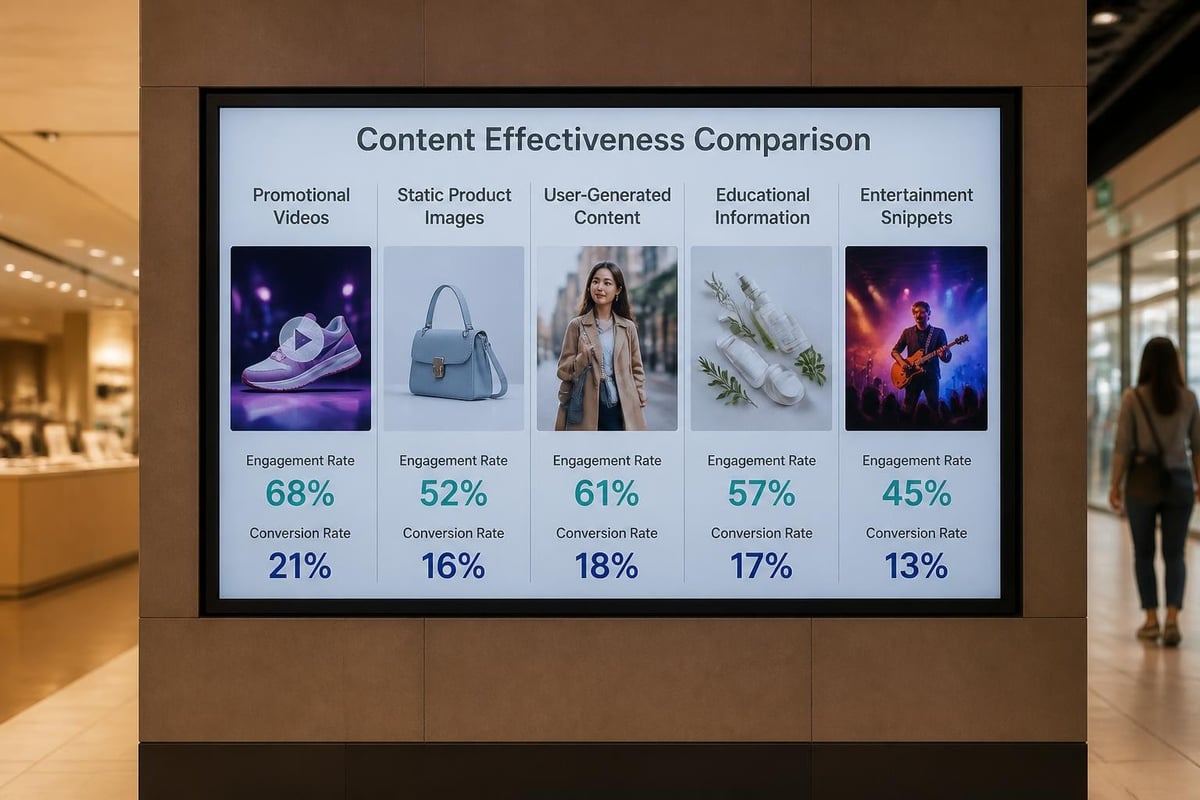
Successful content strategies balance promotional messaging with value-added information. Customers appreciate content that enhances their shopping experience rather than simply pushing sales messages. Weather forecasts, local news snippets, entertainment content, and practical tips create positive associations with the brand whilst maintaining engagement.
The 70-20-10 Content Rule
Industry experts recommend allocating content screen time using a balanced approach:
- 70% promotional content directly related to products and sales
- 20% informational content that adds value to the shopping experience
- 10% entertainment content that captures attention and creates dwell time
This distribution prevents promotional fatigue whilst maintaining commercial effectiveness. Retail digital signage best practices demonstrate that varied content types significantly increase message retention compared to purely promotional approaches.
Motion graphics outperform static images by capturing peripheral vision and drawing eyes to screens. However, excessive movement creates visual clutter and can overwhelm shoppers. The optimal approach uses subtle animation that attracts attention without causing distraction.
Technology Selection and Specifications
Choosing appropriate hardware for retail environments requires careful consideration of multiple factors beyond simple screen size. Ambient lighting conditions, viewing distances, installation locations, and operational hours all influence technology decisions.
Display Technology Comparison:
| Technology | Brightness | Lifespan | Cost | Best Application |
|---|---|---|---|---|
| LCD Commercial | 400-700 nits | 50,000 hrs | Medium | Indoor, controlled lighting |
| LED Direct View | 1,000-5,000 nits | 100,000 hrs | High | Windows, high ambient light |
| Transparent LED | 800-1,200 nits | 80,000 hrs | Very High | Window displays |
| Interactive Touch | 300-500 nits | 30,000 hrs | Medium-High | Product information kiosks |
Signs4SA offers a comprehensive Digital Signage range from P10 to P1.8, suitable for both internal and external retail applications. Their expertise in tailoring solutions to specific retail environments ensures optimal performance and return on investment.
Resolution and Pixel Pitch Considerations
The relationship between viewing distance and pixel pitch determines image clarity. Retail store digital signage positioned within 2 metres requires finer pixel pitch (P2.5 or better) to prevent visible pixelation. Displays viewed from 5 metres or greater can utilise larger pixel pitch (P6-P10) without compromising image quality.
Resolution requirements also depend on content types. Product photography and video content demand higher resolution than text-based messaging. Mixed content strategies benefit from displays capable of rendering detailed imagery whilst maintaining readability for text elements.
Measuring Return on Investment
Quantifying the impact of retail store digital signage requires establishing clear metrics before implementation. Unlike traditional signage, digital systems generate data that enables precise performance measurement and continuous optimisation.
Key Performance Indicators:
- Conversion rate changes in areas with digital signage
- Average transaction value before and after implementation
- Dwell time increases near promotional displays
- Product awareness through customer surveys
- Social media engagement with screen content
- Foot traffic patterns influenced by window displays
Case studies from retail implementations demonstrate average sales increases of 15-30% for products actively promoted through digital signage. These impressive results stem from the combination of visual impact, timely messaging, and strategic positioning.
Attribution Modelling
Understanding which touchpoints contribute to purchase decisions helps optimise content and placement strategies. Modern retail store digital signage platforms integrate with customer tracking systems to map journey paths from initial exposure through to transaction.
Anonymous tracking technologies reveal how long customers view specific content, whether they proceed to featured product locations, and if viewing correlates with purchase behaviour. This data enables A/B testing of different creative approaches and messaging strategies.
Retailers can measure performance at granular levels, comparing individual screen effectiveness, content variations, and time-of-day scheduling impacts. These insights drive continuous improvement in both content creation and system deployment.
Integration with Broader Retail Systems
The true power of retail store digital signage emerges when systems connect with existing retail technology infrastructure. Isolated displays deliver value, but integrated networks create synergies that multiply effectiveness.
Modern implementations link with inventory management platforms to automatically adjust promotions based on stock levels. When popular items run low, the system shifts promotional focus to alternative products with healthy inventory. This prevents customer disappointment whilst maximising sales opportunities across the entire product range.
Customer Data Platform Connections
Sophisticated retailers integrate digital signage with customer data platforms to enable demographic-based messaging. When the majority of customers in-store belong to specific age groups or shopping patterns, content automatically adjusts to match preferences and purchase history.
Privacy regulations require careful implementation, but anonymised demographic data from loyalty programmes and payment systems provides valuable targeting insights. Morning shoppers often differ significantly from evening customers, warranting distinct promotional approaches.
Point-of-sale integration enables real-time performance feedback. When specific products experience purchase spikes following promotion on digital displays, the system recognises successful messaging and extends or repeats effective campaigns. Similarly, underperforming content receives reduced screen time or replacement.
Much like how Energy Warehouse streamlines electrical compliance through digital platforms, retail signage systems benefit from centralised management that ensures consistency whilst enabling local customisation. This balance between standardisation and flexibility proves essential for multi-location retailers.

Content Management and Scheduling
Effective retail store digital signage requires robust content management systems that balance ease of use with sophisticated capabilities. Store managers need simple interfaces for quick updates, whilst marketing teams require advanced scheduling and targeting features.
Essential Content Management Features:
- Drag-and-drop playlist creation
- Multi-location content distribution
- Time-based scheduling with dayparting
- Emergency override capabilities
- Template libraries for quick creation
- Approval workflows for brand consistency
- Performance analytics dashboards
- Asset libraries with version control
Cloud-based platforms enable centralised control across retail chains whilst allowing individual store customisation. Head office teams can push brand campaigns to all locations, whilst store managers overlay local promotions and community-specific messaging.
Automated Content Triggers
Advanced systems respond to external data sources automatically. Weather-triggered content promotes umbrellas during rain, cold weather activates heating product promotions, and sunny conditions feature outdoor merchandise. This responsiveness creates relevant shopping experiences that feel personalised despite automation.
Calendar-based triggers ensure holiday content activates at appropriate times without manual intervention. Back-to-school campaigns, seasonal events, and cultural celebrations receive timely promotion through pre-scheduled content strategies. Marketing teams can plan campaigns months in advance with confidence in accurate execution.
Retailers exploring LED signage benefits discover that modern LED displays offer superior energy efficiency alongside improved brightness and longevity compared to previous generation technologies.
Interactive Experiences and Customer Engagement
Static content on digital displays represents just the beginning of retail store digital signage capabilities. Interactive touchscreens transform passive viewing into active engagement, creating memorable experiences that strengthen brand connections.
Product information kiosks enable customers to access detailed specifications, customer reviews, and comparison data without staff assistance. This self-service approach appeals to shoppers who prefer independent research whilst freeing staff to assist customers with more complex needs.
Virtual Try-On and Visualisation
Augmented reality applications within digital signage allow customers to visualise products in their own environments. Furniture retailers enable room planning, paint suppliers offer wall colour previews, and fashion retailers provide virtual fitting room experiences. These interactive tools reduce purchase hesitation and return rates simultaneously.
The integration of QR codes bridges physical and digital experiences. Customers scan codes displayed on screens to send product information to personal devices, enabling continued research at home and reducing abandoned purchases due to information gaps.
Social media integration encourages user-generated content sharing. Displays featuring customer photos and reviews create authentic endorsements whilst incentivising social sharing. Hashtag campaigns turn customers into brand ambassadors, extending reach beyond physical store boundaries.
Maintenance and Longevity Considerations
Retail environments present challenging operating conditions for electronic equipment. Continuous operation, varying temperatures, dust exposure, and occasional physical contact require robust hardware and proactive maintenance strategies.
Commercial-grade displays designed for 24/7 operation significantly outlast consumer televisions adapted for retail use. The initial cost premium for commercial equipment delivers substantial long-term savings through extended lifespan and reduced failure rates.
Maintenance Schedule Recommendations:
- Daily: Visual inspection for display anomalies
- Weekly: Screen cleaning and content verification
- Monthly: Connection checks and software updates
- Quarterly: Detailed system diagnostics
- Annually: Professional servicing and calibration
Remote monitoring capabilities enable proactive issue identification before customers notice problems. Systems can alert maintenance teams to failing components, connectivity issues, or content playback errors automatically. This approach minimises downtime and maintains professional presentation standards.
Understanding signage maintenance for long-term performance helps retailers protect their investment and ensure consistent operation throughout the system's lifecycle.
Regulatory and Safety Compliance
Retail store digital signage installations must comply with various regulations governing electrical safety, accessibility, and content standards. Local authorities enforce building codes that specify mounting requirements, electrical installations, and emergency egress considerations.
Electrical compliance requires certified installations meeting South African National Standards. Professional installers ensure proper grounding, circuit protection, and fire safety measures. Just as platforms like Energy Warehouse help electricians maintain SANS 10142-1 compliance for certificates of compliance, digital signage installations require similar rigorous adherence to electrical standards.
Accessibility Requirements
Digital signage must accommodate customers with various disabilities. Audio descriptions assist visually impaired shoppers, whilst hearing loops support those with hearing difficulties. Screen positioning must not obstruct wheelchair access or create navigation hazards.
Content flashing at certain frequencies can trigger photosensitive epilepsy, requiring careful design consideration. Industry standards recommend avoiding rapid flashing elements and providing alternative content delivery methods for sensitive individuals.
Brightness levels require balancing visibility against potential disturbance. Window displays utilise high-brightness panels for daytime visibility but should dim during evening hours to prevent light pollution complaints from neighbouring properties.
Future Trends Shaping Retail Digital Signage
The retail store digital signage landscape continues evolving rapidly as new technologies emerge and customer expectations shift. Understanding upcoming trends helps retailers plan investments that remain relevant and competitive.
Artificial intelligence integration enables unprecedented personalisation capabilities. Computer vision systems analyse customer demographics in real-time, adjusting content to match viewer profiles without compromising privacy. These systems recognise general characteristics like age ranges and gender without identifying specific individuals.
Emerging Technologies:
- Transparent OLED displays for window applications
- Ultra-fine pixel pitch LED for close viewing
- Gesture control interfaces for touchless interaction
- Voice-activated product information systems
- Augmented reality shopping assistants
- Holographic product displays
- Scent-enabled multi-sensory experiences
Sustainability considerations increasingly influence technology choices. Energy-efficient LED technology reduces operational costs whilst supporting environmental commitments. Solar-powered displays enable off-grid installations, whilst recyclable materials minimise environmental impact at end-of-life.
The convergence of online and offline retail experiences drives demand for seamless integration between digital signage, mobile applications, and e-commerce platforms. Customers expect consistent messaging and pricing across all touchpoints, requiring sophisticated content management and inventory synchronisation.
For businesses seeking to understand how outdoor signage attracts customers, digital displays offer unique advantages in capturing attention and communicating complex messages effectively.
Overcoming Implementation Challenges
Despite compelling benefits, retail store digital signage implementations face various obstacles that require careful planning and expert guidance. Budget constraints, technical complexity, and organisational resistance represent common challenges that successful projects navigate strategically.
| Challenge | Impact | Solution Strategy |
|---|---|---|
| High initial costs | Delayed adoption | Phased rollout, ROI demonstration |
| Content creation capacity | Poor utilisation | Template systems, external partners |
| Technical expertise gaps | Operational issues | Training programmes, support contracts |
| Integration complexity | Limited functionality | Experienced implementation partners |
| Organisational resistance | Slow adoption | Pilot programmes, stakeholder engagement |
Starting with pilot installations in high-traffic locations demonstrates value before chain-wide deployment. These initial implementations provide learning opportunities whilst generating performance data that justifies broader investment.
Partner Selection Criteria
Choosing experienced implementation partners significantly influences project success. Retailers should evaluate potential partners on technical expertise, industry experience, support capabilities, and financial stability. The cheapest option frequently becomes expensive through extended timelines, poor performance, and inadequate support.
Comprehensive proposals should address hardware specifications, software capabilities, installation processes, training programmes, maintenance plans, and upgrade paths. Clear service level agreements protect retailers from prolonged downtime and ensure responsive technical support.
Working with established providers like Signs4SA ensures access to professional expertise backed by proven project delivery capabilities and ongoing support infrastructure.
Retail store digital signage represents a transformative technology that enhances customer experiences whilst driving measurable business results. Success requires strategic planning, quality hardware selection, compelling content creation, and ongoing optimisation based on performance data. Signs4SA brings extensive experience in delivering professional digital signage solutions tailored to retail environments across South Africa, supported by technical expertise and comprehensive support services that ensure your investment delivers sustained value for years to come.