


Outside Office Sign Guide for South African Businesses
An outside office sign identifies your business from the street, and in South Africa it must be durable, legible and, in most municipalities, approved by the local authority before it goes up. Getting the type, material, size and approval route right at the start avoids rejected applications, fading, rust and costly replacements.
This guide covers the main sign types, the materials that survive South African sun and coastal air, how to size a sign for readability, and what the by-laws expect. It is written for business owners, retailers and property managers who need branded signage for premises, and for facility and construction managers who need signs that are safe and compliant.
What an Outside Office Sign Needs to Achieve
A good exterior sign does three jobs: it tells visitors they have arrived, it communicates your brand in a few seconds, and it stays in good repair for years.
Each job places a different demand on the sign:
- Identification: the business name must be readable from the pavement, the car park entrance or passing traffic.
- Brand consistency: colours, typeface and logo should match your reception area, vehicles and stationery, so the premises feel like one coherent business.
- Durability: the sign must withstand UV exposure, rain, wind and, near the coast, salt-laden air.
- Compliance: the sign must meet municipal by-laws and any road authority requirements.
Treating these as a single brief, rather than as separate purchases, produces a sign that works on day one and still looks professional in year five.
Types of Outside Office Sign and Where Each Works
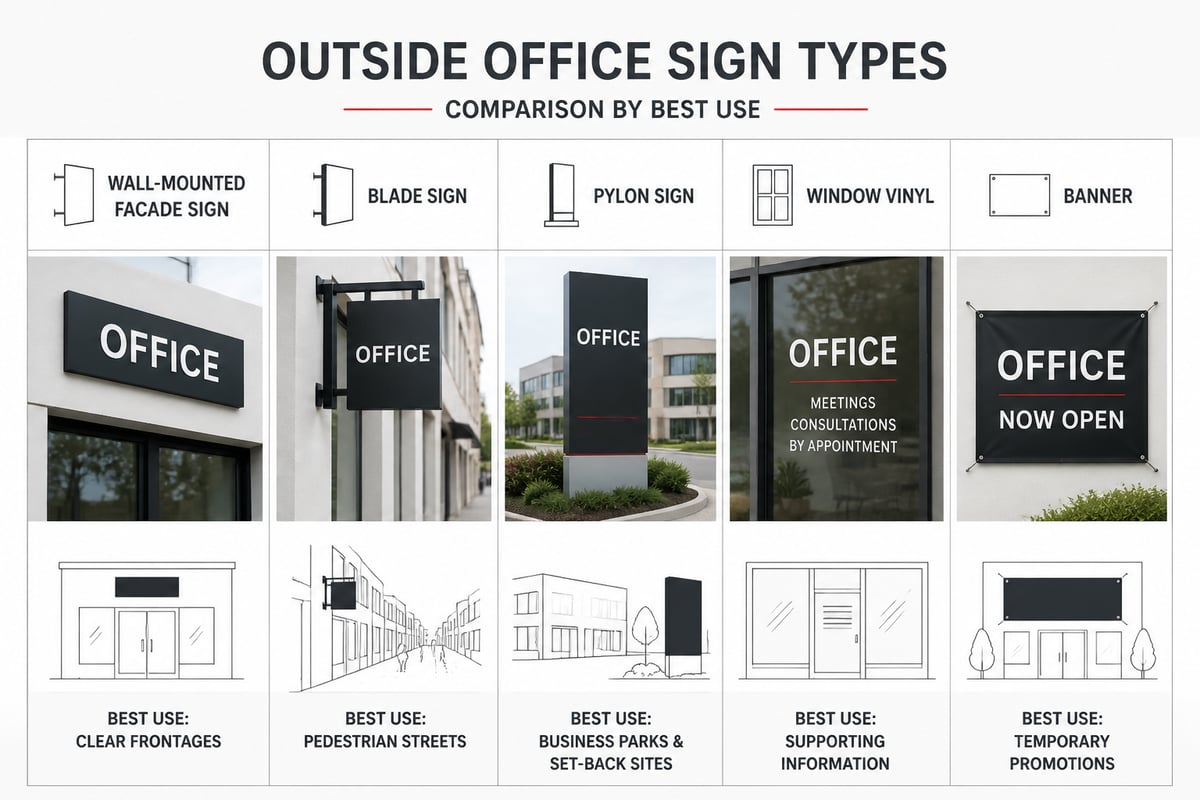
The right sign type depends on your building, your frontage and how people approach it. The options below cover the majority of South African office, retail and industrial premises.
Wall-mounted and facade signs
Flat signs fixed directly to the building are the most common choice for offices. They suit buildings with a clear, uncluttered facade and work well with individual cut-out letters, aluminium composite panels or illuminated lettering. Their weakness is angle: they are hard to read from a side approach.
Blade and projecting signs
These project at right angles from the wall, so they are visible to pedestrians walking along the street from either direction. They suit shopfronts, medical suites and offices in dense business districts where foot traffic is the main source of visitors.
Freestanding and pylon signs
For business parks, industrial sites and premises set back from the road, a freestanding structure is often the only way to be seen early enough. A pylon can carry a single tenant or list several, and it can be illuminated for evening visibility. Signs4SA offers bespoke pylon signage designed and manufactured to a client's specification, which suits multi-tenant parks and sites where the building itself sits too far back to carry a readable sign.
Window and glass signage
Vinyl graphics on glazing are an economical way to add a name, opening hours or a logo. They complement a main sign rather than replace one, and they carry less weight in the approval process in some municipalities, though you should confirm this locally.
Banners and temporary signs
Banners suit launches, relocations and seasonal promotions. They are not a substitute for a permanent sign, and temporary advertising can still fall under by-law control, so check before hanging one on a boundary wall or fence.
Rules and Approvals for an Outside Office Sign in South Africa
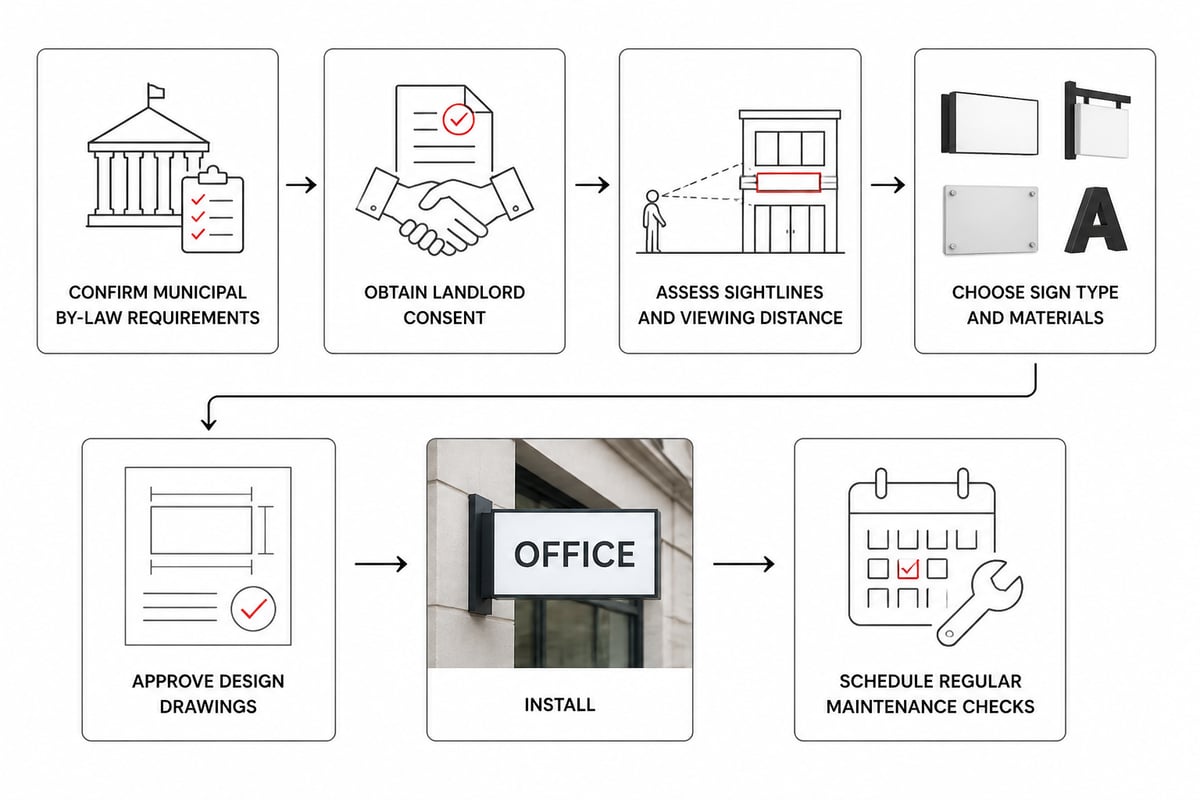
Outdoor signs in South Africa are generally governed by the local authority's outdoor-advertising by-laws, so approval is normally required before installation. The Tourism Knowledge Portal notes that approval from other road authorities may also be needed where a sign is visible from a provincial or national road.
Requirements differ from one municipality to the next, so the first step is always to contact your local authority. Cape Town offers a useful example of how detailed these rules can be. The City of Cape Town lists flat, projected and projecting signs, locality-bound freestanding signs, roof signs, and boundary-wall and fence signs among the sign types that require an application. The city has also approved a replacement outdoor-advertising by-law for outdoor advertising.
Practical points to settle before you order:
- Confirm whether your sign type needs an application in your municipality.
- Check whether your building is in a heritage area or a controlled zone with extra restrictions.
- Ask your landlord or body corporate for written permission if you lease the premises or share a facade.
- Establish whether the sign is visible from a provincial or national road, which may bring a second authority into the process.
- Keep approved drawings on file, because they are useful at renewal and during any dispute.
A signage manufacturer that handles design, manufacture and installation in-house can prepare accurate drawings and specifications for your application, which reduces back-and-forth with the municipality.
Materials That Last in South African Conditions
Material choice determines how long your sign looks professional, and the climate here is demanding. High UV levels fade cheap vinyl and printed panels, coastal salt accelerates corrosion, and summer storms put real load on fixings.
| Material | Strengths | Limitations |
|---|---|---|
| Aluminium composite panel | Flat, light, weather-resistant, takes full-colour graphics | Edges need sealing; large panels need a solid frame |
| Stainless steel letters | Corrosion-resistant, premium look | Higher cost; surface marks show on brushed finishes |
| Acrylic | Crisp edges, works well for illuminated and backlit letters | Can scratch; needs UV-stable grades outdoors |
| Powder-coated steel | Strong, suits large structures and pylons | Needs sound coating to prevent rust |
| Printed vinyl | Economical, easy to update | Shortest lifespan in direct sun |
The Tourism Knowledge Portal recommends durable sign materials, corrosion prevention and regular servicing, and it assigns maintenance responsibility to both the sign owner and the property owner. That shared duty is worth writing into your lease or service agreement so nobody assumes someone else is checking the sign.
Structural safety matters as much as appearance. The same source states that signs and supporting structures should be safely made and able to support twice their weight, in addition to forces such as wind pressure. For anything large, heavy or mounted at height, insist on engineered fixings and an installer who can explain how the structure was specified.
Size, Placement and Legibility
A sign is only effective if it can be read in the time a passer-by has to read it. The practical aim is to keep the message short, the contrast high and the lettering large enough for the viewing distance.
Consider these principles when specifying size:
- Viewing distance drives letter height. A sign read from a slow-moving car at 50 metres needs far taller lettering than one read by pedestrians at 5 metres.
- Contrast beats decoration. Dark lettering on a light background, or the reverse, outperforms low-contrast brand palettes. If your logo colours are subtle, place them on a contrasting panel.
- Limit the words. Business name, a short descriptor and perhaps a street number is usually enough. Telephone numbers rarely belong on a facade sign.
- Mind the sightlines. Trees, boundary walls, parked vehicles and neighbouring signs can all hide a sign that looks prominent on a drawing.
- Mount at the height people look. Place primary signage where the eye naturally falls, avoiding areas obscured by awnings, gutters or security features.
Visit the site at the times your visitors arrive, in morning glare and at dusk, and photograph the approach from the road. A simple mock-up in a design file, overlaid on those photographs, shows problems well before fabrication begins.
Lighting and Visibility After Dark
Lighting extends your sign's working hours, which matters for businesses that operate in the evening and for premises in areas with early winter darkness. Illumination options include internally lit light boxes, backlit channel letters, halo-lit lettering and external flood or spot lighting.
Internal and backlit lighting give a clean, even glow and are well suited to corporate facades. External lighting costs less up front but can produce glare and uneven illumination if poorly aimed. LED sources are now the standard choice because they draw little power and last for many years, which matters in a country where electricity costs and supply interruptions affect running costs.
Two practical considerations apply. First, illuminated signs are often subject to additional conditions in by-laws, particularly near roads, so declare lighting in your application. Second, plan for load shedding: a sign that depends entirely on mains power disappears during an outage. Where after-dark visibility is important, a reflective sign face or a low-draw backup supply keeps the premises identifiable.
Brand Consistency From Street to Reception
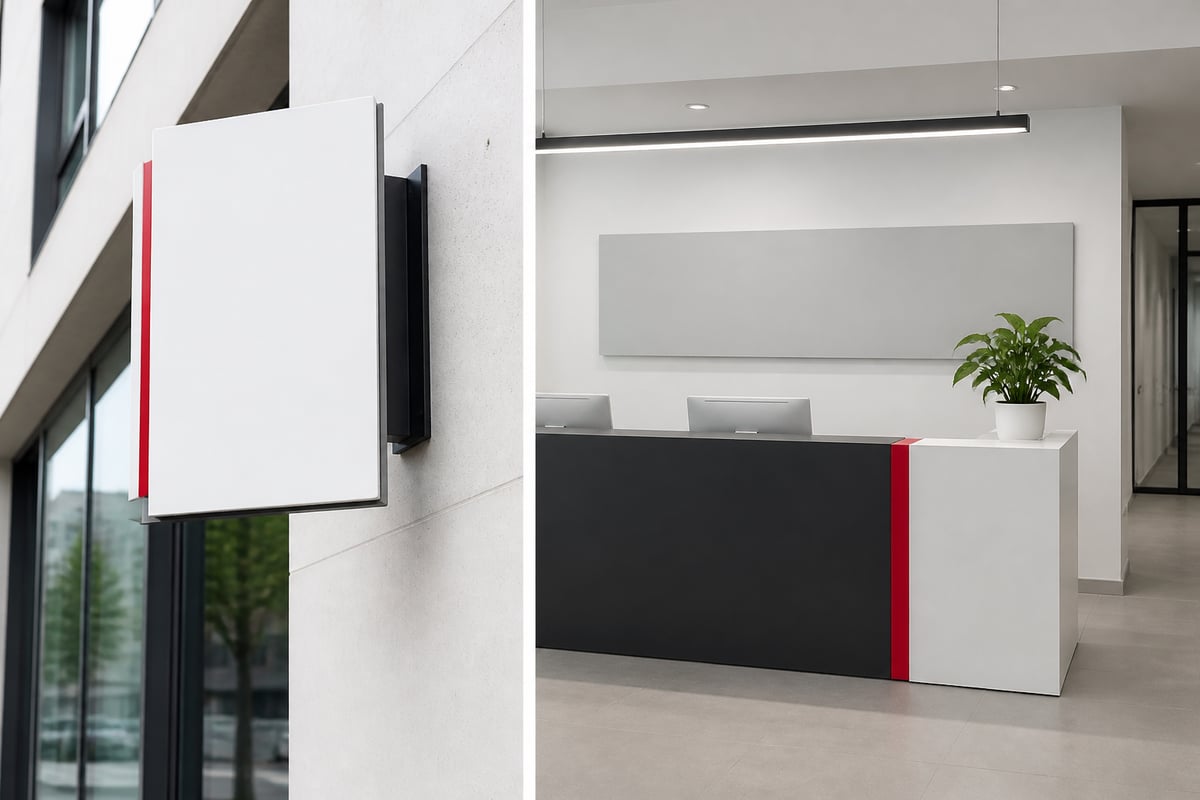
The outside office sign is the first touchpoint, and it should connect visually to what visitors see inside. Matching typefaces, finishes and colours between the facade, the entrance and the reception area signals a well-run business before anyone has spoken to you.
Signs4SA's guide to company signs for the office shows how interior branding supports the same identity, and its custom reception and office signage range lets you carry the exterior design indoors. For larger sites, directional and wayfinding signs guide visitors from the gate to the correct entrance, which reduces confusion and keeps delivery drivers and clients away from restricted areas.
For a wider look at exterior options, the article on business signs for outside covers further formats and use cases.
Safety and Construction Considerations
For facility, safety and construction managers, the outside sign is part of the site's compliance picture, not only its branding. Entrance signage on industrial, construction and pharmaceutical sites often needs to communicate access rules, hazards and emergency information alongside the company name.
Points worth building into the specification:
- Place hazard and access signs at the point of entry, at eye level and in clear view of approaching vehicles and pedestrians.
- Use materials with fade resistance, since a faded warning sign fails its purpose.
- Keep safety messages visually distinct from branding so they are never lost in decoration.
- Record the date of installation and schedule inspections, so damaged or illegible signs are replaced promptly.
- On construction sites, make sure temporary hoarding and project signs are fixed to withstand wind and are removed when the project ends.
Because compliance requirements vary by industry and municipality, confirm the specific standards that apply to your site before finalising the design.
Maintenance Planning for the Life of the Sign
A sign that is installed and forgotten will deteriorate, and in South African conditions that happens faster than most owners expect. A simple maintenance routine protects your investment and keeps the sign compliant.
A practical schedule looks like this:
- Quarterly: wash the face with mild soapy water, remove debris and check for loose fixings or lifting edges.
- Twice a year: inspect illumination, replace failed LEDs, and look for rust streaks or coating breaks on steel and aluminium frames.
- After severe weather: check brackets, anchors and panels for movement or damage.
- Annually: have the structure and electrical connections inspected by a competent person, particularly for freestanding signs and anything mounted at height.
Agree in writing who carries each task. Because maintenance responsibility sits with both the sign owner and the property owner, tenants in shared buildings should clarify the arrangement with the landlord at the outset.
Cost Factors to Budget For
Price depends on a handful of variables rather than on any single standard rate. The main drivers are size, material, illumination, structural complexity, installation height and access, and the extent of any approval or engineering work.
A flat, non-illuminated panel sits at one end of the range, while an illuminated freestanding pylon with foundations and electrical supply sits at the other. When requesting quotations, give each supplier the same brief, including dimensions, materials, lighting and site photographs, so the figures are comparable. For pricing and turnaround on your specific project, speak to Signs4SA directly through its product pages or contact page rather than relying on general estimates.
Choosing a Supplier You Can Rely On
The supplier matters as much as the sign. Look for a manufacturer that handles design, manufacture and installation itself, because that removes the gaps where responsibility is lost between a designer, a fabricator and an installer.
Signs4SA is a professional signage manufacturer based in South Africa, handling manufacture, supply and installation for corporate, retail, construction and pharmaceutical clients. Its work is custom-designed to reflect each business's brand, and the company reports over 80 completed projects and installations.
When assessing any supplier, ask these questions:
- Can they show completed examples of the sign type you need?
- Do they prepare drawings suitable for a municipal application?
- Who is responsible for installation and for making good afterwards?
- What is their approach to aftercare and repairs?
Clear answers to these questions are a better predictor of a trouble-free project than the lowest quotation.
Start by photographing your frontage from the street and confirming with your municipality whether your planned sign needs an application. With that groundwork done, you can brief a supplier accurately and avoid delays. Signs4SA designs, manufactures and installs signage nationwide, including bespoke pylon signage for sites that need visibility from the road, and you can request a quote from Signs4SA to get a specification and price for your premises.