




Stop Sign Standards and Placement for South Africa
The stop sign stands as one of the most recognisable traffic control devices worldwide, commanding drivers to come to a complete halt before proceeding. This seemingly simple regulatory sign carries immense responsibility for road safety, intersection management, and traffic flow optimisation. Understanding the technical specifications, placement standards, and regulatory requirements behind stop signs is essential for traffic engineers, municipal authorities, property developers, and signage professionals who work to create safer road environments across South Africa and internationally.
The Universal Design Standard
The distinctive octagonal shape and red colour scheme of the stop sign has achieved near-universal recognition across the globe. This standardisation stems from international agreements, most notably the Vienna Convention on Road Signs and Signals, which established consistent road signage across signatory nations.
Key design specifications include:
- Octagonal shape (eight equal sides)
- Red background with white border
- White reflective lettering
- Standard size variations depending on road classification
- High-intensity retroreflective sheeting for night visibility
The colour red was specifically chosen for its psychological association with danger and the immediate need for action. This deliberate choice ensures that drivers process the command instantly, even in adverse weather conditions or low-light environments.
Material and Durability Requirements
Modern stop signs must withstand extreme weather conditions, from scorching summer heat to heavy rainfall and wind loading. Professional signage manufacturers use specific materials to ensure longevity:
| Material Component | Purpose | Expected Lifespan |
|---|---|---|
| Aluminium substrate | Lightweight, corrosion-resistant base | 15-20 years |
| High-intensity prismatic sheeting | Retroreflection for night visibility | 10-12 years |
| UV-resistant inks | Colour fastness and fade resistance | 10+ years |
| Galvanised steel posts | Structural support and stability | 20+ years |
The Manual on Uniform Traffic Control Devices provides comprehensive technical guidance on material specifications, though South African standards may differ slightly to accommodate local conditions.

Placement Standards and Engineering Warrants
Installing a stop sign is not a casual decision. Traffic engineers must evaluate specific conditions to determine whether a stop sign represents the most appropriate traffic control measure for a given intersection. The process involves detailed analysis of traffic volumes, collision history, sight distance limitations, and pedestrian activity.
When Stop Signs Are Warranted
Traffic control warrants help professionals make evidence-based decisions about stop sign installation. The Institute of Transportation Engineers provides technical resources that guide these determinations.
Primary warrant considerations include:
- Traffic volume thresholds on both major and minor approaches
- Crash history indicating a pattern of right-angle collisions
- Sight distance restrictions that prevent safe gap acceptance
- Pedestrian crossing needs at unsignalised locations
- Speed differential between intersecting roadways
A 2022 research study evaluating stop sign effectiveness using before-after video analysis demonstrated measurable safety improvements when signs were properly warranted and installed. The research emphasised that inappropriate stop sign installation can actually increase rear-end collisions whilst providing minimal safety benefit.
All-Way Stop Control
Four-way stop intersections represent a specific application requiring careful analysis. The National Academies guidance on local roadway safety outlines the engineering judgement required for all-way stop implementation.
These installations work best when:
- Traffic volumes are roughly balanced between approaches
- Signalisation is not yet warranted
- Intersection geometry creates confusion about right-of-way
- School zones or pedestrian-heavy areas require additional control
Visibility and Retroreflectivity Standards
A stop sign serves no purpose if drivers cannot see it clearly, particularly during night-time hours when visibility challenges increase dramatically. Retroreflectivity ensures that vehicle headlights illuminate the sign, making it visible from appropriate distances.
Modern stop signs use microprismatic or glass bead technology embedded within the sheeting material. When light strikes the surface, it reflects directly back to the source, creating a bright, easily visible sign even in darkness.
Minimum retroreflectivity requirements vary by sign type and road classification:
- Regulatory signs (including stop signs): 50 cd/lx/m² for red backgrounds
- White legend on red: 250 cd/lx/m²
- Rural high-speed roads: Higher standards apply
- Urban low-speed roads: Standard specifications acceptable
Regular maintenance programmes should include retroreflectivity testing to ensure signs meet minimum standards. Signs failing to meet thresholds require immediate replacement to maintain safety standards, particularly along routes featured in safety signage compliance programmes.

Placement Height and Lateral Position
Precise placement ensures optimal visibility whilst avoiding conflicts with other roadside elements. Standard mounting heights range from 2.1 to 2.4 metres measured from the bottom of the sign to the road surface. This positioning places the sign within drivers' normal cone of vision without requiring excessive head movement.
Lateral placement from the edge of the carriageway typically ranges from 1.8 to 3.6 metres, depending on:
- Shoulder width and roadside clear zone requirements
- Presence of pedestrian facilities
- Utility poles or other fixed objects
- Sight distance considerations at the intersection
Accessibility and Inclusive Design
Modern traffic control extends beyond vehicle operators to encompass all road users, including pedestrians with visual impairments, elderly citizens, and children. The U.S. Access Board standards provide guidance on creating accessible pedestrian environments at controlled intersections.
| Accessibility Feature | Purpose | Implementation |
|---|---|---|
| High-contrast colours | Assists low-vision users | Red/white combination |
| Consistent placement | Aids recognition | Standardised mounting height |
| Clear sight lines | Benefits all users | Vegetation management |
| Tactile paving | Warns visually impaired pedestrians | Detectable warning surfaces |
Whilst the stop sign itself primarily serves vehicle operators, the intersection design around it must consider pedestrian crossing facilities, audible signals where warranted, and adequate crossing times for users with mobility limitations.
Font Specifications and Legibility
The word "STOP" appears in specific font sizing calculated to ensure legibility from appropriate decision distances. For standard 750mm signs, lettering height measures 250mm. Larger signs used on higher-speed roads feature proportionally larger lettering to maintain visibility at greater distances.
The font style uses clean, bold characters with high stroke-width-to-height ratios. This design maximises legibility even when signs accumulate dirt, suffer minor damage, or when viewing occurs at acute angles.
Installation Considerations for Commercial Properties
Private property owners, shopping centres, industrial estates, and residential complexes frequently require stop signs to manage internal traffic circulation. These installations must balance regulatory compliance with property-specific needs whilst ensuring consistency with public road standards.
Professional installation involves several critical steps:
- Site assessment to determine optimal placement
- Foundation preparation ensuring stable mounting
- Post installation with appropriate embedment depth
- Sign mounting at correct height and orientation
- Verification of visibility from approach distances
For businesses requiring robust wayfinding and traffic management, solutions such as pylon signage can complement regulatory signs whilst maintaining visual consistency across the property. This integrated approach ensures both safety compliance and brand coherence.
Commercial property managers should consult with professional signage providers to ensure installations meet both legal requirements and insurance stipulations. Liability concerns make proper stop sign installation a critical risk management consideration.
Maintenance and Replacement Cycles
Stop signs face constant exposure to environmental stressors that gradually degrade their effectiveness. A proactive maintenance programme prevents safety gaps and ensures ongoing compliance with visibility standards.
Common degradation factors include:
- UV radiation causing colour fading
- Physical damage from vehicle strikes or vandalism
- Retroreflectivity loss from weathering
- Structural corrosion of posts and mounting hardware
- Vegetation encroachment blocking visibility
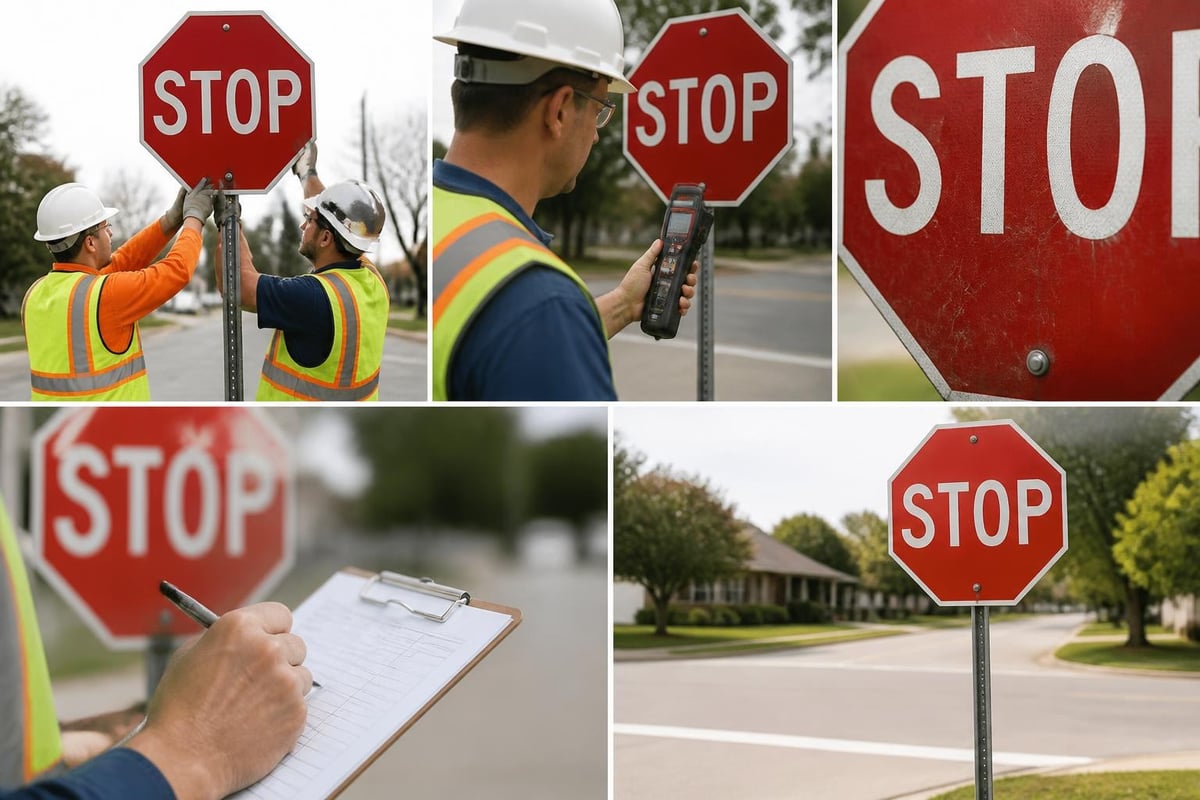
Regular inspection cycles should occur at minimum annually, with more frequent checks in high-traffic areas or locations with known visibility challenges. Many jurisdictions now use retroreflectivity measurement devices to objectively assess sign condition rather than relying on subjective visual inspection.
Documentation and Asset Management
Municipalities and large property owners benefit from maintaining comprehensive sign inventories documenting:
- Installation date and initial specifications
- Maintenance history and retroreflectivity readings
- Replacement schedules based on expected service life
- Warranty information from manufacturers
- Compliance certifications and testing records
This systematic approach ensures no signs fall through maintenance cracks, reducing liability exposure and maintaining consistent safety standards across the road network. Digital asset management systems increasingly support these programmes, allowing GPS-tagged inventories and automated replacement scheduling.
Multi-Way Stop Intersections and Driver Behaviour
The effectiveness of stop sign control depends heavily on driver compliance and understanding of right-of-way rules. Multi-way stop intersections can create confusion, particularly for drivers unfamiliar with local conventions.
Clear supplementary signage helps reinforce expectations:
- "4-WAY" or "ALL-WAY" plaques mounted below primary stop signs
- Advance warning signs on high-speed approaches
- Pavement markings indicating stop lines
- Consistent installation across all approaches
Driver education remains crucial, as stop sign effectiveness depends on voluntary compliance. Unlike traffic signals that physically control movements through timing, stop signs rely entirely on drivers recognising the requirement and responding appropriately.
Research indicates that approximately 30-40% of drivers perform "rolling stops" rather than coming to complete halts, particularly at four-way stop intersections during low-traffic periods. This behaviour increases collision risk and undermines the safety benefits stop signs are designed to provide.
International Variations and Standardisation Efforts
Whilst the red octagonal stop sign has achieved remarkable international consistency, subtle variations exist across different countries and regions. Some nations include the word "STOP" in multiple languages, whilst others use only the universal symbol without text.
South African road signage follows specifications aligned with international best practices whilst accommodating local requirements. The country's multilingual context occasionally requires consideration of language representation on regulatory signage, though the distinctive octagonal shape provides recognition regardless of text comprehension.
The trend towards increasing standardisation benefits international travellers and commercial transport operators who navigate across borders. Consistent signage reduces confusion and supports road safety for all users regardless of their origin or primary language.
Integration with Modern Traffic Management
Contemporary traffic engineering increasingly relies on data-driven decision-making and technology-enhanced safety systems. Stop signs now interface with broader intelligent transportation systems through various mechanisms:
- Video detection monitoring compliance rates
- Connected vehicle technology providing advance warnings
- Digital mapping systems including stop sign locations
- Crash data analysis identifying high-risk intersections
These technological enhancements complement rather than replace traditional stop sign installations. The physical sign remains the primary control device, with technology providing supporting functions that enhance overall system effectiveness.
Future developments may include smart signs with embedded sensors detecting approach speeds and activating enhanced warning systems when vehicles appear unlikely to stop. However, such innovations must maintain the simplicity and universal recognition that makes the standard stop sign so effective.
Procurement and Quality Specifications
Organisations purchasing stop signs must specify materials and construction standards ensuring long-term performance and regulatory compliance. Generic or substandard signs may appear acceptable initially but fail prematurely, creating safety hazards and requiring costly early replacement.
Key procurement specifications should address:
- Substrate material thickness and alloy composition
- Retroreflective sheeting type and warranty period
- Colour specifications matching regulatory standards
- Mounting hardware compatibility
- Manufacturer certifications and testing protocols
Working with established signage professionals ensures specifications align with current standards whilst incorporating lessons learned from field performance. The relationship between initial cost and lifecycle value strongly favours quality materials that provide extended service life with minimal maintenance requirements.
Professional manufacturers maintain testing facilities verifying that products meet specified performance standards before delivery. This quality assurance process protects purchasers and ensures end users receive signs that perform as intended throughout their service life, as detailed in various industry insights focused on signage quality and compliance.
Understanding stop sign standards, placement requirements, and maintenance protocols ensures these critical safety devices perform their intended function effectively. Whether managing municipal road networks, developing commercial properties, or overseeing industrial facilities, proper stop sign implementation represents a fundamental safety investment that protects all road users. For professional guidance on regulatory signage, traffic control devices, and comprehensive signage solutions meeting South African standards and international best practices, Signs4SA delivers expert manufacture and installation services backed by technical knowledge and a commitment to quality that keeps your facilities safe and compliant.