


Advertising Signs in South Africa: A Practical Guide for Businesses
Advertising signs are the visible branding on your premises, vehicles and event spaces that tell customers who you are and why they should come in, and in South Africa most of them need municipal approval before they go up. Choosing the right type, material and position, and securing the correct permissions, determines whether a sign earns its cost or becomes a compliance problem. This guide covers the main sign types, how to match them to your business, the bylaw and structural requirements you must meet, and how to budget and maintain your investment.
What Counts as an Advertising Sign?
An advertising sign is any permanent or temporary display that promotes a business, product or service to people passing or visiting a location. That definition covers a wide range, from a small door vinyl to a multi-storey building-mounted display.
Broadly, advertising signs fall into three groups:
- Identification signs carry your name and logo, such as fascia boards, pylons and reception wall lettering.
- Promotional signs communicate offers or campaigns, such as banners, window graphics and A-frames.
- Directional and wayfinding signs guide people to entrances, parking and departments.
Safety and compliance signage sits alongside these and follows its own rules. For facility and construction managers, advertising and safety signage often share the same site, so it helps to plan both together rather than treating them as separate purchases.
Common Types of Advertising Signs for Business Premises
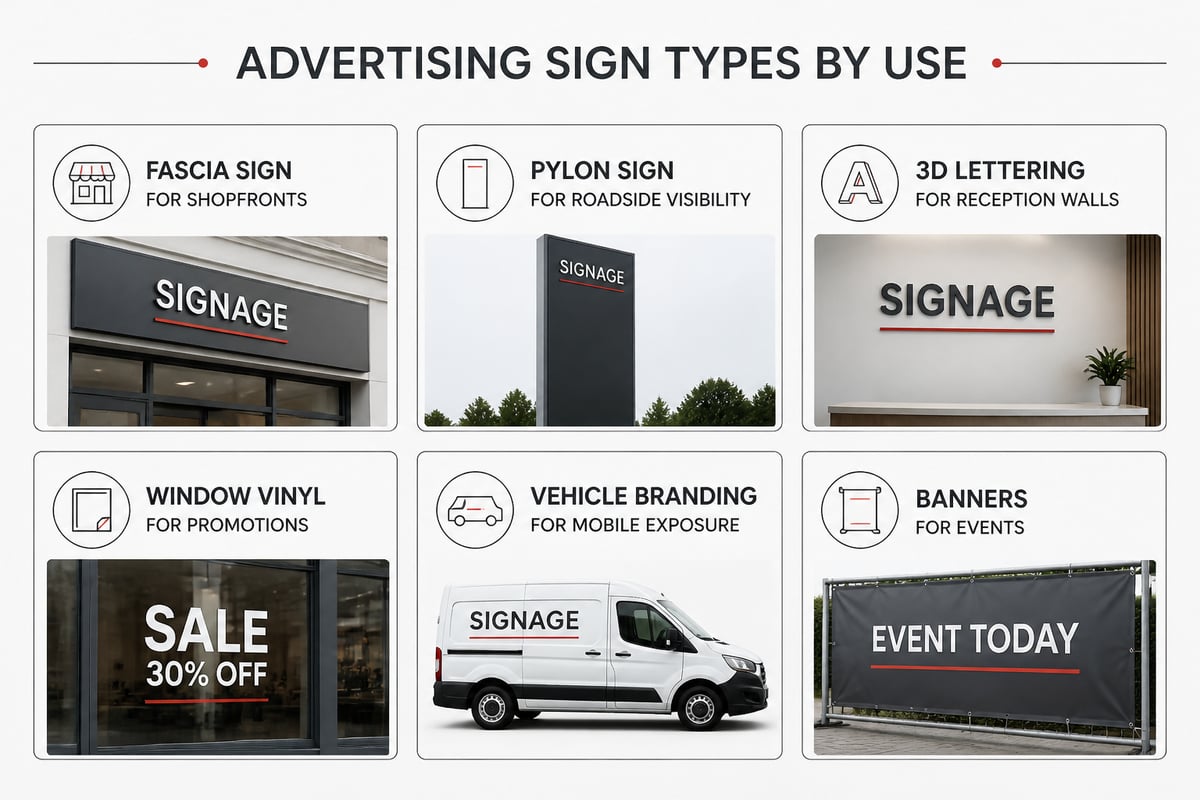
The sign type you choose should reflect where your customers see you from and how long the message needs to last. Each format below suits a different purpose.
Fascia and Shopfront Signs
Fascia signs sit above a shopfront or entrance and are usually the first branded element a visitor notices. They are typically made from aluminium composite panel, acrylic or fabricated letters, and can be lit or unlit. For retailers in shopping centres, landlord criteria often dictate size and lighting, so confirm those before you finalise a design.
Pylon and Freestanding Signs
Pylon signs are tall, freestanding structures built to be read from the road or across a large parking area. They suit multi-tenant sites, filling stations, business parks and standalone commercial buildings where a wall-mounted sign would not be visible from a distance. Because they are structural, they involve engineering, foundations and usually the strictest approval process. Signs4SA offers bespoke pylon signage, designed and manufactured to your specification, which suits businesses that need a landmark presence for a site.
Building-Mounted and 3D Lettering
Individual letters fixed to a facade or reception wall create a clean, premium look. Corporate offices use them in lobbies and on exterior walls, with materials such as brushed stainless steel, acrylic or painted aluminium. They work well where the architecture is part of the brand message.
Window Graphics and Vinyl
Vinyl lettering and printed film are among the most economical advertising signs. They suit trading hours, contact details, promotions and privacy frosting, and they are simple to replace when your offer changes.
Vehicle Branding
A branded fleet turns routine journeys into repeated exposure. Vehicle graphics range from simple door logos to full wraps. Business owners with delivery or service vehicles gain visibility across a wide area without paying for additional site space.
Banners, A-Frames and Event Signage
Temporary signage covers product launches, trade shows, promotions and construction hoardings. Pull-up banners, flags and printed boards are lightweight and portable, which makes them practical for events but less suited to long-term outdoor use.
How to Choose the Right Advertising Signs for Your Business
Choose signage by working backwards from the viewer: who needs to see it, from how far, and for how long. Answering those three questions narrows the options quickly.
Work through this sequence:
- Define the viewing distance. A sign read from a passing vehicle at speed needs larger lettering and fewer words than one read by a pedestrian at an entrance.
- Identify the audience. Drivers respond to a name and a simple cue. Walk-in shoppers respond to offers and hours.
- Set the lifespan. A permanent brand identity needs durable materials. A seasonal promotion does not.
- Check the site constraints. Landlord rules, heritage overlays and municipal zones all limit what you can install.
- Align with your brand. Colours, typefaces and logo proportions should match your other materials so the sign reinforces recognition.
Legibility deserves particular attention. High contrast between lettering and background, clear typefaces and generous spacing do more for readability than size alone. A concise message beats a crowded one every time.
If you want a broader overview of how signage supports marketing goals, Signs4SA's complete guide to signage for advertising expands on the strategy side.
Materials and Lighting: What Lasts in South African Conditions
Material choice should reflect your climate exposure, because South African signs face intense UV, coastal salt air in some regions, and heavy summer rain in others. A sign that suits a covered shopping centre corridor may fail within two seasons on an exposed roadside.
| Material | Typical use | Strengths | Limitations |
|---|---|---|---|
| Aluminium composite panel | Fascias, boards | Light, flat, weather-resistant | Edges can be damaged by impact |
| Acrylic | Lettering, light boxes, indoor feature walls | Clean finish, good for backlighting | Can scratch; UV grade matters outdoors |
| Stainless steel | Premium lettering, plaques | Durable, corrosion-resistant | Higher cost |
| Vinyl | Windows, vehicles, graphics | Affordable, fast to change | Shorter outdoor life than rigid materials |
| Painted steel or aluminium | Pylons, structures | Strong, customisable | Needs quality coating to resist corrosion |
Lighting changes how a sign performs after dark. LED illumination has largely replaced older neon and fluorescent systems because it uses less power and requires less maintenance. For businesses trading in the evening, an illuminated sign extends your visibility well beyond daylight hours. With load shedding a regular consideration for many South African premises, it is worth asking whether illuminated signs need a backup supply or whether a reflective, unlit option would serve you adequately.
Bylaws, Approvals and Structural Safety
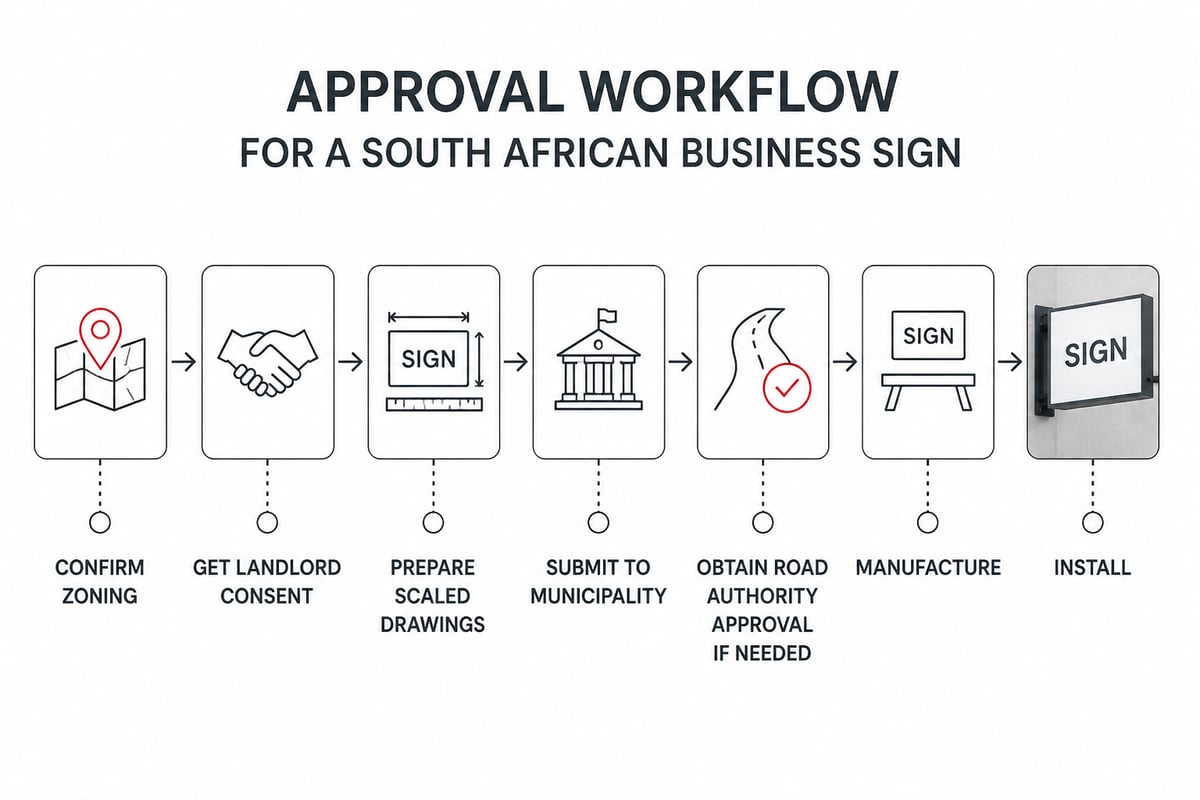
Almost every on-site advertising sign in South Africa needs prior municipal approval, so check requirements before you commission any manufacture. According to the Tourism Knowledge Portal, municipal outdoor-advertising bylaws generally govern signs outside road reserves, almost all on-site signs require prior municipal approval, and signs visible from provincial or national roads may also need approval from the relevant road authority.
In practice this means:
- Rules differ by municipality. Johannesburg, Cape Town, eThekwini and Tshwane each apply their own bylaws covering size, height, illumination, placement and the number of signs per site.
- Zoning matters. A sign permitted in a commercial zone may be refused in a residential or heritage area.
- Roadside signs face extra scrutiny. Visibility from a national or provincial road can bring in a second authority and additional conditions focused on driver distraction.
- Landlord consent is separate. Tenants usually need written permission from the property owner in addition to municipal approval.
Structural safety is non-negotiable. The same source notes that signs and their supporting structures should be safely made and erected to support twice their weight, in addition to forces such as wind pressure. For large or elevated signs, that typically means engineering input on foundations, fixings and wind loading rather than a simple site decision.
Submitting an application usually requires scaled drawings, dimensions, the exact location and sometimes an engineer's certificate. Because requirements vary, contact your municipal building or outdoor-advertising department early, and allow for processing time in your project schedule.
Advertising Signs for Construction and Industrial Sites
Construction sites combine advertising and compliance, and managers need to keep the two clearly distinct. Contractor and developer boards, hoardings and project signs promote the businesses involved, while safety signs communicate legal obligations.
Keep these points in mind:
- Site boards and hoardings identify the project, the principal contractor, consultants and sometimes the funder. They also create a professional boundary treatment around the site.
- Safety signs must stay unobstructed. Branding should never cover or compete with prohibition, mandatory, warning and emergency signs.
- Sign placement should follow site risk. Entrances, plant areas, excavations and storage zones each need their own signage, positioned where hazards are first encountered.
- Temporary signs still need securing. Wind loads on large hoardings are significant, so fixings should be engineered rather than improvised.
For facility and safety managers, a sensible approach is to audit existing signage at the start of each project phase. As hazards move on a construction site, the signs that warn of them need to move too.
Planning Your Budget and Timeline
Signage costs depend on size, material, lighting, structural complexity and installation requirements, so any figure quoted without a brief is unreliable. Rather than hunting for a standard price, prepare the information a manufacturer needs to quote accurately.
Costs to include in your planning:
- Design and artwork preparation
- Manufacture of the sign and any lighting or electrical components
- Engineering for structural or large-format signs
- Municipal application fees and any professional drawings required
- Installation, including access equipment for elevated work
- Electrical connection for illuminated signs
- Ongoing maintenance and cleaning
Timelines stretch most often at the approval stage rather than in manufacture, so start the application early. Where a project involves a landlord, an architect and a municipality, building a buffer into your launch date prevents a sign from missing a store opening.
A fully managed supplier simplifies this. Signs4SA handles manufacture, supply and installation in-house, and has completed over 80 projects, which can help procurement teams that need a single accountable contractor. For specifics on sizes, materials and lead times, check the relevant product pages or contact the team directly rather than relying on general assumptions.
Maintaining Advertising Signs Over Time
A well-maintained sign protects your brand, while a faded, flickering or damaged one signals neglect to every customer who passes. Maintenance is cheaper than replacement and often required to keep a sign compliant.
A simple routine covers most needs:
- Inspect quarterly. Check fixings, brackets, panel edges and any visible rust or cracking.
- Clean regularly. Remove dust, bird droppings and pollution film, using methods suited to the material.
- Test lighting. Replace failed LED modules promptly so the sign does not appear partially lit.
- Check electrical safety. Have a qualified electrician review wiring and isolators, particularly after storms.
- Review after severe weather. High winds and heavy rain are the most common causes of structural damage.
- Update content. Remove expired promotions and outdated contact details.
For multi-site operators, a signage register recording each sign's location, approval reference, installation date and maintenance history makes audits and renewals far easier to manage.
Getting More From Your Signage
A few practical habits improve the return on any signage budget. Place signs where sightlines are clear and not obstructed by trees, poles or parked vehicles. Photograph the site from the customer's approach direction before finalising the design. Keep the message short, and use your logo and one clear call to action instead of a full product list.
Consistency across touchpoints also matters. A shopfront, delivery vehicle, staff uniform and reception wall that share the same palette and logo treatment build recognition faster than any single sign could. Businesses that issue branded workwear alongside their signage, for example, often source from specialist suppliers such as The Uniforms Closet, which provides uniforms for hospitality, spa and cleaning staff, though availability and delivery are focused on Saudi Arabia, so South African buyers should confirm suitability first.
Start by listing every sign you need, noting each location, its viewing distance and whether it is temporary or permanent, then contact your municipality to confirm the approval route. With that brief in hand, a manufacturer can quote accurately and flag compliance issues before they cost you time. Signs4SA designs, manufactures and installs signage for corporate, retail, construction and pharmaceutical clients across South Africa, including bespoke pylon signage for sites that need roadside presence. To discuss your project and get a costed proposal, Request a Quote from Signs4SA.