


Traffic Sign Frames: A Buyer's Guide for South Africa
Traffic sign frames are the rigid supports that hold a sign face flat, protect its edges and fix it to a pole, wall, barrier or portable stand. In South Africa, the right frame depends on where the sign is used, the speed of the road it serves, and whether the sign face must meet national dimension rules. This guide sets out the materials, sizes, mounting options and compliance points that matter before you place an order.
What Traffic Sign Frames Do and Where They Are Used
A sign frame keeps the face rigid, prevents edge damage and corrosion, and provides the fixing points that attach the sign to its support. Without a suitable frame, an aluminium or composite face can flex in wind, peel at the corners or work loose from its fixings.
Frames appear across a wide range of South African settings:
- Construction sites: temporary speed limits, road works warnings and site access boards that move as the project progresses.
- Mines and industrial yards: permanent regulatory signs along haul roads and internal routes.
- Retail centres and parking areas: direction, restriction and pedestrian crossing signs on private roads.
- Corporate campuses and pharmaceutical facilities: controlled entrances, visitor routing and loading bay signage.
- Events and temporary closures: portable frames that can be set up and removed quickly.
The frame you choose should match the sign's working life. A permanent roadside sign needs a different specification to a board that is carried to a new location every fortnight.
Frame Materials Compared
The main frame materials are aluminium, galvanised steel, stainless steel and polymer, and each suits a different duration and environment. Aluminium is the most common choice for fixed signs because it resists rust and keeps weight down, while galvanised steel is favoured where impact resistance matters.
| Material | Strengths | Limitations | Typical use |
|---|---|---|---|
| Aluminium extrusion | Lightweight, corrosion resistant, clean edge finish | Can dent under heavy impact | Permanent signs, retail and corporate sites |
| Galvanised steel | Strong, impact resistant, cost effective | Heavier; coating can fail if scratched | Haul roads, industrial yards, construction |
| Stainless steel | Excellent corrosion resistance | Higher cost | Coastal sites, food and pharmaceutical facilities |
| Polymer or composite | Light, will not rust, easy to handle | Less rigid at large sizes | Temporary and portable signs |
Coastal conditions in Durban, Cape Town and Gqeberha are harder on metal than inland Gauteng, so salt exposure should weigh heavily in your decision. Sites with frequent vehicle movement should also allow for the occasional knock, which favours steel over thin aluminium.
Sizes and the Rules That Govern Them
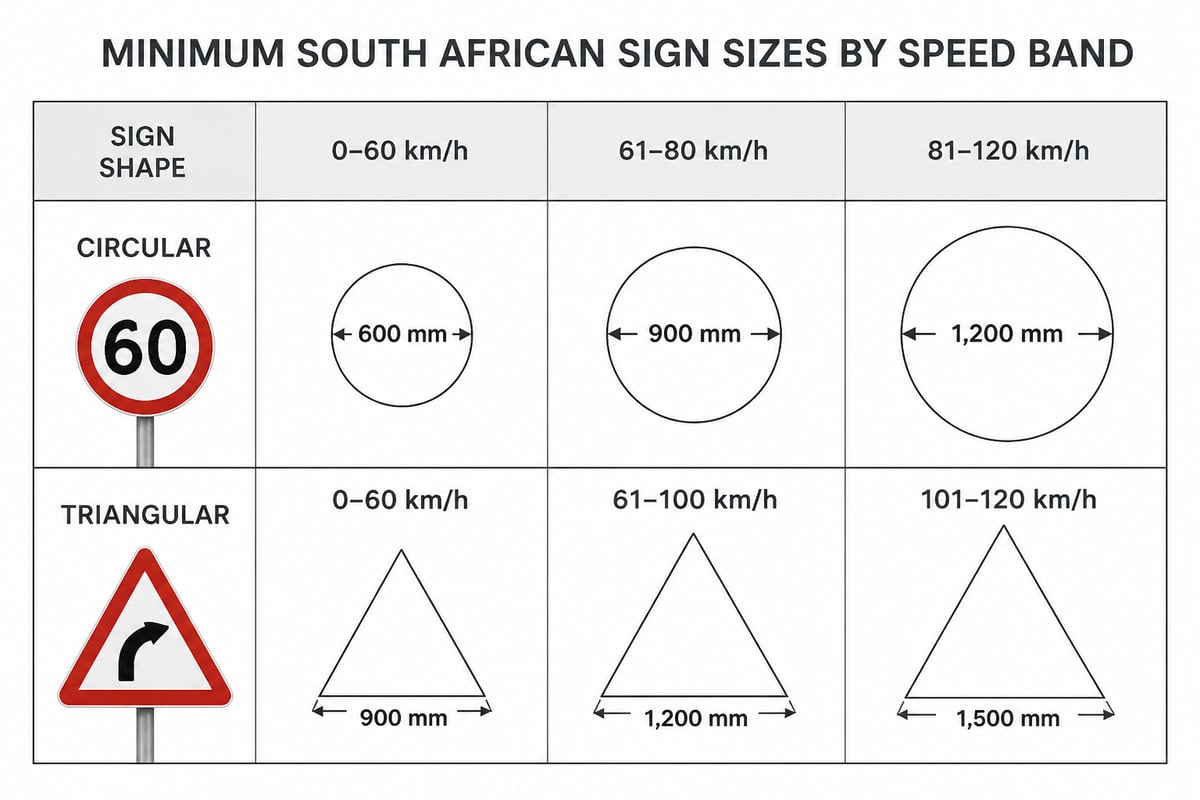
Sign face dimensions for regulatory and warning signs are set by the National Road Traffic Regulations, and your frame must accommodate the correct face size for the road's speed limit. Under regulation 286 of the National Road Traffic Regulations, circular signs have a minimum diameter of 600 mm at 0 to 60 km/h, 900 mm at 61 to 80 km/h and 1,200 mm at 81 to 120 km/h.
Triangular signs follow the same logic. The same regulation sets minimum side lengths of 900 mm at 0 to 60 km/h, 1,200 mm at 61 to 100 km/h and 1,500 mm at 101 to 120 km/h.
Two further points from the regulation are worth building into your specification:
- The regulations allow a tolerance of 5% below the stated minimum external dimensions, but designing to the stated minimum rather than the tolerance floor gives you a safer margin.
- Dimensions, lettering styles and symbols should substantially conform to the SADC Road Traffic Signs Manual Volume 4, so the face artwork matters as much as the frame.
A frame sized too tightly leaves no allowance for the border, fixings or a reflective edge. Always confirm the finished external size, not just the visible sign area.
Mounting Options for Traffic Sign Frames
Frames are mounted by pole clamp, wall bracket, barrier clip or portable base, and the method should be chosen before the frame is ordered, not after. A frame drilled for the wrong fixing pattern is difficult to correct on site.
Pole and post mounting
Pole-mounted frames use clamps or bands that grip a round or square post. This suits permanent roadside and yard installations, and it allows height adjustment so the sign sits where drivers expect it. Posts should be set in concrete to a depth suited to the sign's face area, because larger faces catch more wind.
Wall and structure mounting
Wall brackets suit parking structures, loading docks and building entrances. The key checks are the substrate, whether brick, concrete or sheeting, and whether the fixings will resist vibration from passing vehicles.
Portable and temporary mounting
Folding stands, sandbag bases and barrier clips suit road works and event signage. Weight is the main concern here. A frame that is light enough to carry easily may also be light enough to topple in a Highveld gust, so base weight and wind loading deserve attention.
Reflective Faces and Visibility Requirements
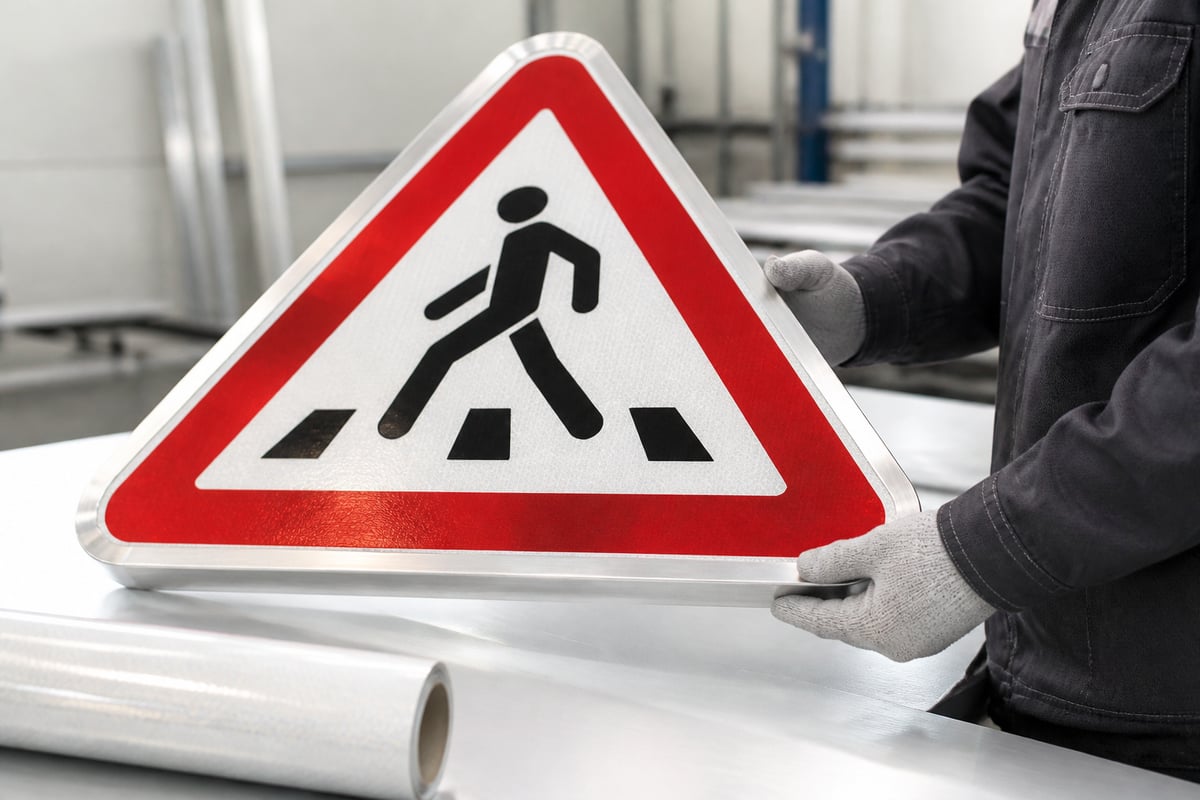
The sign face fitted to the frame needs retroreflective sheeting if the sign will be read after dark, and the frame should protect that sheeting's edges. Retroreflective grades vary in brightness and durability, and higher grades suit high-speed roads where drivers need more time to read the sign.
Frames with a rolled or capped edge protect the sheeting from lifting, which is the most common early failure on exposed signs. Sealed edges also keep water and dust from working under the face, a particular concern in dusty mining and construction environments.
Colour fastness matters on permanent installations. Red and yellow inks can fade under strong UV, and South Africa receives high levels of it for much of the year. Ask your supplier about the expected face life and whether the sheeting carries a manufacturer's warranty.
Temporary Versus Permanent Installations
Choose the frame for the duration of use: lighter, quick-release designs for temporary work, and heavier, tamper-resistant designs for anything that will stay in place for years. Mixing the two up is a common and avoidable cost. A heavy steel frame on a board that moves every fortnight wastes labour at each relocation, while a lightweight polymer frame left on a permanent post will flex, crack or disappear.
- Temporary (days to months): polymer or lightweight aluminium frames, portable bases, quick-release fixings. Prioritise handling and storage. A road works warning board that is set up each morning and packed away each evening suits a folding stand, but the base needs enough weight to hold the face against wind.
- Permanent (years): extruded aluminium or galvanised steel, vandal-resistant fixings, concrete-set posts. Prioritise durability and low maintenance. On a mine haul road or retail car park, tamper-resistant bolts stop casual removal and keep the face aligned.
- Semi-permanent (project duration): galvanised steel frames on driven posts that can be lifted and relocated when the project ends.
For construction managers, the semi-permanent category often gives the best value. The frame outlasts a single site and can be reused, while the face can be replaced if the project requirements change. Whichever category applies, the face size still has to meet the minimum for the road's speed limit, so a temporary sign on a faster road needs a larger frame than one inside a 0 to 60 km/h site.
Custom Frames and Branded Signage
Custom traffic sign frames let a business match private-road signage to its brand while keeping the regulatory content intact. For retailers, corporate campuses and property managers, this means entrance, parking and direction signs that look consistent with the building rather than bolted on as an afterthought.
Customisation usually covers frame colour, finish and profile, and the supporting information panels that sit alongside the regulatory sign. Regulatory symbols and colours themselves should not be altered, since they need to be recognisable to every driver. Signs4SA covers the point in more detail in its guide to custom traffic signs.
Signs4SA manufactures, supplies and installs in-house, which keeps design, fabrication and fitting under one roof. The company works with Corporate, Retail, Construction and Pharmaceutical clients on bespoke signage, and has completed over 80 projects.
A Practical Buying Checklist
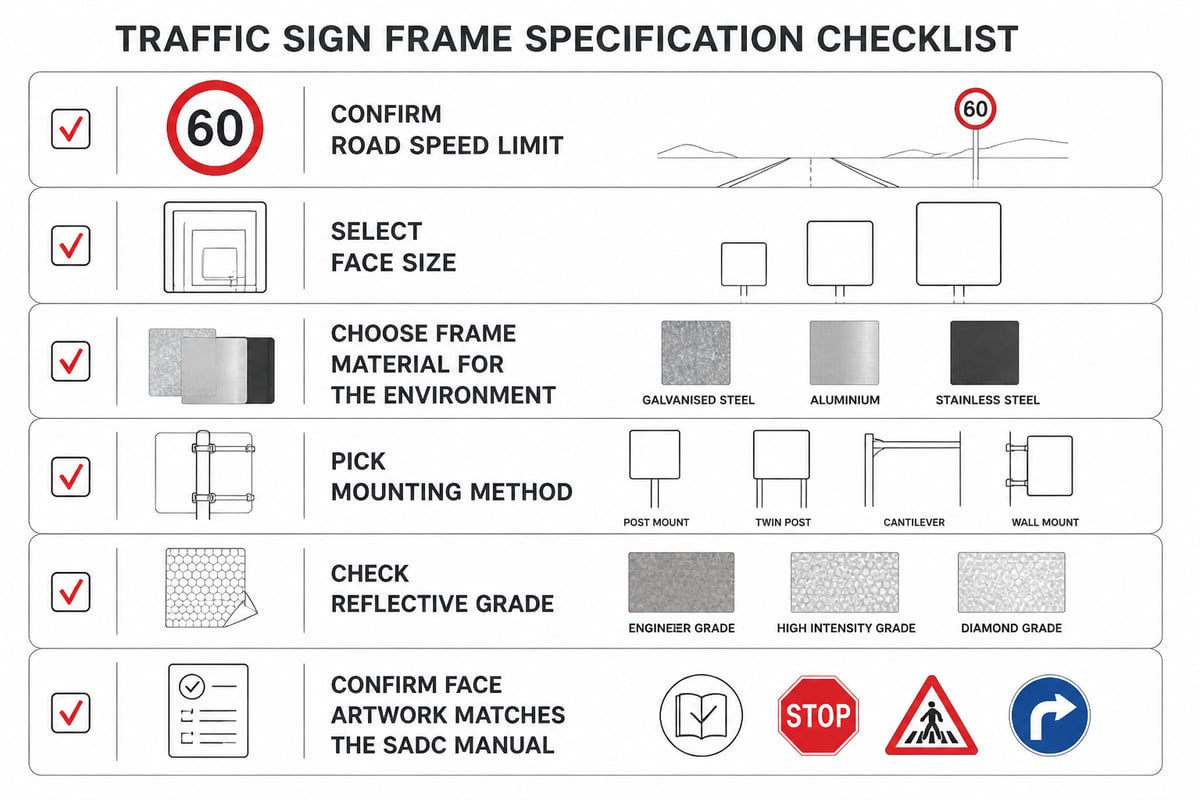
Before ordering, confirm these points in order, because each decision constrains the next:
- Speed limit of the road or yard route. This sets the minimum face size. A circular sign on a 70 km/h access road needs a 900 mm face, whereas the same sign inside a 40 km/h yard can be 600 mm, and the frame must be sized to match.
- Sign type. Regulatory, warning or information signs follow different rules. Check the artwork against the SADC Road Traffic Signs Manual Volume 4.
- Environment. Coastal, dusty, high-vandalism or high-wind sites change the best material. Salt air points towards stainless steel or well-finished aluminium, while a busy yard favours galvanised steel.
- Duration. Temporary, semi-permanent or permanent use. This decides whether quick-release fixings or tamper-resistant ones are appropriate.
- Mounting surface or support. Pole diameter, wall substrate or portable base. Measure the pole or confirm the wall material, since the fixing pattern is drilled at manufacture.
- Face specification. Reflective grade, artwork and any branding. Higher reflective grades suit faster roads, and any branding must leave the regulatory symbols and colours untouched.
- Quantity and delivery location. Multiple sites often benefit from a consistent specification, which also simplifies spares and replacements.
Taking a short written specification to your supplier reduces errors and speeds up quoting. If you are unsure about sizes, ask for a site assessment rather than guessing.
Maintenance and Replacement
A well-chosen frame needs little maintenance, but a short inspection routine extends the life of both frame and face. Check fixings for looseness, clean the face with mild soapy water, and look for lifting at the edges where moisture can enter.
Replace a sign when the face has faded noticeably, the reflective sheeting no longer performs after dark, or the frame is bent enough to distort the face. A bent frame is not only unsightly. It can also alter how the sign reflects headlights, reducing legibility at the moment drivers need it most.
Keep a simple register of every sign, its location, installation date and face type. For safety managers, it makes audits quicker and helps you plan replacements before a sign fails, rather than after an incident.
Frequently Asked Questions
Do traffic sign frames need to be a specific size?
The sign face must meet the minimum dimensions for its type and the road's speed limit, and the frame must hold that face securely. The frame itself is sized to suit the face, plus a border and fixing allowance.
Which frame material lasts longest outdoors?
Stainless steel resists corrosion best, particularly near the coast. Extruded aluminium and hot-dip galvanised steel both give long service inland when correctly finished.
Can private sites use the same signs as public roads?
Many private sites choose to follow the national sign standards so that drivers recognise the signs instantly. Following the SADC manual's symbols and layouts is sensible even where the regulations do not strictly apply.
Can a frame be reused if the sign changes?
Often yes. Where the face size stays the same, a robust frame can take a new face. Confirm the fixing arrangement allows the face to be removed without damaging the frame.
Start by listing every sign on your site with its speed zone, mounting surface and expected lifespan, as this gives any supplier what they need to specify frames accurately. Signs4SA can then turn that list into manufactured and installed signage, with the frame, face and fitting handled together. To discuss your requirements, Request a Quote from the team and get a specification matched to your premises.