


How to Choose an Outdoor Sign Company in South Africa
The right outdoor sign company for a South African workplace is one that can manufacture durable, compliant signage, handle municipal approval requirements, and install the finished work safely. For facility, safety and construction managers, the choice should rest on proven manufacturing capability, knowledge of local bylaws and verifiable references, not on the lowest quotation.
Outdoor signs work harder than almost any other workplace asset. They face UV radiation, coastal salt, highveld storms and the daily wear of vehicles and people. A sign that fades within a season, or one that is erected without approval, becomes a liability rather than a safeguard. The sections below set out how to assess suppliers methodically.
What to Look for in an Outdoor Sign Company
A reliable supplier combines four things: in-house manufacturing, relevant industry experience, a clear understanding of regulation, and a willingness to be assessed against evidence. Each can be checked before you commit.
Start with how the work is actually produced. A company that manufactures, supplies and installs under one roof carries accountability for the whole job. When fabrication is outsourced and installation is subcontracted, a fault in one stage tends to become a dispute between three parties. Signs4SA, for example, states that it handles manufacture, supply and installation in-house, which keeps responsibility in one place.
Experience matters, but it should be specific. Ask for work in your sector. A supplier who has produced hazard signage for a construction site understands a different brief from one who has only made shopfront lettering. Signs4SA serves Corporate, Retail, Construction and Pharmaceutical clients, which covers the environments where compliance signage is most often scrutinised.
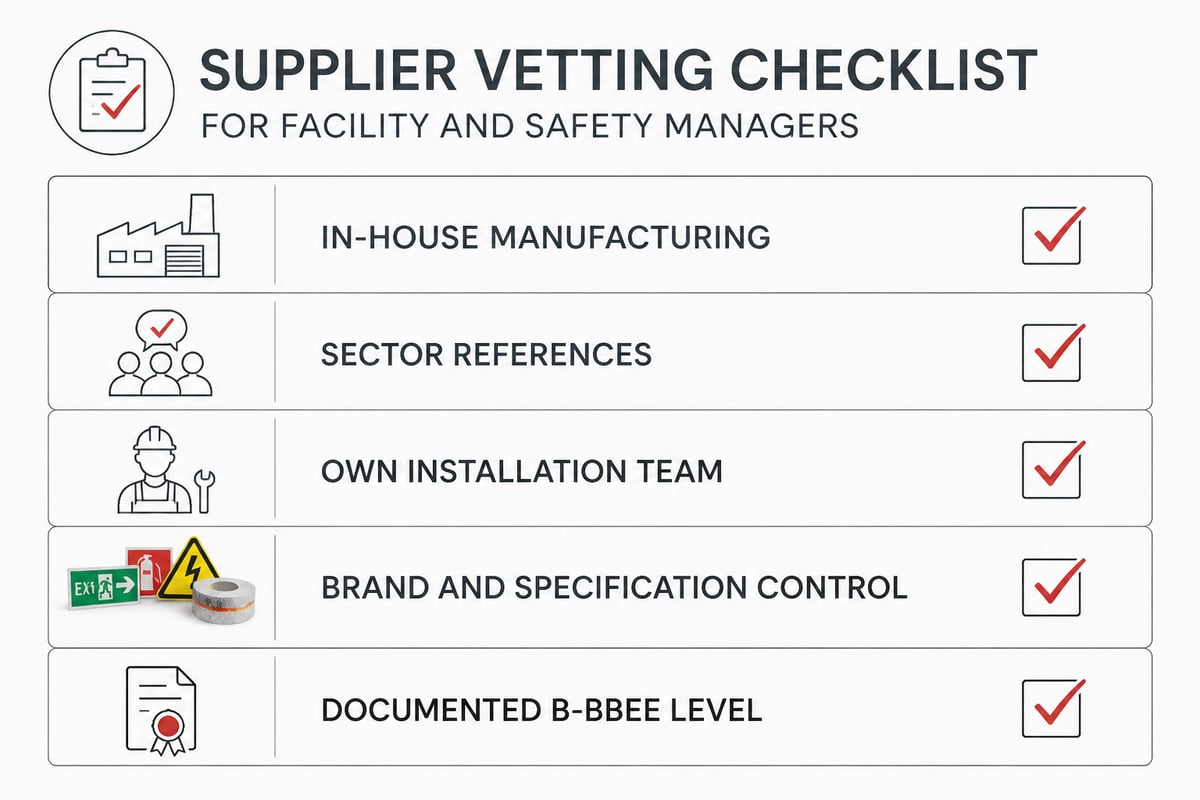
Use this short checklist when comparing suppliers:
- Manufacturing location: Is production done by the company itself, or outsourced?
- Sector references: Can they name comparable projects, preferably in your industry?
- Installation capability: Do their own teams fit the signs, including at height?
- Brand and specification control: Will they work to your corporate colours, symbols and wording?
- Transformation status: Is their B-BBEE level documented? A verified certificate can matter for procurement scorecards.
Compliance and Municipal Approval Come First
In South Africa, most outdoor signs need municipal permission before they go up, so a good supplier will raise approvals before they raise colour options. This is where inexperienced suppliers expose clients to fines and forced removal.
The Tourism Knowledge Portal states that almost all on-site signs require prior approval from the relevant municipality, and that signage outside a road reserve is normally governed by the local authority's outdoor advertising bylaws. Requirements therefore differ from one municipality to the next.
Cape Town offers a clear example. The City of Cape Town requires municipal permission to display a new sign, to alter or add to an approved sign, or to submit a signage plan as part of a Site Development Plan proposal. The same authority also requires a permit for directional boards placed on City-owned land by property marketing agents, private sellers, developers or auctioneers. Other metros and local municipalities apply their own rules, so a supplier operating nationally should be able to tell you which process applies in your area.
Ask any prospective supplier these questions:
- Which municipal approvals does this sign require, and who submits the application?
- Can you supply drawings and dimensions in the format the municipality expects?
- What happens if the application is declined or amended?
Be aware that statutory safety signage inside a workplace is a separate matter from advertising signage. Your supplier should help you distinguish between the two, so that exit routes, hazard warnings and prohibition signs follow the relevant occupational health and safety expectations, while boundary and site-identification signs follow the bylaws.
Materials and Build Quality for South African Conditions
Materials determine whether a sign lasts five years or five months, so ask for the specification in writing rather than accepting a general assurance of quality. South African weather is demanding: intense UV on the Highveld, salt air along the coast and heavy summer storms in many regions.
Questions to put to a supplier about construction:
- Substrate: Is the sign face aluminium composite, powder-coated metal, acrylic or another material, and why was it selected for your location?
- Printing and finishing: Are graphics UV-resistant, and is a protective laminate or coating applied?
- Reflectivity: For roadside, yard or site-entrance signs, is reflective sheeting available for night visibility?
- Fixings: Are brackets, posts and fasteners corrosion-resistant, and are they rated for the wind loading at your site?
Marking technology can also be relevant for durable identification plates and equipment labels. Specialist processes such as laser engraving produce permanent markings that resist abrasion, and a capable supplier should be able to explain when engraved or etched plates are a better choice than printed vinyl.
Large formats need particular attention. Billboards and big boards carry higher wind loads and structural demands, which is covered in more detail in this guide to big outdoor signs.
Custom Design, Branding and Legibility
A good supplier designs for readability at distance and speed, not only for appearance. Safety and construction managers need signs that communicate in seconds, to workers in high-visibility clothing, drivers entering a site, and visitors who have never seen the premises.
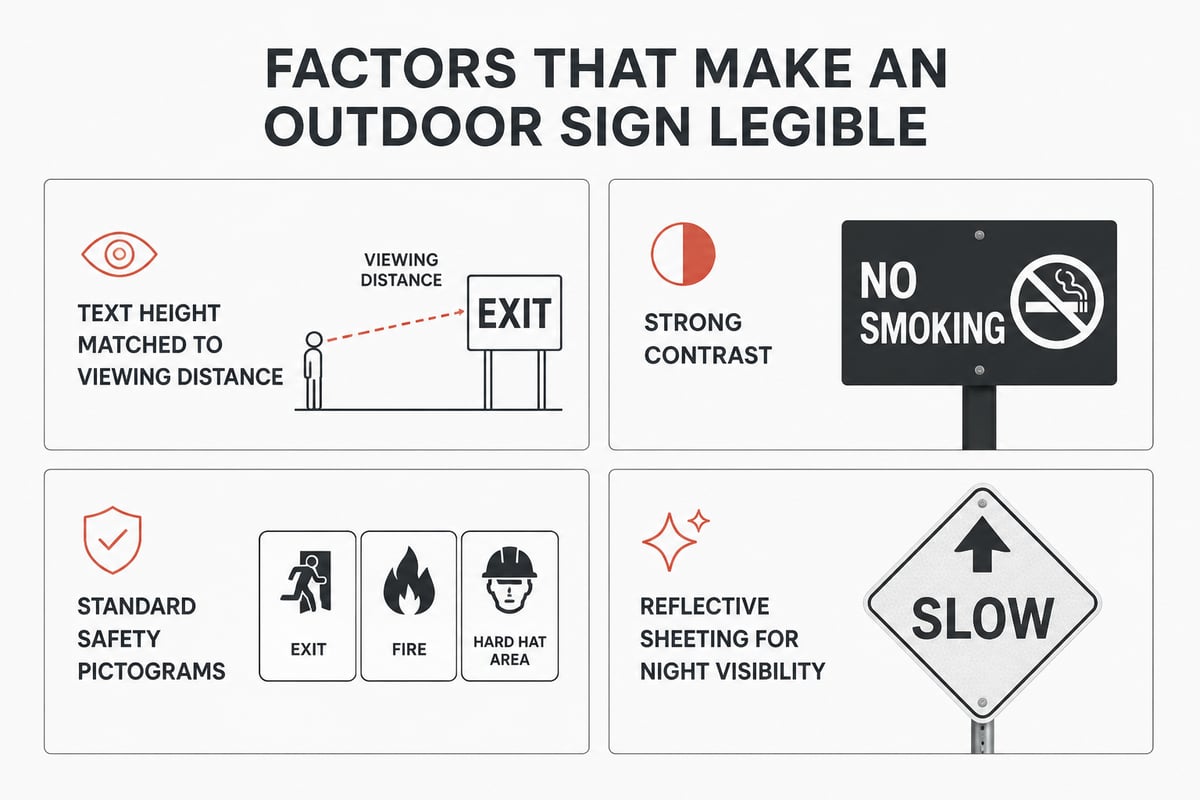
Legibility rests on a few principles. Text height should relate to viewing distance, contrast between lettering and background must be strong, and symbols should follow recognised safety conventions so that they are understood across language groups. In a multilingual country, pictograms often communicate faster and more reliably than long written warnings.
Custom work should still reflect your organisation. A supplier that designs signage around your brand, rather than offering only stock templates, helps you keep a consistent identity across entrances, car parks and perimeter fencing. Ask to see proofs before production, and confirm how many revisions are included in the quotation.
For help with the early planning stage, Signs4SA's article on how to choose the right outdoor signage sets out the factors that shape size, placement and format.
Installation, Safety and Site Access
Installation is where many signage projects succeed or fail, so confirm who fits the sign and how they work. A well-made sign that is poorly mounted can detach in wind, damage a façade or injure a passer-by.
Establish the following before you accept a quotation:
- Who installs: the supplier's own team or a subcontractor, and whether they carry out work at height.
- Site induction: whether installers will complete your site safety induction and wear the required protective equipment.
- Method statements: whether they provide a risk assessment or method statement for fitting at height or near live traffic.
- Structural suitability: how fixings are chosen for the wall, post or frame involved.
- Making good: whether the area is left clean and any fixing holes are dealt with.
Where a supplier manages installation in-house, the same organisation that fabricates the sign is responsible for fitting it. That arrangement shortens the chain of accountability if something needs correcting after handover.
For large or complex sites, ask whether installation can be scheduled in phases so that operations are not disrupted. Construction sites in particular may need signs fitted before a project phase begins, which makes lead times and scheduling a central question rather than an afterthought.
Comparing Quotations and True Cost
The cheapest quotation is rarely the lowest cost over the life of a sign, so compare what each price actually includes. Two quotes for the same nominal sign can differ widely in material grade, finishing, installation and approvals support.
| Item to compare | What to confirm |
|---|---|
| Design and proofs | Number of revisions and sign-off process |
| Materials and finish | Substrate, coatings and UV protection |
| Manufacturing | Where and by whom the sign is made |
| Installation | Included or charged separately, including access equipment |
| Approvals | Whether application support is part of the service |
| Aftercare | Process for repairs, replacements or faded graphics |
Request itemised quotations so that you can compare like with like. If a figure seems unusually low, ask which line has been reduced. Ask Signs4SA or any other supplier for pricing through the contact page, as costs depend on size, materials and site conditions and cannot be responsibly estimated in general terms.
Think also about replacement cycles. A sign that must be redone every two years carries repeated design, manufacture and installation costs, and each replacement may need fresh approval. Spending more on a better specification at the outset often reduces total expenditure.
Insurance, Risk and Contractual Safeguards
Signage work carries physical risk, and a careful buyer checks that the supplier is covered before any ladder or scaffold is set up. Installing at height, drilling into structures and working near public access routes all create potential for injury or property damage.
Ask for evidence of the supplier's public liability cover and confirm that it applies to installation work. It is also sensible to review your own arrangements. A specialist commercial insurance broker can advise businesses on how third-party contractors and installed assets fit within their wider cover, although South African organisations should confirm local requirements with a locally licensed adviser.
Put the essentials in writing. A sound agreement sets out the specification, delivery and installation dates, the approval responsibilities of each party, the payment schedule, and the remedy if the finished sign does not match the agreed proof. Where the supplier offers a guarantee or aftercare, request the terms directly rather than relying on a verbal assurance.
Digital and Illuminated Options
Some sites benefit from illuminated or digital outdoor displays, particularly where entrances need to communicate changing safety information, shift notices or visitor instructions. If this applies to you, ask whether the supplier can handle these products and the electrical considerations that come with them.
Digital units introduce further questions: brightness in direct sunlight, weatherproof enclosures, power supply, and content management. Signs4SA's overview of outdoor digital signage explains what this category involves, and the related article on a digital signage display for outdoor use covers practical considerations such as brightness and enclosure ratings.
Illuminated signs generally require separate electrical sign-off and may be treated differently under local bylaws. Confirm early whether your municipality places restrictions on illumination or animated content, since this can alter the design before production begins.
Questions to Ask Before You Appoint
Put a consistent set of questions to every shortlisted outdoor sign company so that their answers can be compared directly. Consistency makes weak responses easier to identify.
- How long has the company been manufacturing signage, and for which industries?
- Can you provide recent references or completed project examples similar to mine?
- Which approvals are needed for this sign in my municipality, and who manages them?
- What materials will be used, and how will they perform in my local climate?
- Is installation handled by your own team, and will they comply with my site safety rules?
- What is included in the quotation, and what is charged separately?
- What happens if a sign fades, is damaged or needs amendment?
Pay attention to how readily the supplier answers. A company that is confident in its processes will usually respond clearly and with specifics. Vague replies, reluctance to put details in writing, or pressure to decide quickly are reasons to pause.
Finally, consider scale. A supplier with a national footprint can serve multi-site organisations consistently, which helps when the same signage standard must be applied at a head office, a depot and several construction sites. For a wider view of how outdoor signage supports visibility and wayfinding, the article on outdoor signage that attracts customers offers useful background, and the guide to a company sign board covers entrance and identification signs.
Before you contact any supplier, write down every sign you need, its location and the approvals your municipality is likely to require, so that quotations can be compared on the same brief. Signs4SA brings over 25 years of signage experience, in-house manufacture, supply and installation, and a track record across Corporate, Retail, Construction and Pharmaceutical sites. If you would like to discuss your requirements and have them priced, Signs4SA can help you request a quote tailored to your site.