


Construction Signs for Buildings: A Practical Guide
A sign of building activity is any board, notice or marker that tells people a construction project is under way and what rules apply on site. In practice this means safety signs, project information boards and directional notices placed at the perimeter, the entrance and inside the work area. Getting them right protects workers and the public, supports compliance and gives the project a professional face from the first day of work.
For facility, safety and construction managers in South Africa, the question is rarely whether to put signs up. It is which signs are required, what each one must communicate, and how to keep them legible for the full duration of the project.
What Is Signage in Construction?
Signage in construction is the collection of safety, information, directional and identification signs used to manage risk and communicate with everyone who enters or passes a building site. It covers permanent fixtures such as a company fascia board and temporary items such as a detour notice.
Accessibility Standards Canada describes temporary signs as including construction notices, temporary closures and detour routes when they convey safety information, directional guidance or essential event-related information. That description is a useful working definition for any site manager, because it separates signs that carry safety weight from those that simply decorate a hoarding.
Construction signage generally falls into five groups:
- Safety signs, which prohibit, mandate, warn or identify safe conditions.
- Project information boards, which name the client, contractor, designer and project.
- Directional signs, which guide deliveries, visitors and pedestrians.
- Regulatory notices, which display permits, contact numbers and site rules.
- Branding and hoarding graphics, which present the project to the public.
The Five Safety Sign Categories and What They Mean
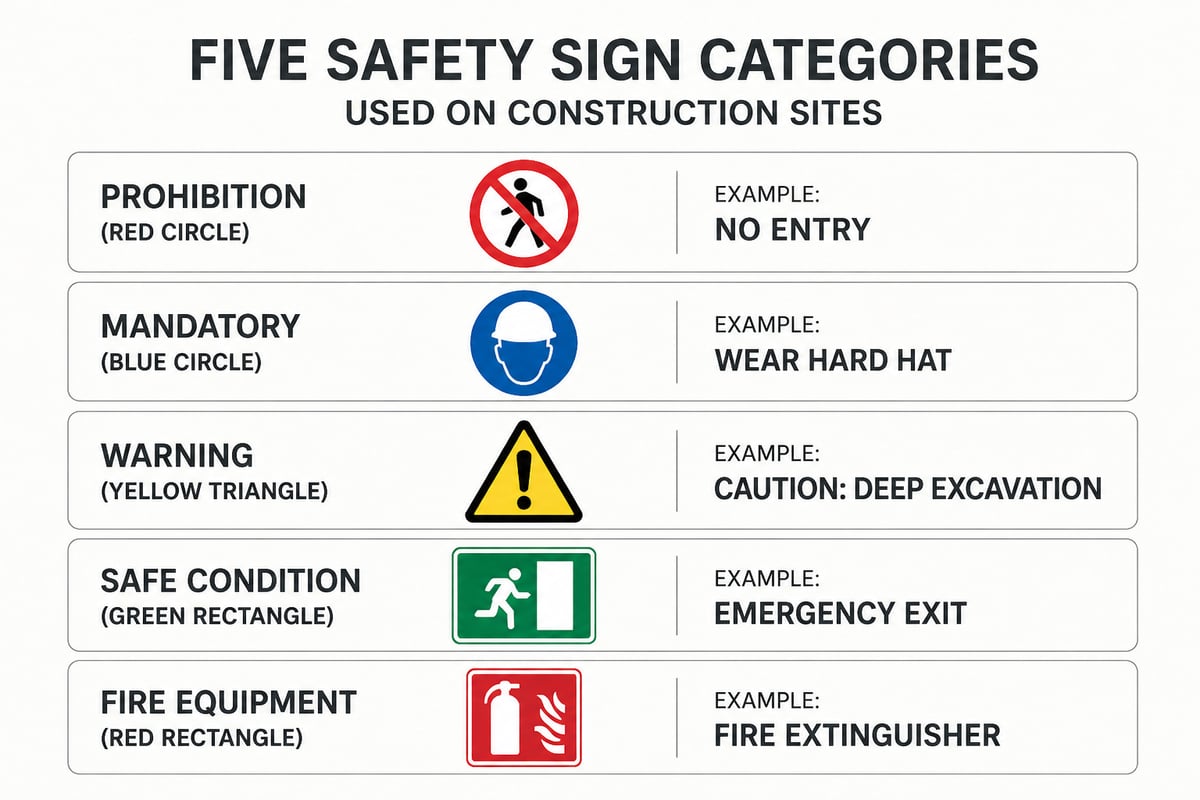
Safety signs are grouped by shape and colour so that a worker can read the instruction before reading the words. The five categories most site managers work with are prohibition, mandatory, warning, safe condition and fire equipment signs.
| Category | Shape and colour | Typical message |
|---|---|---|
| Prohibition | Red circle with a diagonal bar | No entry, no smoking, no unauthorised access |
| Mandatory | Blue circle, white symbol | Hard hats, safety boots, eye protection required |
| Warning | Yellow triangle, black border | Excavations, overhead loads, live electrical equipment |
| Safe condition | Green rectangle or square | First aid point, emergency exit, assembly point |
| Fire equipment | Red rectangle, white symbol | Extinguisher location, fire alarm call point |
These categories answer the common question about the five safety signs. Each one tells a different story: what you must not do, what you must do, what could hurt you, where help is, and where fire equipment sits. A site entrance usually carries a combined board showing the mandatory personal protective equipment alongside prohibition notices, so that every visitor sees the requirements before crossing the threshold.
What Are the Signs in Front of Buildings Called?
The signs in front of buildings are called site boards or hoarding signs while construction is under way, and fascia signs, pylon signs or building identification signs once the building is occupied. The name depends on the stage of the project and on where the sign is mounted.
During construction, the project information board at the gate is the main sign of building progress for the public. It typically lists the project name, the client, the principal contractor, the architect or engineer, and an emergency contact number. After handover, the same frontage may carry channel 3D lettering, backlit letters or neon signage that present the tenant's brand. For larger sites, shopping centres and business parks, a freestanding pylon gives the development a landmark visible from the road.
Signs4SA manufactures bespoke pylon signage designed to a client's specification, which suits developments that need a durable identification structure from the earliest marketing phase through to occupation.
Which Signs Does a Building Site Need at the Entrance and Perimeter?
A building site needs a minimum set of signs at the entrance and along the perimeter: a project information board, a combined safety board, an access control notice and directional signs for vehicles and pedestrians. The exact requirements depend on the project's size and its health and safety plan, so confirm them with your appointed safety officer.
A practical entrance checklist looks like this:
- Project information board naming the parties involved and an emergency number.
- Mandatory PPE sign showing the protective equipment required beyond the gate.
- Prohibition notices covering unauthorised entry, smoking and unaccompanied visitors.
- Vehicle and pedestrian separation signs showing where each group may travel.
- Site speed limit and delivery bay signs to control traffic inside the boundary.
- Emergency assembly point sign positioned where it can be reached quickly from all work areas.
Along the perimeter, warning signs should be repeated at regular intervals on fencing and hoarding, particularly near public walkways. The public rarely reads detailed text, so symbols and short phrases carry the message.
How Signs Support Safety Compliance on Site
Signs support compliance by making the controls in your safety plan visible, but they do not replace those controls. A sign states a rule, and the site's procedures, training and supervision are what enforce it.
South African employers work within the Occupational Health and Safety Act and the Construction Regulations, which place duties on contractors to protect workers and others affected by the work. Signage is one of the visible, auditable ways to show that hazards have been identified and communicated. During an inspection, a missing or faded sign is an easy finding to avoid.
To keep signage defensible, many safety managers adopt these habits:
- Match every sign to a hazard recorded in the site risk assessment.
- Replace damaged or faded signs promptly rather than at the next scheduled review.
- Move or add signs as the work phase changes, for example when excavation gives way to structural work.
- Keep a dated record of sign inspections alongside other site safety checks.
What Do Building Control Sign Off?
Building control sign off refers to the approval given by the local authority's building inspectors that work complies with the approved plans and regulations. In South Africa this is handled by the municipal building control office, which issues the certificate of occupancy once the building is satisfactory.
Signage connects to this process in practical ways. Fire exit signs, assembly point signs, fire equipment markers and accessibility wayfinding are commonly checked as part of the completion inspection. Having the correct signs installed before the inspector arrives avoids delays to occupation. Where fire systems form part of the completion package, a specialist provider such as Logic Fire and Security illustrates the type of detection and monitoring installation that sits alongside compliant fire signage, although local requirements will differ from those applied in other countries.
Design Rules That Keep Construction Signs Readable
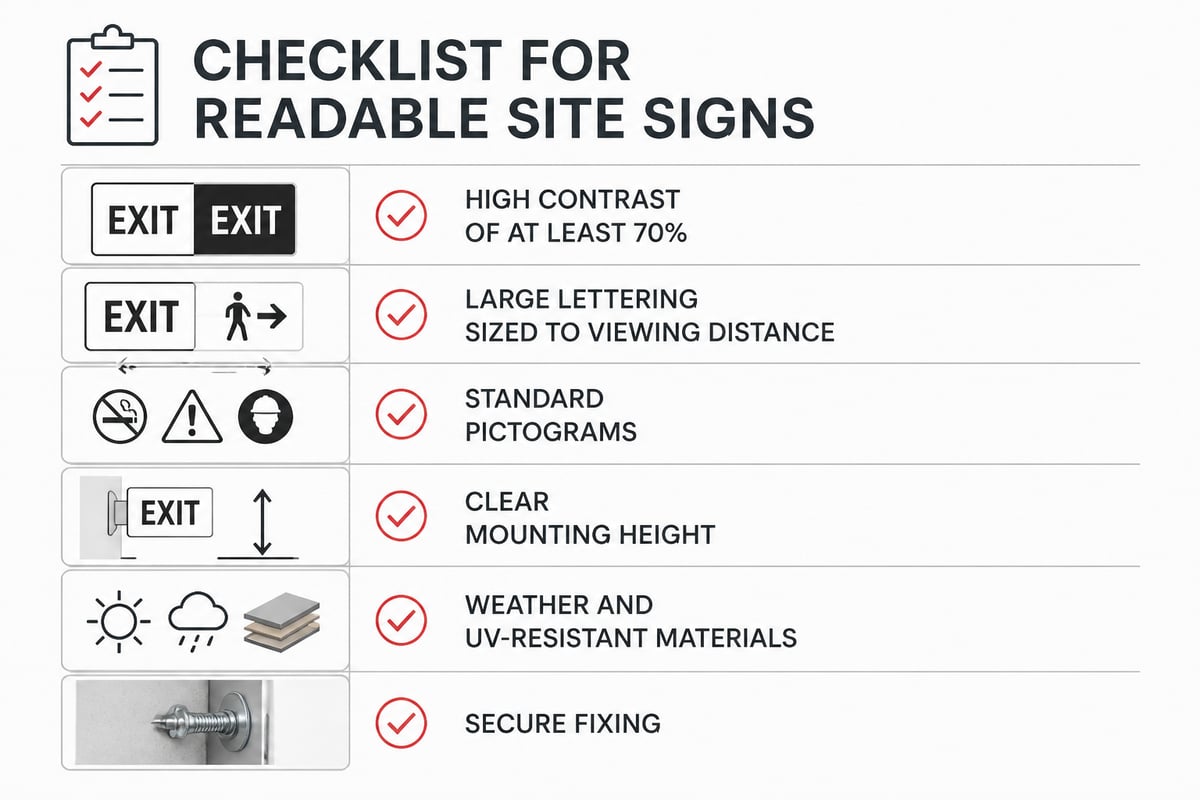
Construction signs stay readable when they combine high contrast, large lettering, simple symbols and sensible mounting height. A sign that cannot be read from the intended distance fails its purpose, however accurate its wording.
Accessibility Standards Canada advises that outdoor vertical signs should not intrude into the path of travel and should maintain strong luminance contrast with their surroundings, including mounting elements. This is a sound benchmark for hoardings and gate signs: dark text on a pale panel, or the reverse, rather than mid-tone colours that fade at dusk or in strong sun.
Lettering, Symbols and Placement
Letter height should rise with viewing distance, so a sign meant to be read from a passing vehicle needs far larger characters than one beside a door. Use standard pictograms where possible, because workers who speak different languages recognise them faster than words. Mount signs where they are not blocked by stacked materials, scaffolding or parked plant.
Lighting and Weather
Sites operate in rain, wind and low light. Exterior signage design guidance addresses visibility, night-time lighting, wind resistance and secure attachment to building materials, all of which apply equally to site hoardings. In South Africa's strong UV conditions, fade-resistant inks and weatherproof substrates are worth specifying so that a sign of building activity remains clear for the whole programme.
Accessibility Considerations for Signs on and Around Buildings
Permanent building signs should be accessible to people with visual impairments, and the ADA standards offer precise reference measurements even though they are not South African law. They are worth consulting where a tenant or international owner expects a recognised benchmark.
The U.S. Access Board's Chapter 7 requirements set out several specific figures for tactile signs:
- Tactile characters must be raised at least 1/32 inch (0.8 mm) above the sign background.
- Character height must be between 5/8 inch (16 mm) and 2 inches (51 mm), measured on the uppercase letter "I".
- Braille must be contracted Grade 2 and positioned below the corresponding text.
- Characters must be mounted between 48 inches (1,220 mm) and 60 inches (1,525 mm) above the finished floor or ground.
- Where a tactile sign sits at a door, a clear floor space of at least 18 by 18 inches (455 by 455 mm) must be provided beyond the door-swing arc.
For a plain-language explanation of these rules, the Access Board also publishes a guide to ADA sign requirements covering tactile and visual features, placement and common compliance questions. Even where you are not bound by these figures, they give a reliable basis for door signs, room identification and toilet signage in new commercial buildings.
Keeping Signs Effective Throughout a Project
A construction sign keeps working only if it is inspected, cleaned and updated as the site changes. Dust, mud, damage and shifting hazards erode a sign's usefulness faster than most managers expect.
Assign sign checks to a named person and include them in the weekly site inspection. Remove obsolete signs once a hazard has gone, because a board warning of an excavation that has been backfilled teaches workers to ignore warnings. Where a site is cleaned by an outside provider, include signage in the scope, as integrated facilities partners such as MetroKleen MKMaintX show is common practice in managed multi-site environments.
Installation quality matters as much as design. A sign fixed to a hoarding with inadequate fasteners becomes a hazard in high wind. Signs4SA handles manufacture, supply and installation, and its installation services page explains how fixing is handled. To see the wider range of frontage options for a completed project, browse the building signage collection.
From Site Hoarding to Permanent Brand Signage
The best construction programmes plan the permanent signage while the site is still active, so that branding, wayfinding and safety markings form one consistent system. Treating them separately often leads to rework and mismatched materials at handover.
Hoarding graphics can preview the future tenant's brand, which supports leasing and community relations during construction. Once the building opens, the temporary safety signs come down and permanent identification, directional and compliance signs take their place. Planning the transition early lets you order long-lead items, such as illuminated lettering or a pylon structure, in time for practical completion.
Signs4SA designs custom signage to reflect each business's brand, which makes it practical to align site signs with the finished frontage.
FAQ
What is the difference between a safety sign and an information sign?
A safety sign communicates a hazard or a required behaviour, using standard colours and symbols, while an information sign gives details such as the project name or contact number. Both are needed on a building site, but only safety signs carry a compliance weight in inspections.
How often should construction signs be replaced?
There is no fixed interval. Replace a sign as soon as it is damaged, faded or no longer legible, and whenever the hazard it describes changes. Weekly inspections make this routine.
Can the same sign serve during construction and after completion?
Generally no. Temporary hoarding and hazard signs are removed at handover, while permanent signs such as fire exits, wayfinding and brand identification are installed for the finished building.
Start by walking your site entrance and perimeter with a copy of your safety plan, listing every hazard that lacks a matching sign. Once you have that list, Signs4SA can manufacture and install the boards, wayfinding and permanent frontage you need, including a bespoke pylon for larger developments, so you can request a quote through Signs4SA and move from audit to installation without delay.