


How to Choose a Road Sign Printing Supplier in South Africa
The best road sign printing supplier for a South African workplace is one that can show compliance with SADC Road Traffic Signs Manual specifications, supply the correct reflective sheeting grade, and handle manufacture and installation under one roof. Price matters, but a sign that fades, fails a reflectivity check or is rejected by an authority costs far more to replace than it saved at purchase.
This guide sets out what to check, what to ask and which red flags to watch for, so that facility, safety and construction managers can brief a supplier with confidence.
What Does Road Sign Printing Actually Involve?
Road sign printing is the process of producing durable, reflective signs on aluminium or composite substrates, using specified sheeting, inks and protective films so that the finished sign stays legible in all light and weather conditions.
It differs from general banner or poster printing in three ways. The artwork follows prescribed shapes, colours, symbols and typefaces. The face material is usually retroreflective sheeting, which returns headlight beams to the driver. The finished sign must survive years of UV exposure, heat and rain without the colours shifting out of tolerance.
For workplaces, this covers more than public roads. Mines, construction sites, distribution centres, hospitals, pharmaceutical plants and corporate campuses all use road-style signs for speed limits, stop and yield control, pedestrian crossings, loading zones and hazard warnings. The same discipline applies on private property, because a driver or visitor expects a stop sign to look and behave like one.
Which Standards and Approvals Should a Supplier Work To?
A credible supplier works to the South African Road Traffic Signs Manual (SARTSM), which sets out the shape, colour, size and symbol for each regulatory, warning and information sign.
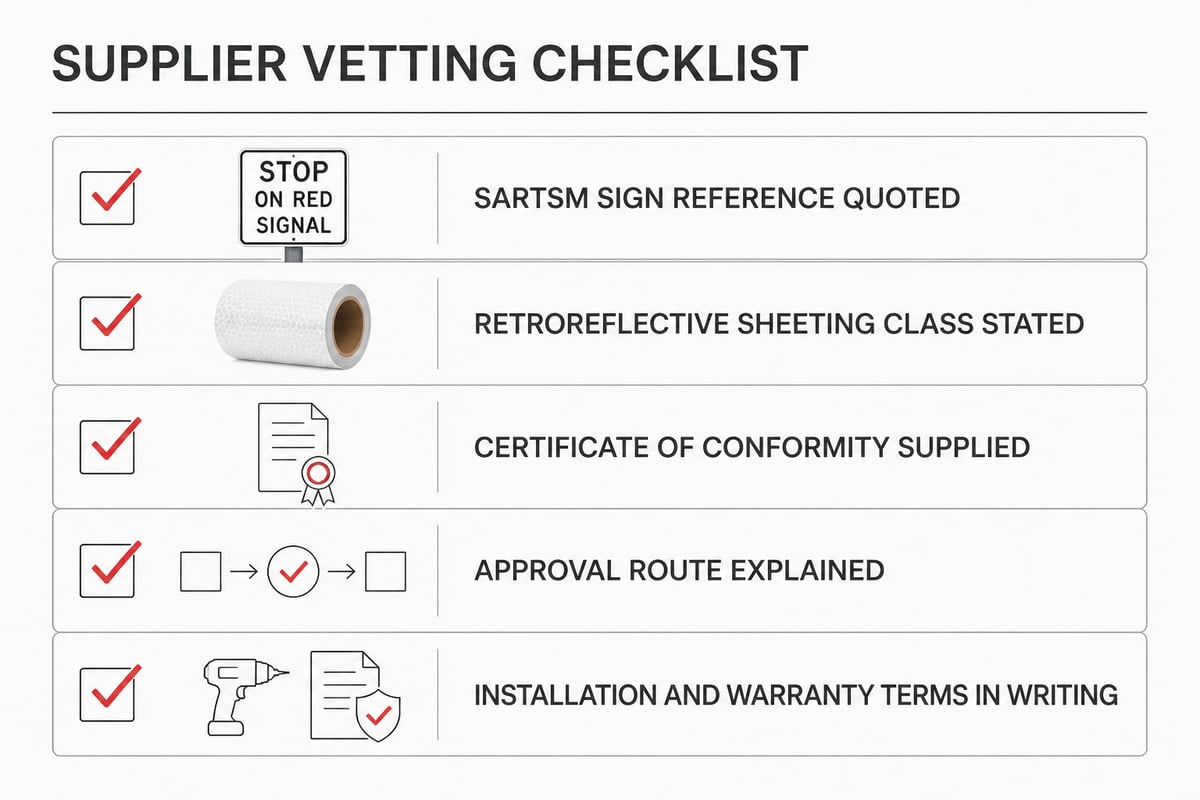
Ask any supplier three direct questions:
- Which edition of the manual do you work from, and can you quote the sign reference number for what I am ordering?
- Which class of retroreflective sheeting do you use, and can you supply the manufacturer's data sheet?
- Do you hold any quality management certification, and can you supply a certificate of conformity with the order?
Approvals depend on where the sign will stand. Signs inside a road reserve belong to the road authority, whereas signs on private land or outside the reserve follow different rules. The Department of Tourism's guiding principles for road signage summarise how approval and authority requirements differ between official signs within road reserves and signs outside them. A good supplier will tell you early whether your project needs authority sign-off, rather than printing first and discovering the problem at installation.
For site managers, the practical test is simple. If a supplier cannot explain which sign category you are ordering and which authority, if any, must approve it, treat that as a warning.
What Are the Standard Dimensions of a Road Sign?
Standard road sign dimensions in South Africa depend on the sign type and the speed of the road it serves, with the manual specifying a set of size classes rather than one universal measurement.
Smaller sizes generally suit low-speed environments such as car parks, factory yards and internal access roads, while larger sizes are used where approach speeds are higher and drivers need more reading distance. Regulatory signs such as stop, yield and speed limit signs follow fixed proportions, so a supplier should not be improvising dimensions to fit a cheaper blank.
Before ordering, confirm these points with your supplier:
- The size class appropriate to the posted speed of your site road
- The pole diameter and mounting height the sign is designed for
- Whether the sign is single-sided or double-sided
- Any border, corner radius and edge-protection specification
The exact sizes, tolerances and minimum order quantities offered vary by manufacturer, so request them in writing from the supplier or through Signs4SA's contact page instead of assuming a catalogue figure.
Circular, Triangular and Rectangular Signs: What Is the Difference?
Circular signs give a regulatory instruction that must be obeyed, triangular signs warn of a hazard ahead, and rectangular signs provide information or direction.
This is a useful reference when auditing the signs you already have on site:
| Shape | Typical purpose | Common workplace example |
|---|---|---|
| Circular | Regulation: prohibits or commands | Speed limit, no entry, no parking |
| Triangular | Warning of a hazard | Pedestrian crossing ahead, slippery surface |
| Octagonal | Stop control only | Stop sign at a gatehouse or intersection |
| Inverted triangle | Yield control | Give way at a yard junction |
| Rectangular | Information or direction | Loading bay, visitor parking, exit |
The shape is itself a message. A driver glancing at a sign from a distance recognises its silhouette before reading any text, which is why a supplier must not alter shapes for aesthetic reasons. If your site uses a triangular sign to give an instruction, or a circular sign to describe a hazard, the signage is inconsistent with the manual and worth replacing.
Which Materials and Sheeting Grades Should You Insist On?
Insist on aluminium or an equally corrosion-resistant substrate faced with retroreflective sheeting of a grade matched to how the sign will be viewed, with a written warranty on both.
The three decisions that most affect longevity are:
- Substrate: Aluminium is the usual choice for permanent road signs because it resists rust and holds its flatness. Thin or poorly finished substrates warp in heat and corrode at edges.
- Retroreflective sheeting: Higher grades return more light and stay reflective for longer. Lower grades may suit short-term or low-speed use. Ask which grade is quoted, as a cheap quote often hides a lower grade.
- Print method and protective film: Screen-printed or digitally printed graphics should be sealed against UV. Colour fade on a red stop sign or a yellow warning sign is a compliance problem, not only a cosmetic one.
South Africa's climate adds its own demands. Strong UV exposure on the Highveld, coastal salt air in Durban and Cape Town, and dust on mining sites all shorten the life of poorly specified signs. Ask for a written statement of expected service life and what the warranty actually covers.
How Do You Compare Suppliers on Manufacturing Capability?
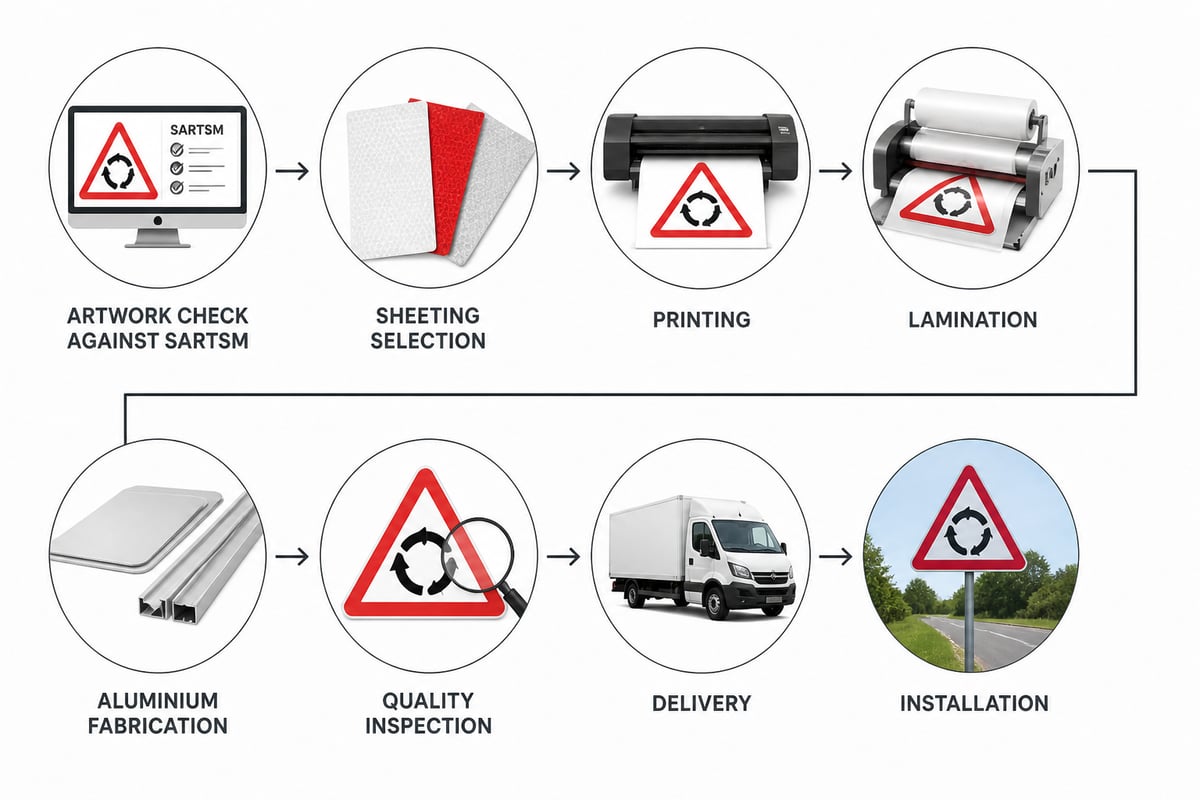
Compare suppliers on whether they manufacture in-house, because a business that designs, prints, fabricates and installs under one roof controls quality and timelines better than one that outsources each stage.
An in-house manufacturer can correct an artwork error on the day it is found. A broker passing work between three subcontractors cannot. Signs4SA, for example, handles manufacture, supply and installation in-house, and reports more than 25 years of signage experience and BEE Level 1 status, which is relevant if your procurement scorecard rewards transparent B-BBEE credentials.
When shortlisting, work through the following:
- Ask where the sign is made. Request a factory visit or photographs of the production floor.
- Ask for references from similar sites. A supplier serving construction, corporate, retail or pharmaceutical clients understands compliance pressure.
- Ask who installs. If the installer is a subcontractor, find out who carries liability for poor mounting.
- Ask about design support. Custom signage that reflects your branding alongside regulatory content needs a designer who knows which elements may not be altered.
- Ask about national reach. Multi-site operators benefit from one supplier able to serve branches in different provinces.
Why Does Installation Matter as Much as Printing?
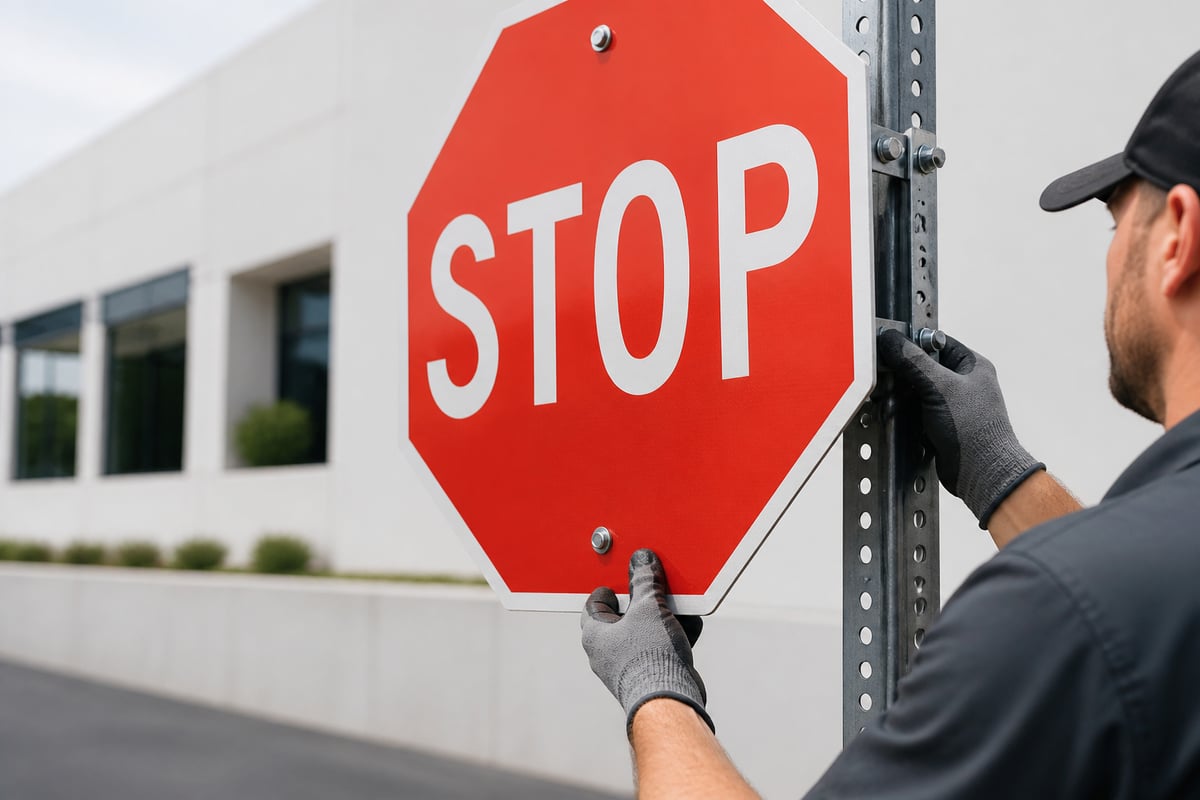
Installation matters because a correctly printed sign that is mounted at the wrong height, angle or position fails its purpose and may fail an inspection.
Sign placement affects visibility, legal validity and safety. A stop sign hidden behind a tree or angled away from approaching traffic gives a driver no usable warning. Poles set in weak concrete lean within a season. Fixings that are not tamper-resistant invite theft in some areas.
A supplier that installs can make site decisions on the day, such as moving a pole a metre to clear a sightline. One that only prints leaves you to coordinate a separate contractor and resolve any blame when something is wrong. For managers with several sites and limited time, a single point of accountability is often worth more than a small price difference.
Ask the following about installation:
- Are installers employed directly or subcontracted?
- Is a site survey done before manufacture?
- What happens if a sign is damaged during installation?
- Is public liability cover held, and can you see the certificate?
How Should You Brief a Supplier to Get an Accurate Quote?
You get an accurate quote by supplying a sign schedule that lists each sign by type, size, quantity, mounting method and location, rather than a general request for road signs.
A clear brief should include:
- A site plan or marked-up photographs showing sign positions
- The posted or intended speed limit for each road section
- Sign wording, symbols and any company branding to be included
- The mounting method: existing pole, new pole, wall or base plate
- The required delivery window and any site access restrictions
- Whether the work falls within a road reserve and needs authority approval
Request that quotes state the sheeting grade, substrate thickness, warranty period and what is included in installation. Quotes that look cheap but leave these lines blank cannot be compared fairly. If you are unsure of your own requirements, a short site visit from the supplier often produces a better specification than a document written from the office.
Suppliers differ in how they structure pricing, lead times and minimum orders, so confirm these directly instead of relying on assumptions from elsewhere.
What Red Flags Should Make You Walk Away?
Walk away from any supplier that cannot name the standard it works to, will not state the sheeting grade, or offers a price far below the rest of the market without explaining why.
Watch for these warning signs:
- Vague answers about which sign reference numbers apply
- No certificate of conformity or material data sheet available
- Reluctance to put warranty terms in writing
- Artwork approvals skipped to save time
- No physical address, or no verifiable previous projects
- Pressure to order before a site survey or approval check
Another point worth raising before you order is how the supplier handles replacements. Road signs on active sites are struck by vehicles, vandalised or damaged by weather. A supplier that keeps your artwork files and approved specifications on record can reproduce an identical sign quickly, which keeps your site consistent and avoids another round of design approval.
Maintenance of the signs once installed is also a consideration. Dust and grime reduce reflectivity, so a regular wash is part of keeping signs compliant. For simple upkeep around a site office or vehicle fleet, a cordless cleaning tool from Take Manners can handle dust on vehicle interiors, though signs themselves need only a soft cloth and water. For fleet managers who also maintain site vehicles, Launch Dealer supplies diagnostic tools for cars and heavy-duty trucks, and 3W Distributing lists auto parts for European vehicles.
Can You Compare International Suppliers' Offerings for Reference?
You can read how overseas suppliers describe their exterior and traffic sign ranges to understand material and format options, though South African projects must still follow local standards and be sourced locally.
For general background on how UK suppliers present exterior and pavement signage, Sign Shop Telford and Better Printing describe their exterior sign ranges. Both are useful for vocabulary only. Their sizes, colours and legal references follow UK rules, which differ from the South African manual, so do not copy specifications from them into a local order.
FAQ
Who manufactures road signs in South Africa?
Road signs are produced by specialist signage manufacturers, which serve both public road authorities and private clients such as mines, developers and corporates. Choose a manufacturer that can document its sheeting source, production process and installation capability.
Are street signs set in Helvetica?
No. South African road signs use prescribed lettering styles set out in the Road Traffic Signs Manual, designed for legibility at speed and distance. Commercial typefaces such as Helvetica are not a substitute for the specified letterforms on regulatory and directional signs.
Can a business print its own regulatory road signs for private roads?
A business can commission regulatory-style signs for private property, but they should still follow the manual's shapes, colours and symbols so that drivers recognise them. Signs within a public road reserve require approval from the relevant road authority.
Your next step is to compile a sign schedule listing each sign's type, size, quantity, mounting method and location, then send it to two or three suppliers for like-for-like quotes. If you want a manufacturer that handles design, production and installation in-house, backed by more than 25 years of experience, Signs4SA can review your schedule and prepare a quote, so request a quote through their contact page once your list is ready.