




Neon Sign: Complete Guide to Design, Installation & Care
The distinctive glow of a neon sign has captivated audiences for over a century, transforming ordinary shopfronts into memorable landmarks and turning nighttime cityscapes into works of art. Whether you're considering traditional glass tube technology or exploring modern alternatives, understanding the full spectrum of neon sign capabilities helps businesses make informed decisions about their visual presence. This comprehensive guide examines the technical foundations, design considerations, installation requirements, and maintenance protocols that define successful neon signage projects across corporate, retail, and commercial environments.
Understanding Neon Sign Technology
The term "neon sign" technically refers to illuminated signage created through gas-discharge tubes, though the industry has evolved to include several distinct technologies under this umbrella. Traditional neon signs utilise sealed glass tubes filled with neon or other noble gases that emit coloured light when electrified.
Classic Gas-Discharge Systems
Authentic neon technology relies on the principle of gas discharge lighting, where an electrical current excites gas molecules within a sealed tube. Neon gas produces the iconic red-orange glow, whilst other noble gases and phosphor coatings create the full spectrum of colours associated with these signs.
The manufacturing process requires exceptional craftsmanship:
- Glass tubes heated and bent by hand to form letters, logos, and decorative elements
- Electrodes sealed at each end to maintain vacuum integrity
- Gas filling performed at precise pressures for optimal luminescence
- Transformer units providing high-voltage, low-current electricity
According to IEEE technical documentation on discharge lamps, the electrical characteristics of gas-discharge systems require careful engineering to ensure both efficiency and safety. These systems typically operate at voltages between 2,000 and 15,000 volts, depending on tube length and gas type.
Modern LED Neon Alternatives
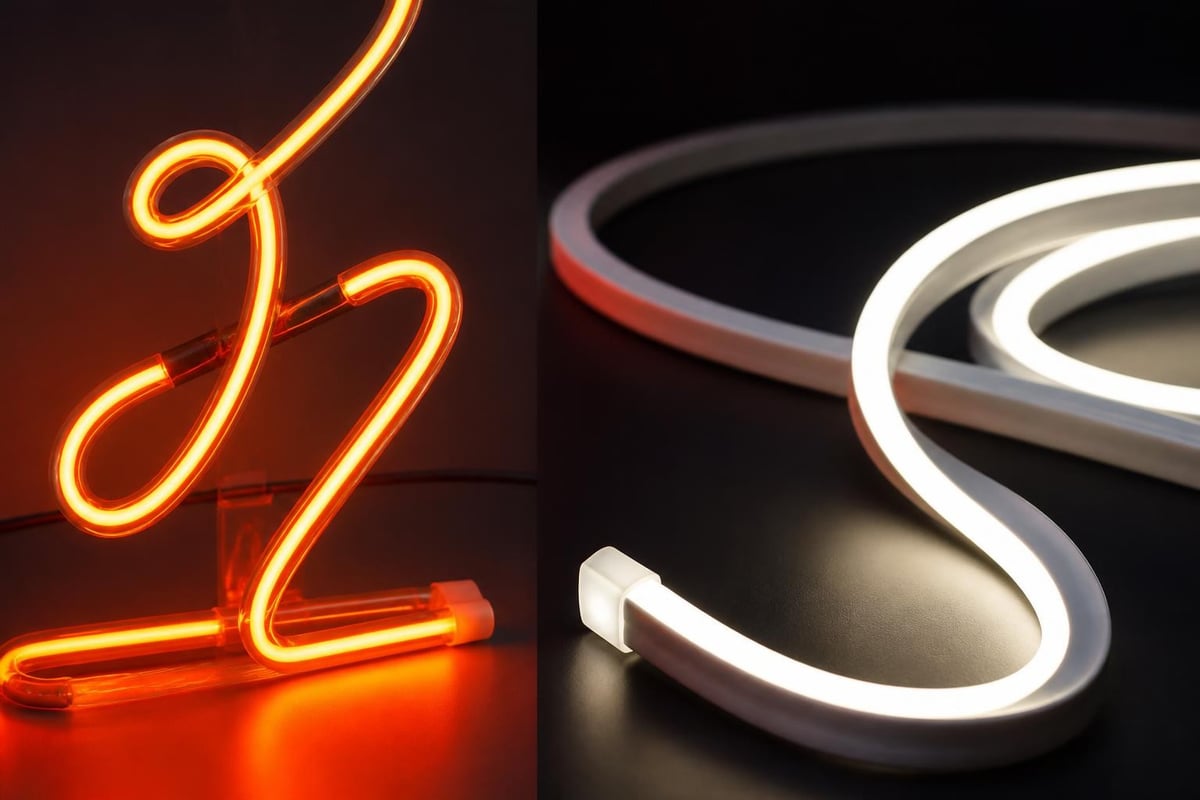
The contemporary signage industry has introduced LED neon flex technology, which replicates the aesthetic of traditional neon whilst offering distinct operational advantages. These systems use flexible silicone or PVC tubing containing LED strips that simulate the continuous glow of gas-discharge tubes.
| Feature | Traditional Neon | LED Neon Flex |
|---|---|---|
| Energy consumption | Higher (60-100W/metre) | Lower (10-20W/metre) |
| Lifespan | 10-15 years | 15-25 years |
| Fragility | Glass tubes, breakable | Flexible, durable |
| Installation complexity | Specialist fitting required | Simplified mounting |
| Voltage requirements | High-voltage transformers | Low-voltage drivers |
| Weather resistance | Moderate (with proper sealing) | Excellent |
Design Considerations for Commercial Applications
Creating an effective neon sign requires balancing aesthetic appeal with practical functionality. The design phase determines not only visual impact but also long-term maintenance requirements and operational costs.
Colour Selection and Visibility
Colour choice influences both brand recognition and visibility across different lighting conditions. Traditional neon offers approximately 40 distinct colours through various gas combinations and phosphor coatings. Common options include:
Primary neon colours:
- Red-orange (pure neon gas)
- Blue (mercury and argon)
- Green (argon with phosphor coating)
- Yellow (helium and neon mixture)
- White (mercury, argon, and phosphor)
- Purple (argon and mercury variations)
The most visible colour combinations depend on viewing distance and ambient lighting. Red and blue provide excellent contrast against most backgrounds, whilst white offers superior brightness in well-lit urban environments. Businesses exploring broader illuminated signage options might also consider Digital Signage for applications requiring frequent content updates or full-colour displays.
Typography and Readability
Letter design in neon signage must account for the continuous nature of tube bending. Script fonts and cursive styles work particularly well with neon's flowing aesthetic, though sans-serif typefaces offer superior readability at distance.
Key typography principles include:
- Maintain minimum stroke widths of 25-30mm for visibility beyond 10 metres
- Ensure adequate letter spacing prevents visual crowding
- Limit intricate details that complicate fabrication and reduce legibility
- Consider viewing angles when positioning text elements
- Balance artistic expression with functional communication
Size and Scale Planning
Determining appropriate dimensions requires analysing viewing distances, mounting locations, and local regulations. A neon sign visible from 30 metres needs substantially larger letterforms than one intended for pedestrian traffic at 3 metres.
Professional designers typically apply the 25mm-per-metre rule: for every metre of viewing distance, letters require approximately 25mm of height for comfortable readability. This guideline adjusts based on font complexity, ambient lighting, and viewer expectations.
Installation and Electrical Requirements
Proper installation ensures both visual effectiveness and operational safety. The technical demands of neon sign installation require specialist knowledge of electrical systems, structural mounting, and weatherproofing techniques.
Structural Mounting Considerations
The mounting substrate must support not only the sign's weight but also wind loads, particularly for external applications. Wall-mounted installations require:
- Load-bearing capacity assessment of mounting surface
- Corrosion-resistant brackets and fixings
- Weather-sealed cable entry points
- Adequate clearance for heat dissipation
- Accessibility for maintenance and lamp replacement
Freestanding and suspended installations introduce additional structural engineering requirements. The International Sign Association provides comprehensive guidance on installation best practices that address both safety and longevity.
Electrical Safety and Compliance
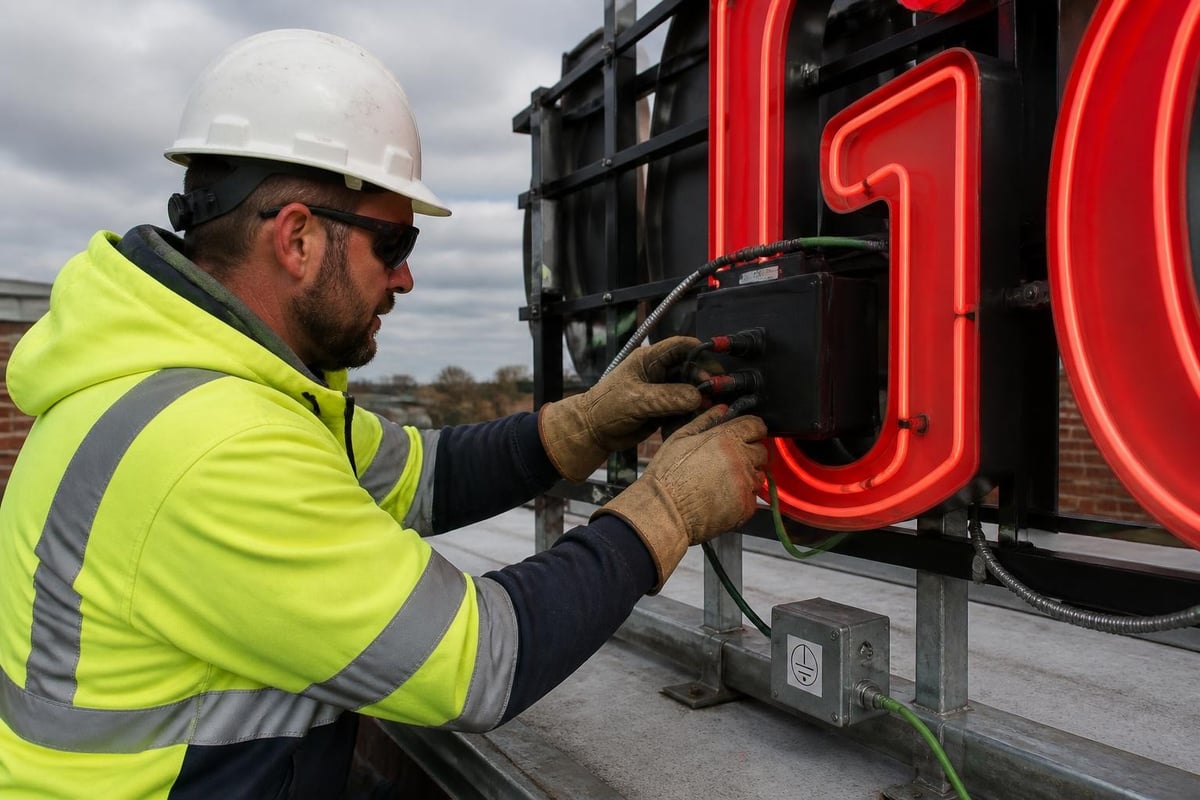
High-voltage electrical systems demand rigorous safety protocols. NFPA 70E electrical safety standards outline specific requirements for working with energised equipment, emphasising protective equipment, safe work distances, and lockout/tagout procedures.
Neon sign transformers convert standard mains voltage (220-240V in South Africa) to the high voltages required for gas discharge. Proper installation includes:
Transformer specifications:
- Appropriate voltage output for total tube length
- Current limiting to prevent tube damage
- Ground fault protection
- Weatherproof enclosures for external applications
- Emergency disconnect switches
South African electrical installations must comply with SANS 10142 (wiring of premises) standards, which specify requirements for illuminated signage. Whilst these regulations don't differ dramatically from international standards, the National Electrical Code provides detailed technical guidance on transformer requirements and circuit protection.
Maintenance and Longevity Strategies
Maximising the operational lifespan of a neon sign requires proactive maintenance and timely intervention when performance degrades. Well-maintained traditional neon installations regularly exceed 15 years of service, whilst LED alternatives can surpass 25 years.
Routine Inspection Protocols
Regular visual inspections identify developing issues before they escalate into costly failures. Recommended inspection frequencies vary by environment:
- Monthly checks for high-traffic retail locations
- Quarterly inspections for standard commercial installations
- Bi-annual reviews for indoor or protected signage
- Post-storm inspections for exposed external signage
Inspection checklists should document:
- Tube integrity and gas pressure (dimming indicates gas leakage)
- Electrode condition and black deposits at tube ends
- Transformer function and unusual noise or heat
- Mounting bracket security and corrosion
- Electrical connection integrity and insulation condition
- Weather seal effectiveness around penetrations
Common Failure Modes and Solutions
Understanding typical failure patterns enables cost-effective repairs rather than complete replacements. The most frequent issues include:
| Problem | Symptom | Typical Cause | Solution |
|---|---|---|---|
| Tube flickering | Intermittent illumination | Loose electrode connections | Re-seat electrodes, check wiring |
| Dimming | Reduced brightness | Gas leakage | Replace affected tubes |
| Dead sections | Complete darkness in portions | Broken tubes or failed transformer | Replace damaged components |
| Colour shift | Changed hue from original | Phosphor degradation | Tube replacement required |
| Buzzing | Audible transformer noise | Loose laminations or overload | Service or replace transformer |
Professional maintenance services typically cost 10-15% of the original installation price annually, though this investment significantly extends operational life. For businesses seeking guidance on broader signage maintenance, long-term signage maintenance tips offer valuable insights applicable across multiple sign types.
Cultural Heritage and Preservation
The neon sign occupies a unique position in architectural history, representing both commercial functionality and artistic expression. Many mid-20th century installations have achieved heritage status, requiring specialised preservation approaches.
Historical Significance in Urban Landscapes
Neon technology reached its commercial zenith between the 1920s and 1960s, when these signs defined urban nightscapes from Las Vegas to Johannesburg. The cultural value of historic signs extends beyond advertising to encompass social memory, architectural character, and community identity.
South Africa's urban centres contain numerous significant vintage installations, particularly in theatre districts and historic commercial areas. These signs represent irreplaceable craftsmanship from an era when skilled artisans hand-bent each tube and mixed custom phosphor formulations.

Restoration Best Practices
Preserving historic neon requires balancing authenticity with modern safety standards. The National Park Service provides detailed guidance on conservation approaches that respect original design whilst ensuring structural and electrical safety.
Successful restoration projects typically follow this methodology:
Documentation phase:
- Comprehensive photography from multiple angles and lighting conditions
- Measurement and drawing of all components
- Research into original manufacturers and installation dates
- Assessment of structural condition and remaining service life
Conservation approach:
- Repair existing tubes where possible rather than replacement
- Source period-appropriate materials and colours
- Maintain original transformer technology when safely feasible
- Document all interventions for future reference
The Neon Museum in Las Vegas demonstrates how large-scale restoration projects can revitalise entire sign collections whilst educating communities about this distinctive art form. Their work provides templates for preservation initiatives in other regions.
Economic Considerations and Return on Investment
The financial aspects of neon signage extend beyond initial purchase price to encompass operational costs, maintenance expenses, and marketing effectiveness. Businesses must evaluate total ownership costs against visibility and brand recognition benefits.
Initial Investment Factors
Traditional neon sign pricing varies significantly based on complexity, size, and customisation requirements. Cost components include:
- Design and engineering services (10-15% of total)
- Materials and fabrication (40-50% of total)
- Electrical components and transformers (15-20% of total)
- Installation and commissioning (20-25% of total)
- Permits and regulatory compliance (variable by municipality)
LED neon alternatives typically cost 20-30% less for equivalent size and complexity, though aesthetic differences may influence brand alignment. Understanding these economic factors connects to broader signage investment considerations that help businesses allocate marketing budgets effectively.
Operational Cost Analysis
Energy consumption represents the primary ongoing expense. A typical 3-metre traditional neon storefront sign drawing 200 watts costs approximately R150-200 monthly at South African commercial electricity rates. Equivalent LED systems reduce this to R30-50 monthly.
| Cost Category | Traditional Neon (15 years) | LED Neon (15 years) |
|---|---|---|
| Initial purchase | R25,000 | R20,000 |
| Energy costs | R36,000 | R9,000 |
| Maintenance | R15,000 | R6,000 |
| Total ownership | R76,000 | R35,000 |
These calculations demonstrate the compelling economics of modern alternatives for businesses prioritising operational efficiency. However, traditional neon remains preferred where authentic aesthetic character justifies the premium.
Environmental and Sustainability Aspects
Contemporary signage decisions increasingly incorporate environmental impact assessments. Both traditional and modern neon technologies present distinct sustainability profiles that merit consideration.
Energy Efficiency Comparisons
Traditional neon operates at approximately 60-100 watts per metre of tubing, whilst LED alternatives consume 10-20 watts per metre for equivalent brightness. This 80-85% reduction translates to substantial carbon footprint improvements over a sign's operational lifetime.
For a medium-sized retail installation operating 12 hours daily:
Annual energy consumption:
- Traditional neon: 2,190 kWh
- LED neon flex: 438 kWh
- Carbon reduction: approximately 1.1 tonnes CO2 annually (based on South African grid carbon intensity)
Businesses committed to sustainability objectives find that modern neon alternatives align better with environmental targets whilst maintaining distinctive visual character. This consideration extends to other signage categories discussed in industry insights across commercial applications.
Materials and End-of-Life Management
Traditional neon tubes contain small quantities of mercury (in blue and white colours) and noble gases, requiring proper disposal through specialist recycling facilities. Glass tubes, aluminium electrodes, and copper wiring are all recyclable materials.
LED systems contain electronic components with rare earth elements, necessitating electronic waste recycling rather than general disposal. Responsible manufacturers increasingly offer take-back programmes ensuring proper materials recovery.
Application-Specific Considerations
Different commercial environments demand tailored approaches to neon sign implementation. Industry-specific requirements influence design choices, mounting strategies, and regulatory compliance.
Retail and Hospitality Applications
Storefronts and entertainment venues leverage neon's ability to create atmospheric lighting that enhances brand personality. Restaurants, bars, and boutiques particularly benefit from the warm, inviting glow that traditional neon provides.
Retail applications prioritise:
- Window-mounted installations maximising street visibility
- Compact designs suitable for limited facade space
- Colour schemes reinforcing brand identity
- Operational flexibility with timer controls for after-hours display
Corporate and Professional Signage
Business parks and office buildings typically favour understated elegance over bold neon aesthetics, though reception areas and entrance lobbies increasingly incorporate refined neon elements. Corporate applications emphasise:
- Sophisticated typography and minimal design
- Integration with architectural lighting schemes
- Professional colour palettes (white, blue, subtle accent colours)
- Concealed mounting systems for clean appearances
- Compliance with building management requirements
For businesses requiring more versatile outdoor signage solutions, guidance on selecting appropriate outdoor signage addresses complementary approaches that work alongside or instead of neon installations.
Heritage and Conservation Contexts
Historic buildings and conservation areas often require specialised approval for new signage installations. Working within these constraints demands:
- Sympathetic design responding to architectural character
- Materials and colours appropriate to building era
- Reversible mounting systems avoiding permanent alterations
- Documentation supporting heritage sensitivity
Local authorities increasingly recognise that well-designed neon can enhance rather than compromise heritage values. The Route 66 preservation case studies demonstrate successful integration of historic neon within protected streetscapes.
Regulatory and Permitting Requirements
Navigating the approval process for neon sign installations requires understanding multiple regulatory frameworks spanning electrical safety, building codes, and municipal signage ordinances.
South African Regulatory Framework
Municipal bylaws govern signage dimensions, placement, illumination levels, and aesthetic standards. Major metropolitan areas maintain distinct requirements:
Common regulatory elements:
- Maximum sign area relative to building facade
- Setback distances from property boundaries
- Illumination intensity limits preventing light pollution
- Electrical certification requirements (Certificate of Compliance)
- Heritage impact assessments in conservation areas
The signage regulations and permits landscape varies considerably between jurisdictions, making local expert consultation essential for compliance assurance.
Electrical Certification Requirements
All electrical installations in South Africa require certification by a registered electrician confirming compliance with SANS 10142 standards. Neon signs specifically demand verification of:
- Proper transformer sizing and protection
- Adequate grounding and bonding
- Safe cable routing and support
- Appropriate circuit breakers and isolation devices
- Weatherproofing standards for external installations
Documentation must remain available for municipal inspections and insurance purposes throughout the sign's operational life.
Technical Advancements and Future Developments
The neon sign industry continues evolving through materials innovation, manufacturing automation, and hybrid technologies combining traditional aesthetics with modern efficiency.
Smart Control Systems
Contemporary installations increasingly incorporate intelligent control systems enabling:
- Programmable operating schedules optimising energy use
- Dimming capabilities responding to ambient light levels
- Remote monitoring detecting performance issues
- Integration with building management systems
- Dynamic colour changing (LED systems)
These capabilities transform static signage into responsive environmental elements whilst reducing operational costs through optimised energy consumption.
Hybrid Technologies
Manufacturers now offer hybrid systems combining traditional neon's distinctive aesthetic qualities with LED efficiency. These installations use gas-discharge tubes for primary visual elements whilst incorporating LED accent lighting and backlighting for enhanced effects.
Such approaches allow businesses to achieve authentic neon character where it matters most whilst moderating costs and energy consumption through strategic LED integration. The evolving LED signage versus traditional signs comparison helps businesses navigate these technological choices.
The enduring appeal of neon sign technology stems from its unique combination of visual impact, cultural resonance, and technical sophistication that continues capturing attention in our increasingly digital world. Whether your project demands authentic gas-discharge craftsmanship or modern LED alternatives, success requires partnering with experienced professionals who understand both the artistic and technical dimensions of illuminated signage. Signs4SA brings comprehensive expertise across all signage technologies, from traditional neon fabrication to cutting-edge digital solutions, ensuring your vision translates into a compelling, compliant, and cost-effective reality backed by national support infrastructure and industry-leading craftsmanship.