Turn right ahead
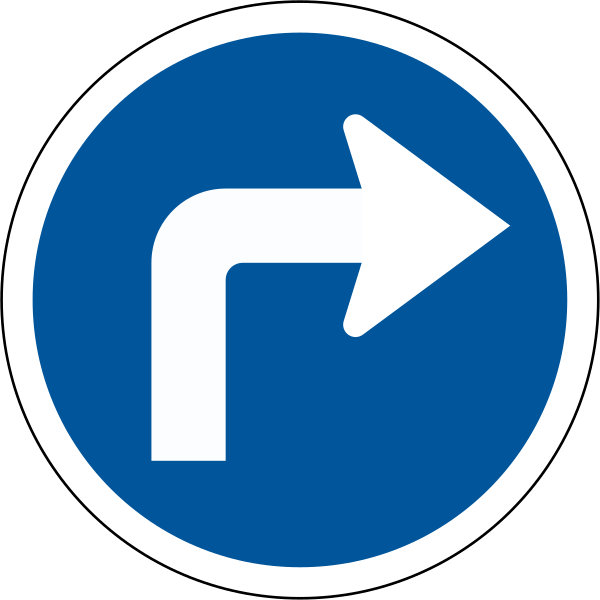
Turn right ahead
The Turn Right road sign, designated R109, is a mandatory regulatory traffic sign used to instruct drivers to proceed to the right at the junction ahead.
The R109 sign requires the driver of a vehicle to proceed only in the direction indicated by the right-pointing arrow. It is used where traffic approaching a junction is permitted or required to enter the junction only by turning right.
R109 means TURN RIGHT. It is a mandatory instruction, rather than a general directional recommendation.
When an R109 sign applies, drivers approaching the junction must follow the right-turn direction shown by the arrow and should not proceed straight ahead or turn left from that approach.
R109 is used in advance of junctions where traffic from the particular approach may only enter one leg of the junction by turning right.
Applications can include:
The exact application depends on the road layout and the traffic-control requirements at the location.
The South African Road Traffic Signs Manual specifies that R109 should be displayed in advance of a junction where traffic approaching from that direction may only enter one leg of the junction by turning right.
The sign is therefore normally positioned before the junction so that drivers receive the mandatory instruction before reaching the point where the turn must be made.
R109 should be displayed on the left side of the roadway at least 15 metres in advance of the junction, subject to the applicable road layout and signing requirements.
Where the roadway is a one-way roadway, a second R109 sign may be positioned on the right side of the roadway.
Care should also be taken to ensure that a property access does not occur between the R109 sign and the junction, as this could create confusion about where the mandatory turn applies.
R109 can be used together with the appropriate One-Way Roadway signs, such as R4.1 or R4.2, where these signs are required to control vehicle movements at a junction.
The combination of signs depends on the specific junction and traffic-management arrangement.
The temporary version of R109 is TR109. It can be used under the same general circumstances as the permanent Turn Right sign where temporary traffic arrangements or a detour require vehicles to turn right.
The SARTSM specifically provides for TR109 where temporary detours are required in urban areas, including business and central business districts.
The permanent R109 is a circular regulatory sign with a blue retroreflective background and a white retroreflective border and right-pointing arrow.
The temporary TR109 uses a yellow retroreflective background and outer border with a black semi-matt arrow and inner border.
The use of retroreflective materials is intended to make the regulatory sign more readily visible when illuminated by vehicle headlights, subject to the sign material and installation conditions.
R109 should not be confused with a general description such as Proceed Right Only. R109 is officially designated TURN RIGHT and is specifically used in advance of a junction.
The correct sign depends on the traffic movement that needs to be controlled and the location where the instruction is being given.
R108 and R109 are a matching pair of regulatory turn signs:
The two signs use the same general regulatory format, with the direction of the arrow determining the required movement.
Turn Right signage can also form part of traffic-management arrangements at commercial properties, industrial sites, shopping centres, warehouses, parking facilities and other controlled environments.
For private-property applications, the site owner or manager should consider the site's traffic flow, access points and any applicable property or authority requirements when selecting and positioning regulatory-style traffic signs.
R109 means TURN RIGHT. It requires the driver to proceed only in the direction indicated by the right-pointing arrow at the junction ahead.
Yes. R109 is the South African regulatory sign code for TURN RIGHT.
The temporary version is TR109. It can be used under the same general circumstances as R109 when temporary traffic control or a detour requires vehicles to turn right.
The SARTSM specifies that R109 should normally be displayed on the left side of the roadway at least 15 metres before the junction. A second sign may be used on the right side of a one-way roadway.
No. The standard R109 is the general TURN RIGHT regulatory sign. If a restriction applies only to a particular class of vehicle, the appropriate selective restriction arrangement should be used separately.
Yes. The temporary TR109 version can be used for temporary traffic arrangements, including suitable detours where vehicles are required to turn right.
Turn Right signage can form part of traffic management on private property, subject to the site's traffic requirements and any applicable regulations or authority requirements.
Signs4SA can assist with R109 Turn Right road signs and temporary TR109 signage for junctions, commercial properties, industrial sites, parking areas, roadworks, temporary detours and other controlled traffic environments.
Contact Signs4SA to discuss your R109 Turn Right signage requirements, provide your specifications and request a quotation.
Turn right ahead signs come in a variety of styles and formats, including danger signs, warning signs, and caution signs. Danger signs are used to indicate an immediate threat that could cause serious injury or death, such as high voltage areas or hazardous materials. Warning signs are used to indicate potential hazards that could cause injury, such as slippery floors or falling objects. Caution signs are used to indicate potential hazards that could cause minor injury, such as low ceilings or uneven surfaces. Another type of safety sign is the Turn right ahead sign, which is used to provide guidance on safe behavior. These signs can include instructions on how to use equipment or machinery safely, as well as reminders to wear personal protective equipment (PPE) or follow specific safety protocols. Turn right ahead signs can also be used to ensure compliance with safety regulations. For example, fire safety signs are required by law in most public buildings and workplaces. These signs indicate the location of fire exits, fire extinguishers, and other fire safety equipment.
Safety signs are an essential part of any workplace or public space. They are used to warn people of potential hazards, provide guidance on safe behavior, and ensure compliance with safety regulations. One type of safety sign is the Turn right ahead sign, which is designed to alert people to potential dangers in a particular area. Turn right ahead signs come in a variety of styles and formats, including danger signs, warning signs, and caution signs. Danger signs are used to indicate an immediate threat that could cause serious injury or death, such as high voltage areas or hazardous materials. Warning signs are used to indicate potential hazards that could cause injury, such as slippery floors or falling objects. Caution signs are used to indicate potential hazards that could cause minor injury, such as low ceilings or uneven surfaces. Another type of safety sign is the Turn right ahead sign, which is used to provide guidance on safe behavior. These signs can include instructions on how to use equipment or machinery safely, as well as reminders to wear personal protective equipment (PPE) or follow specific safety protocols. Turn right ahead signs can also be used to ensure compliance with safety regulations. For example, fire safety signs are required by law in most public buildings and workplaces. These signs indicate the location of fire exits, fire extinguishers, and other fire safety equipment. In addition to these types of safety signs, there are also specialized signs available for specific industries or hazards. For example, construction sites may use signs to indicate the location of underground utilities or to warn of falling debris. Healthcare facilities may use signs to remind employees to wash their hands or to indicate the location of first aid supplies. When selecting safety signs, it is important to choose signs that are appropriate for the specific hazard or situation. Signs should be placed in prominent locations where they are easily visible, and should be made from durable materials that can withstand harsh environmental conditions. By using safety signs effectively, businesses and organizations can help protect their employees, customers, and visitors from harm.